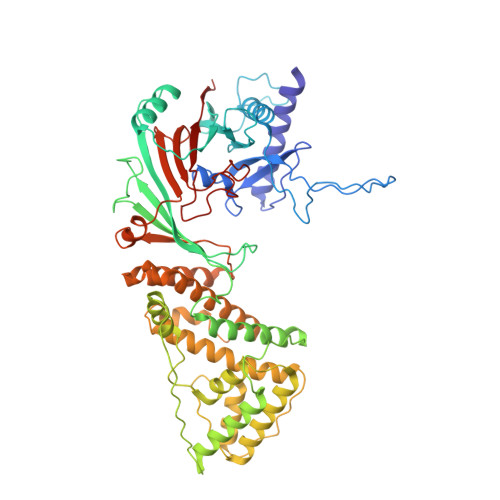
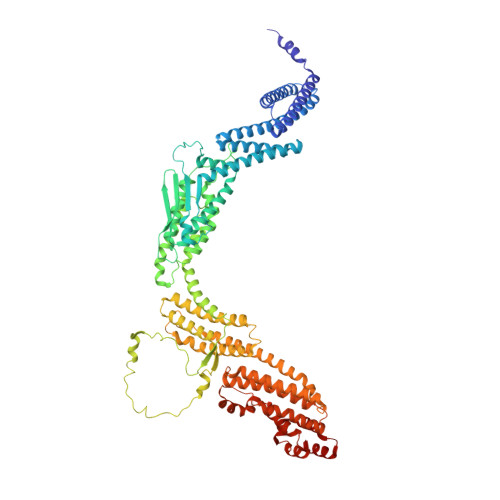
7QPG | pdb_00007qpg

Human RZZ kinetochore corona complex.


Experimental Data Snapshot

  • Method: ELECTRON MICROSCOPY
  • Resolution: 3.90 Å
  • Aggregation State: PARTICLE 
  • Reconstruction Method: SINGLE PARTICLE 

wwPDB Validation 3D Report Full Report

Validation slider image for 7QPG

This is version 1.4 of the entry. See complete history

Literature

Structure of the RZZ complex and molecular basis of Spindly-driven corona assembly at human kinetochores.

Raisch, T.Ciossani, G.d'Amico, E.Cmentowski, V.Carmignani, S.Maffini, S.Merino, F.Wohlgemuth, S.Vetter, I.R.Raunser, S.Musacchio, A.

(2022) EMBO J 41: e110411-e110411

  • DOI: https://doi.org/10.15252/embj.2021110411
  • Primary Citation Related Structures: 
    7QPG

  • PubMed Abstract: 

    In metazoans, a ≈1 megadalton (MDa) multiprotein complex comprising the dynein-dynactin adaptor Spindly and the ROD-Zwilch-ZW10 (RZZ) complex is the building block of a fibrous biopolymer, the kinetochore fibrous corona. The corona assembles on mitotic kinetochores to promote microtubule capture and spindle assembly checkpoint (SAC) signaling. We report here a high-resolution cryo-EM structure that captures the essential features of the RZZ complex, including a farnesyl-binding site required for Spindly binding. Using a highly predictive in vitro assay, we demonstrate that the SAC kinase MPS1 is necessary and sufficient for corona assembly at supercritical concentrations of the RZZ-Spindly (RZZS) complex, and describe the molecular mechanism of phosphorylation-dependent filament nucleation. We identify several structural requirements for RZZS polymerization in rings and sheets. Finally, we identify determinants of kinetochore localization and corona assembly of Spindly. Our results describe a framework for the long-sought-for molecular basis of corona assembly on metazoan kinetochores.


  • Organizational Affiliation
    • Department of Structural Biochemistry, Max Planck Institute of Molecular Physiology, Dortmund, Germany.

Macromolecule Content 

  • Total Structure Weight: 872.08 kDa 
  • Atom Count: 57,164 
  • Modeled Residue Count: 7,156 
  • Deposited Residue Count: 7,668 
  • Unique protein chains: 3

Macromolecules

Find similar proteins by:|  3D Structure
Entity ID: 1
MoleculeChains  Sequence LengthOrganismDetailsImage
Protein zwilch homologA [auth B],
B [auth C]
591Homo sapiensMutation(s): 0 
Gene Names: ZWILCH
UniProt & NIH Common Fund Data Resources
Find proteins for Q9H900 (Homo sapiens)
Explore Q9H900 
Go to UniProtKB:  Q9H900
PHAROS:  Q9H900
GTEx:  ENSG00000174442 
Entity Groups
Sequence Clusters30% Identity50% Identity70% Identity90% Identity95% Identity100% Identity
UniProt GroupQ9H900
Sequence Annotations
Expand
Reference Sequence
Find similar proteins by:|  3D Structure
Entity ID: 2
MoleculeChains  Sequence LengthOrganismDetailsImage
Kinetochore-associated protein 1C [auth R],
D [auth S]
2,464Homo sapiensMutation(s): 0 
Gene Names: DS885_16260KNTC1KIAA0166
UniProt & NIH Common Fund Data Resources
Find proteins for P50748 (Homo sapiens)
Explore P50748 
Go to UniProtKB:  P50748
PHAROS:  P50748
GTEx:  ENSG00000184445 
Entity Groups
Sequence Clusters30% Identity50% Identity70% Identity90% Identity95% Identity100% Identity
UniProt GroupP50748
Sequence Annotations
Expand
Reference Sequence
Find similar proteins by:|  3D Structure
Entity ID: 3
MoleculeChains  Sequence LengthOrganismDetailsImage
Centromere/kinetochore protein zw10 homologE [auth W],
F [auth X]
779Homo sapiensMutation(s): 0 
Gene Names: ZW10
UniProt & NIH Common Fund Data Resources
Find proteins for O43264 (Homo sapiens)
Explore O43264 
Go to UniProtKB:  O43264
PHAROS:  O43264
GTEx:  ENSG00000086827 
Entity Groups
Sequence Clusters30% Identity50% Identity70% Identity90% Identity95% Identity100% Identity
UniProt GroupO43264
Sequence Annotations
Expand
Reference Sequence

Experimental Data & Validation

Experimental Data

  • Method: ELECTRON MICROSCOPY
  • Resolution: 3.90 Å
  • Aggregation State: PARTICLE 
  • Reconstruction Method: SINGLE PARTICLE 

Structure Validation

View Full Validation Report


Entry History 

& Funding Information

Deposition Data


Funding OrganizationLocationGrant Number
Max Planck SocietyGermany--

Revision History  (Full details and data files)

  • Version 1.0: 2022-03-16
    Type: Initial release
  • Version 1.1: 2022-04-20
    Changes: Database references
  • Version 1.2: 2022-04-27
    Changes: Structure summary
  • Version 1.3: 2022-05-11
    Changes: Database references
  • Version 1.4: 2024-07-17
    Changes: Data collection