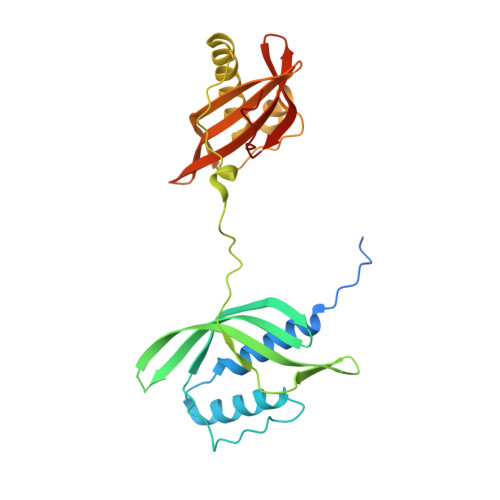
7PKW | pdb_00007pkw

Crystal structure of VIRB8-like OrfG central and C-terminal domains of Streptococcus thermophilus ICESt3 (Gram positive conjugative type IV secretion system).


Experimental Data Snapshot

  • Method: X-RAY DIFFRACTION
  • Resolution: 1.83 Å
  • R-Value Free: 
    0.215 (Depositor), 0.220 (DCC) 
  • R-Value Work: 
    0.183 (Depositor), 0.194 (DCC) 
  • R-Value Observed: 
    0.185 (Depositor) 

Starting Models: experimental
View more details

wwPDB Validation 3D Report Full Report

Validation slider image for 7PKW

This is version 1.2 of the entry. See complete history

Literature

Elucidating assembly and function of VirB8 cell wall subunits refines the DNA translocation model in Gram-positive T4SSs.

Maffo-Woulefack, R.Ali, A.M.Laroussi, H.Cappele, J.Romero-Saavedra, F.Ramia, N.Robert, E.Mathiot, S.Soler, N.Roussel, Y.Fronzes, R.Huebner, J.Didierjean, C.Favier, F.Leblond-Bourget, N.Douzi, B.

(2025) Sci Adv 11: eadq5975-eadq5975

  • DOI: https://doi.org/10.1126/sciadv.adq5975
  • Primary Citation Related Structures: 
    7PKW, 8S7L

  • PubMed Abstract: 

    Bacterial type IV secretion systems (T4SSs) are widespread nanomachines specialized in the transport across the cell envelope of various types of molecules including mobile genetic elements during conjugation. Despite their prevalence in Gram-positive bacteria, including relevant pathogens, their assembly and functioning remain unknown. This study addresses these gaps by investigating VirB8 proteins, known to be central components of conjugative T4SSs in Gram-positive bacteria. However, the functional packing and precise role of VirB8 in T4SSs biology remain undefined. Our findings elucidate the nature of VirB8 proteins as cell wall components, where they multimerize and exhibit a conserved assembly pattern, distinct from VirB8 in Gram-negative bacteria. We also demonstrate that VirB8 proteins interact with other T4SS subunits and DNA, indicating their pivotal role in the building of the DNA translocation channel across the cell wall. We lastly propose a distinct architecture for conjugative T4SSs in Gram-positive bacteria compared to their Gram-negative counterparts, possibly attributed to the differences in the cell wall structure.


  • Organizational Affiliation
    • Université de Lorraine, INRAE, DynAMic, F-54000 Nancy, France.

Macromolecule Content 

  • Total Structure Weight: 31.16 kDa 
  • Atom Count: 2,335 
  • Modeled Residue Count: 240 
  • Deposited Residue Count: 268 
  • Unique protein chains: 1

Macromolecules

Find similar proteins by:|  3D Structure
Entity ID: 1
MoleculeChains  Sequence LengthOrganismDetailsImage
Putative transfer protein268Streptococcus thermophilusMutation(s): 0 
UniProt
Find proteins for Q70CA4 (Streptococcus thermophilus)
Explore Q70CA4 
Go to UniProtKB:  Q70CA4
Entity Groups
Sequence Clusters30% Identity50% Identity70% Identity90% Identity95% Identity100% Identity
UniProt GroupQ70CA4
Sequence Annotations
Expand
Reference Sequence

Experimental Data & Validation

Experimental Data

  • Method: X-RAY DIFFRACTION
  • Resolution: 1.83 Å
  • R-Value Free:  0.215 (Depositor), 0.220 (DCC) 
  • R-Value Work:  0.183 (Depositor), 0.194 (DCC) 
  • R-Value Observed: 0.185 (Depositor) 
Space Group: P 41 3 2
Unit Cell:
Length ( Å )Angle ( ˚ )
a = 124.92α = 90
b = 124.92β = 90
c = 124.92γ = 90
Software Package:
Software NamePurpose
REFMACrefinement
XDSdata reduction
Aimlessdata scaling
MOLREPphasing

Structure Validation

View Full Validation Report


Entry History 

& Funding Information

Deposition Data


Funding OrganizationLocationGrant Number
Not funded--

Revision History  (Full details and data files)

  • Version 1.0: 2022-09-07
    Type: Initial release
  • Version 1.1: 2024-01-31
    Changes: Data collection, Refinement description
  • Version 1.2: 2025-03-12
    Changes: Database references, Structure summary