7PC6 | pdb_00007pc6

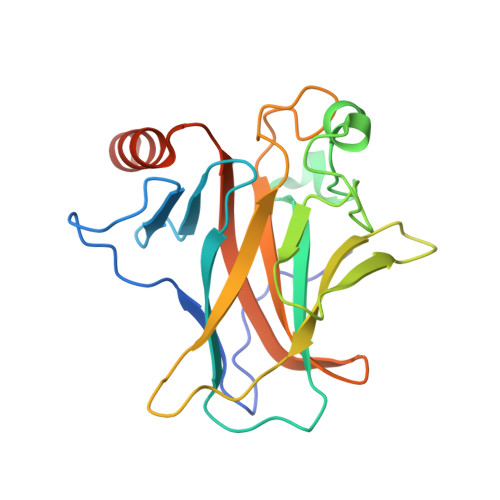
DNA-binding domain of a p53 homolog from the hydrothermal vent annelid Alvinella pompejana


Experimental Data Snapshot

  • Method: X-RAY DIFFRACTION
  • Resolution: 1.92 Å
  • R-Value Free: 
    0.225 (Depositor), 0.237 (DCC) 
  • R-Value Work: 
    0.183 (Depositor) 
  • R-Value Observed: 
    0.186 (Depositor) 

Starting Model: experimental
View more details

wwPDB Validation 3D Report Full Report

Validation slider image for 7PC6

This is version 1.2 of the entry. See complete history

Literature

Evolutionary history of the p53 family DNA-binding domain: insights from an Alvinella pompejana homolog.

Zhang, Q.Balourdas, D.I.Baron, B.Senitzki, A.Haran, T.E.Wiman, K.G.Soussi, T.Joerger, A.C.

(2022) Cell Death Dis 13: 214-214

  • DOI: https://doi.org/10.1038/s41419-022-04653-8
  • Primary Citation Related Structures: 
    7PC6

  • PubMed Abstract: 

    The extremophile Alvinella pompejana, an annelid worm living on the edge of hydrothermal vents in the Pacific Ocean, is an excellent model system for studying factors that govern protein stability. Low intrinsic stability is a crucial factor for the susceptibility of the transcription factor p53 to inactivating mutations in human cancer. Understanding its molecular basis may facilitate the design of novel therapeutic strategies targeting mutant p53. By analyzing expressed sequence tag (EST) data, we discovered a p53 family gene in A. pompejana. Protein crystallography and biophysical studies showed that it has a p53/p63-like DNA-binding domain (DBD) that is more thermostable than all vertebrate p53 DBDs tested so far, but not as stable as that of human p63. We also identified features associated with its increased thermostability. In addition, the A. pompejana homolog shares DNA-binding properties with human p53 family DBDs, despite its evolutionary distance, consistent with a potential role in maintaining genome integrity. Through extensive structural and phylogenetic analyses, we could further trace key evolutionary events that shaped the structure, stability, and function of the p53 family DBD over time, leading to a potent but vulnerable tumor suppressor in humans.


  • Organizational Affiliation
    • Department of Neuroscience, Biomedicum, Karolinska Institutet, Stockholm, Sweden.

Macromolecule Content 

  • Total Structure Weight: 186.1 kDa 
  • Atom Count: 12,782 
  • Modeled Residue Count: 1,525 
  • Deposited Residue Count: 1,632 
  • Unique protein chains: 1

Macromolecules

Find similar proteins by:|  3D Structure
Entity ID: 1
MoleculeChains  Sequence LengthOrganismDetailsImage
DNA-binding domain
A, B, C, D, E
A, B, C, D, E, F, G, H
204Alvinella pompejanaMutation(s): 0 

Small Molecules

Ligands 2 Unique
IDChains Name / Formula / InChI Key2D Diagram3D Interactions
ZN

Query on ZN


Download:Ideal Coordinates CCD File
I [auth A]
J [auth B]
L [auth C]
M [auth D]
P [auth E]
I [auth A],
J [auth B],
L [auth C],
M [auth D],
P [auth E],
Q [auth F],
R [auth G],
T [auth H]
ZINC ION
Zn
PTFCDOFLOPIGGS-UHFFFAOYSA-N
EDO

Query on EDO


Download:Ideal Coordinates CCD File
K [auth B],
N [auth D],
O [auth D],
S [auth G]
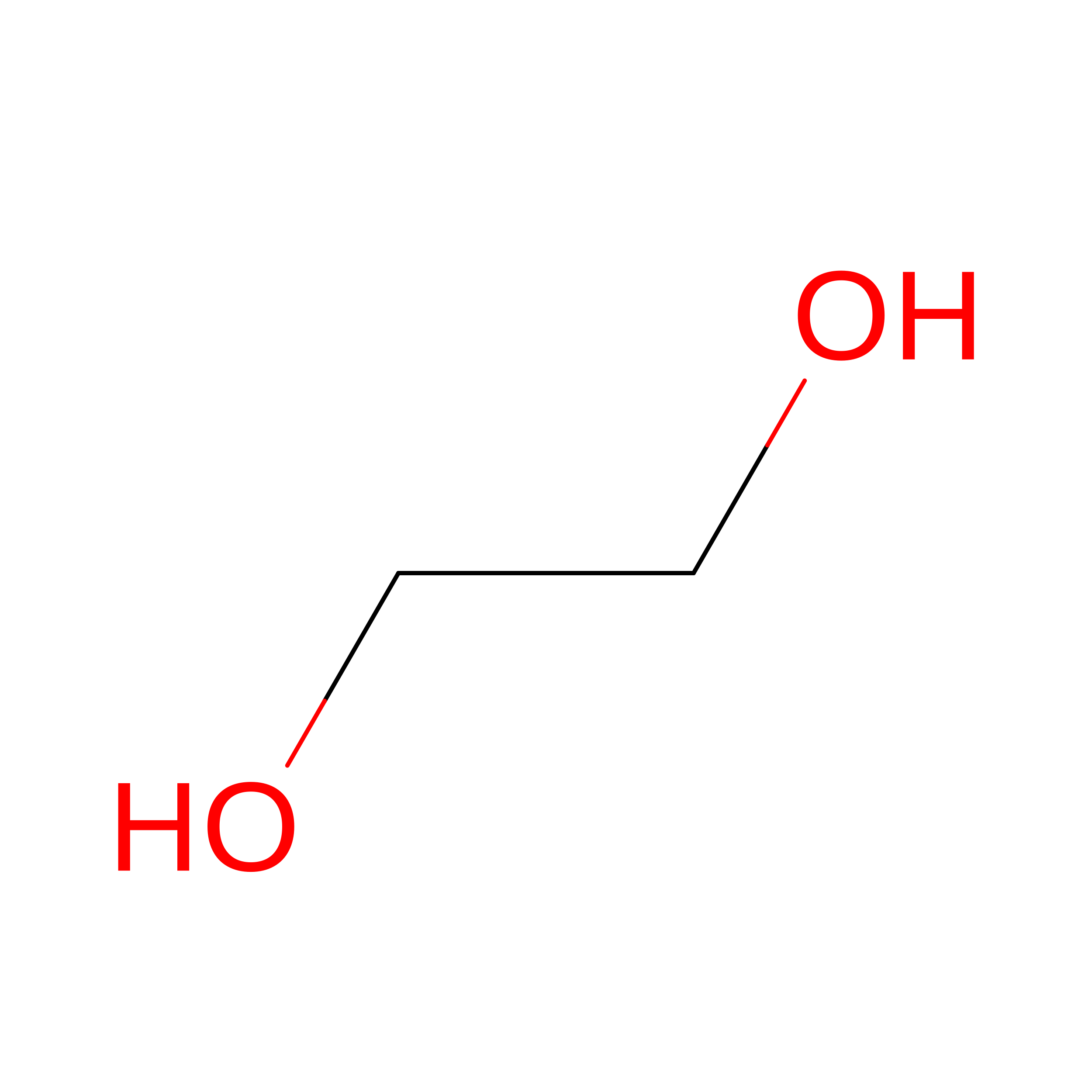
1,2-ETHANEDIOL
C2 H6 O2
LYCAIKOWRPUZTN-UHFFFAOYSA-N

Experimental Data & Validation

Experimental Data

  • Method: X-RAY DIFFRACTION
  • Resolution: 1.92 Å
  • R-Value Free:  0.225 (Depositor), 0.237 (DCC) 
  • R-Value Work:  0.183 (Depositor) 
  • R-Value Observed: 0.186 (Depositor) 
Space Group: P 1
Unit Cell:
Length ( Å )Angle ( ˚ )
a = 55.9α = 88.074
b = 69.985β = 89.919
c = 114.849γ = 81.512
Software Package:
Software NamePurpose
PHENIXrefinement
XDSdata reduction
Aimlessdata scaling
PHASERphasing

Structure Validation

View Full Validation Report


Entry History 

& Funding Information

Deposition Data


Funding OrganizationLocationGrant Number
German Research Foundation (DFG)GermanyJO 1473/1-3

Revision History  (Full details and data files)

  • Version 1.0: 2022-03-23
    Type: Initial release
  • Version 1.1: 2024-01-31
    Changes: Data collection, Refinement description
  • Version 1.2: 2024-11-20
    Changes: Structure summary