7P92 | pdb_00007p92

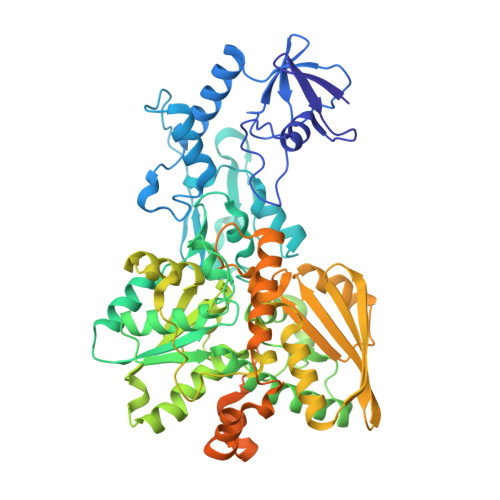
TmHydABC- T. maritima bifurcating hydrogenase with bridge domain up


Experimental Data Snapshot

  • Method: ELECTRON MICROSCOPY
  • Resolution: 2.70 Å
  • Aggregation State: PARTICLE 
  • Reconstruction Method: SINGLE PARTICLE 

wwPDB Validation 3D Report Full Report

Validation slider image for 7P92

This is version 1.1 of the entry. See complete history

Literature

Structural insight on the mechanism of an electron-bifurcating [FeFe] hydrogenase.

Furlan, C.Chongdar, N.Gupta, P.Lubitz, W.Ogata, H.Blaza, J.N.Birrell, J.A.

(2022) Elife 11

  • DOI: https://doi.org/10.7554/eLife.79361
  • Primary Citation Related Structures: 
    7P5H, 7P8N, 7P91, 7P92

  • PubMed Abstract: 

    Electron bifurcation is a fundamental energy conservation mechanism in nature in which two electrons from an intermediate-potential electron donor are split so that one is sent along a high-potential pathway to a high-potential acceptor and the other is sent along a low-potential pathway to a low-potential acceptor. This process allows endergonic reactions to be driven by exergonic ones and is an alternative, less recognized, mechanism of energy coupling to the well-known chemiosmotic principle. The electron-bifurcating [FeFe] hydrogenase from Thermotoga maritima (HydABC) requires both NADH and ferredoxin to reduce protons generating hydrogen. The mechanism of electron bifurcation in HydABC remains enigmatic in spite of intense research efforts over the last few years. Structural information may provide the basis for a better understanding of spectroscopic and functional information. Here, we present a 2.3 Å electron cryo-microscopy structure of HydABC. The structure shows a heterododecamer composed of two independent 'halves' each made of two strongly interacting HydABC heterotrimers connected via a [4Fe-4S] cluster. A central electron transfer pathway connects the active sites for NADH oxidation and for proton reduction. We identified two conformations of a flexible iron-sulfur cluster domain: a 'closed bridge' and an 'open bridge' conformation, where a Zn 2+ site may act as a 'hinge' allowing domain movement. Based on these structural revelations, we propose a possible mechanism of electron bifurcation in HydABC where the flavin mononucleotide serves a dual role as both the electron bifurcation center and as the NAD + reduction/NADH oxidation site.


  • Organizational Affiliation
    • Structural Biology Laboratory and York Biomedical Research Institute, Department of Chemistry, The University of York, York, United Kingdom.

Macromolecule Content 

  • Total Structure Weight: 165.57 kDa 
  • Atom Count: 10,436 
  • Modeled Residue Count: 1,322 
  • Deposited Residue Count: 1,460 
  • Unique protein chains: 3

Macromolecules

Find similar proteins by:|  3D Structure
Entity ID: 1
MoleculeChains  Sequence LengthOrganismDetailsImage
Fe-hydrogenase, subunit alpha645Thermotoga maritima MSB8Mutation(s): 0 
Gene Names: TM_1426
EC: 1.12.1.4
UniProt
Find proteins for O52683 (Thermotoga maritima (strain ATCC 43589 / DSM 3109 / JCM 10099 / NBRC 100826 / MSB8))
Explore O52683 
Go to UniProtKB:  O52683
Entity Groups
Sequence Clusters30% Identity50% Identity70% Identity90% Identity95% Identity100% Identity
UniProt GroupO52683
Sequence Annotations
Expand
Reference Sequence
Find similar proteins by:|  3D Structure
Entity ID: 2
MoleculeChains  Sequence LengthOrganismDetailsImage
Fe-hydrogenase, subunit beta626Thermotoga maritima MSB8Mutation(s): 0 
Gene Names: TM_1425
EC: 1.12.1.4
UniProt
Find proteins for O52682 (Thermotoga maritima (strain ATCC 43589 / DSM 3109 / JCM 10099 / NBRC 100826 / MSB8))
Explore O52682 
Go to UniProtKB:  O52682
Entity Groups
Sequence Clusters30% Identity50% Identity70% Identity90% Identity95% Identity100% Identity
UniProt GroupO52682
Sequence Annotations
Expand
Reference Sequence
Find similar proteins by:|  3D Structure
Entity ID: 3
MoleculeChains  Sequence LengthOrganismDetailsImage
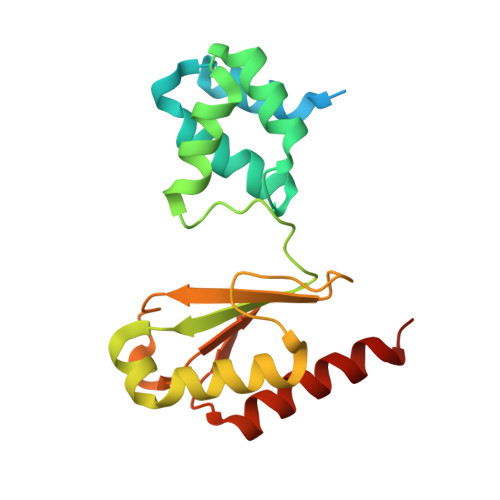
Fe-hydrogenase, subunit gamma189Thermotoga maritima MSB8Mutation(s): 0 
Gene Names: TM_1424HydC
EC: 1.12.1.4
UniProt
Find proteins for O52681 (Thermotoga maritima (strain ATCC 43589 / DSM 3109 / JCM 10099 / NBRC 100826 / MSB8))
Explore O52681 
Go to UniProtKB:  O52681
Entity Groups
Sequence Clusters30% Identity50% Identity70% Identity90% Identity95% Identity100% Identity
UniProt GroupO52681
Sequence Annotations
Expand
Reference Sequence

Small Molecules

Ligands 4 Unique
IDChains Name / Formula / InChI Key2D Diagram3D Interactions
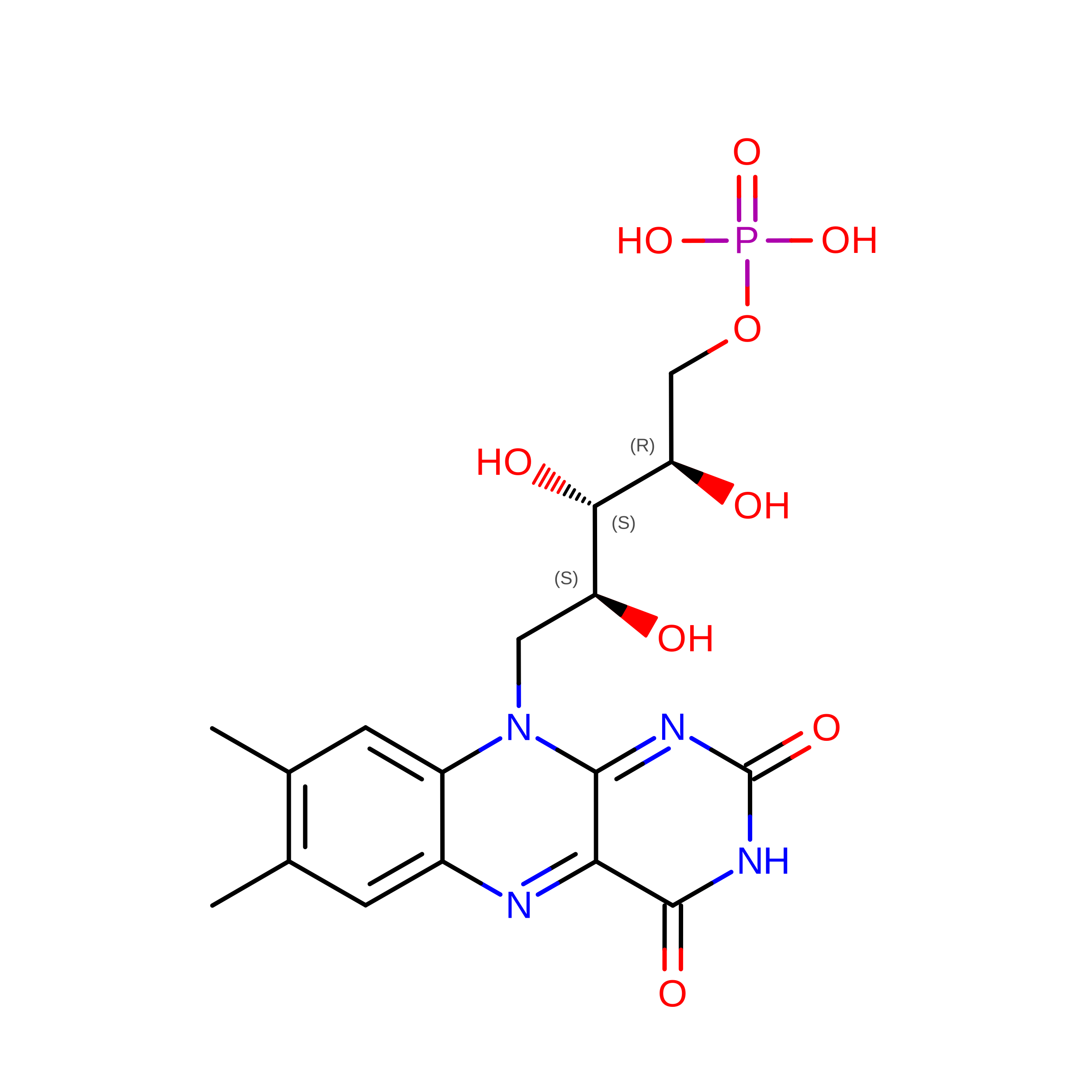
FMN

Query on FMN


Download:Ideal Coordinates CCD File
L [auth B]FLAVIN MONONUCLEOTIDE
C17 H21 N4 O9 P
FVTCRASFADXXNN-SCRDCRAPSA-N
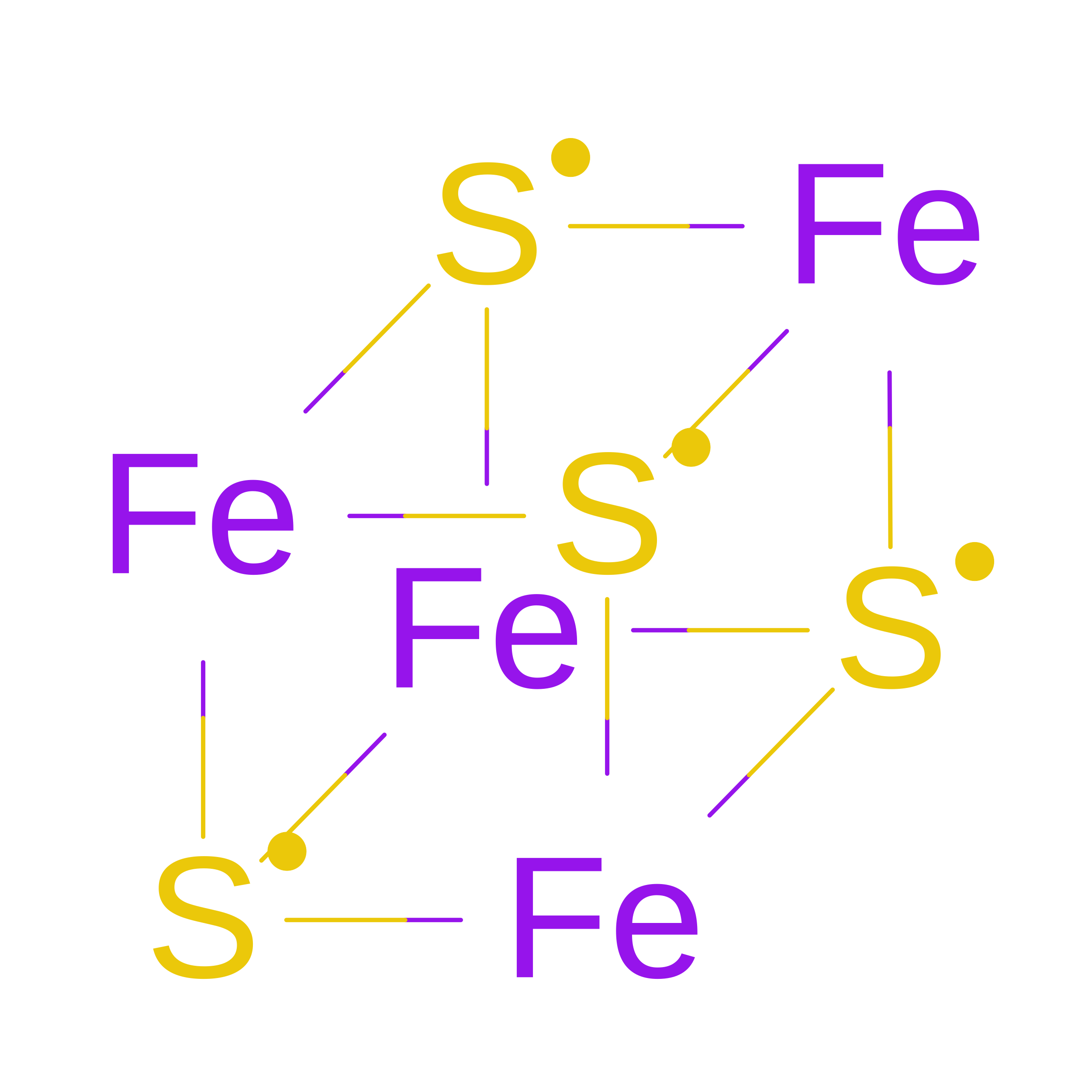
SF4

Query on SF4


Download:Ideal Coordinates CCD File
D [auth A]
E [auth A]
F [auth A]
G [auth A]
I [auth B]
D [auth A],
E [auth A],
F [auth A],
G [auth A],
I [auth B],
J [auth B],
K [auth B]
IRON/SULFUR CLUSTER
Fe4 S4
LJBDFODJNLIPKO-UHFFFAOYSA-N
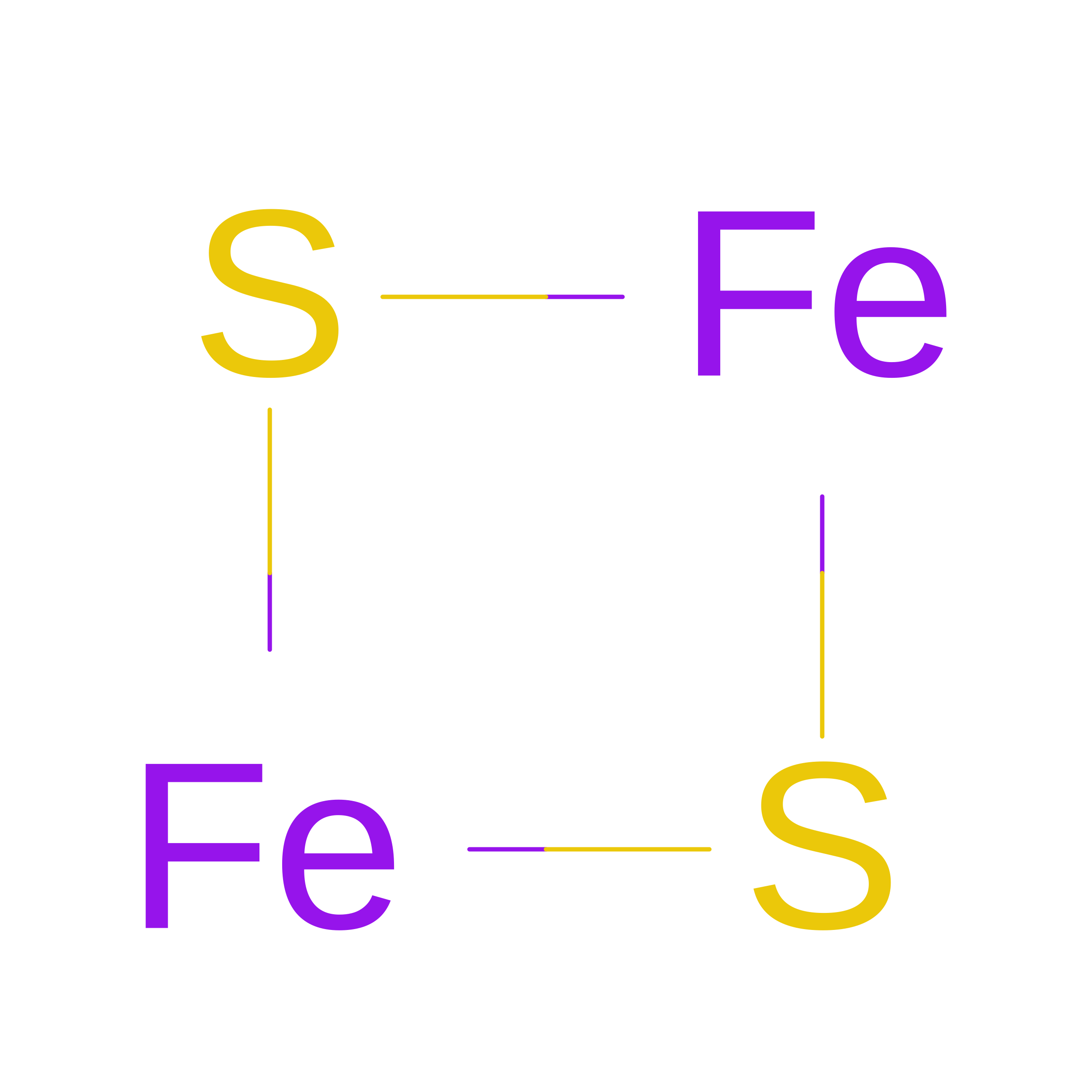
FES

Query on FES


Download:Ideal Coordinates CCD File
H [auth A],
M [auth B],
O [auth C]
FE2/S2 (INORGANIC) CLUSTER
Fe2 S2
NIXDOXVAJZFRNF-UHFFFAOYSA-N
ZN

Query on ZN


Download:Ideal Coordinates CCD File
N [auth B]ZINC ION
Zn
PTFCDOFLOPIGGS-UHFFFAOYSA-N

Experimental Data & Validation

Experimental Data

  • Method: ELECTRON MICROSCOPY
  • Resolution: 2.70 Å
  • Aggregation State: PARTICLE 
  • Reconstruction Method: SINGLE PARTICLE 
EM Software:
TaskSoftware PackageVersion
MODEL REFINEMENTPHENIX
RECONSTRUCTIONRELION3.1

Structure Validation

View Full Validation Report


Entry History 

& Funding Information

Deposition Data


Funding OrganizationLocationGrant Number
UK Research and Innovation (UKRI)United KingdomMR/T040742/1
German Research Foundation (DFG)GermanyBI 2198/1-1
Japan Society for the Promotion of Science (JSPS)Japan16K21748

Revision History  (Full details and data files)

  • Version 1.0: 2022-09-14
    Type: Initial release
  • Version 1.1: 2024-07-17
    Changes: Data collection