7P77 | pdb_00007p77

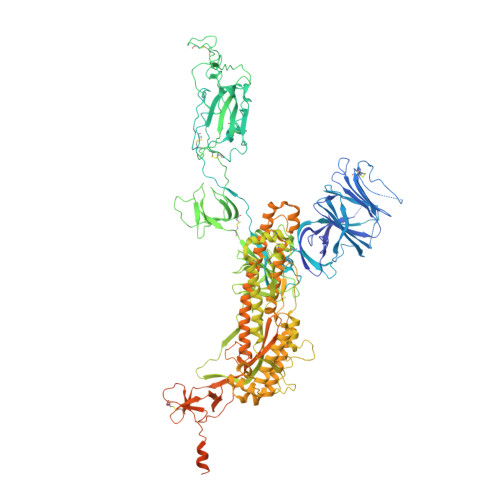
SARS-CoV-2 spike protein in complex with sybody#15 and sybody#68 in a 3up conformation


Experimental Data Snapshot

  • Method: ELECTRON MICROSCOPY
  • Resolution: 2.98 Å
  • Aggregation State: PARTICLE 
  • Reconstruction Method: SINGLE PARTICLE 

Starting Models: experimental
View more details

wwPDB Validation 3D Report Full Report

Validation slider image for 7P77

This is version 1.3 of the entry. See complete history

Literature

Biparatopic sybodies neutralize SARS-CoV-2 variants of concern and mitigate drug resistance.

Walter, J.D.Scherer, M.Hutter, C.A.J.Garaeva, A.A.Zimmermann, I.Wyss, M.Rheinberger, J.Ruedin, Y.Earp, J.C.Egloff, P.Sorgenfrei, M.Hurlimann, L.M.Gonda, I.Meier, G.Remm, S.Thavarasah, S.van Geest, G.Bruggmann, R.Zimmer, G.Slotboom, D.J.Paulino, C.Plattet, P.Seeger, M.A.

(2022) EMBO Rep 23: e54199-e54199

  • DOI: https://doi.org/10.15252/embr.202154199
  • Primary Citation Related Structures: 
    7P77, 7P78, 7P79, 7P7A, 7P7B

  • PubMed Abstract: 

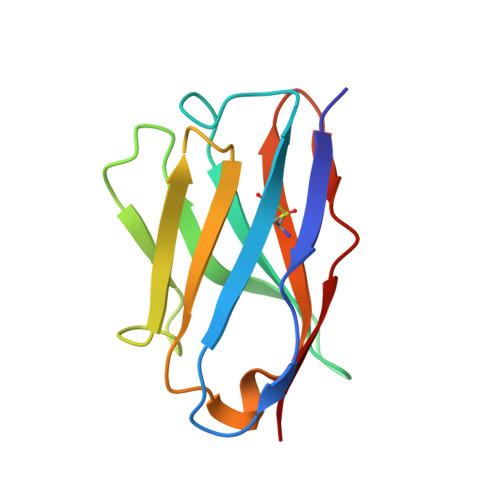
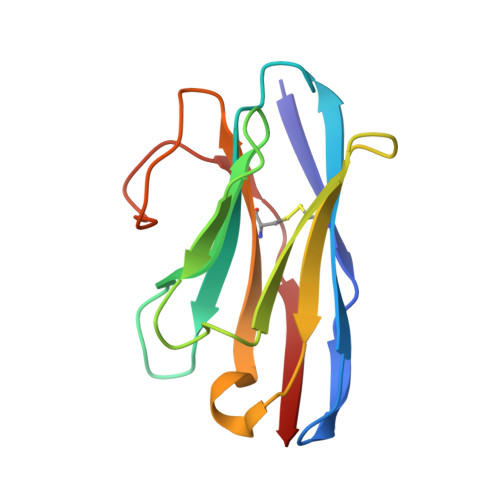
    The ongoing COVID-19 pandemic represents an unprecedented global health crisis. Here, we report the identification of a synthetic nanobody (sybody) pair, Sb#15 and Sb#68, that can bind simultaneously to the SARS-CoV-2 spike RBD and efficiently neutralize pseudotyped and live viruses by interfering with ACE2 interaction. Cryo-EM confirms that Sb#15 and Sb#68 engage two spatially discrete epitopes, influencing rational design of bispecific and tri-bispecific fusion constructs that exhibit up to 100- and 1,000-fold increase in neutralization potency, respectively. Cryo-EM of the sybody-spike complex additionally reveals a novel up-out RBD conformation. While resistant viruses emerge rapidly in the presence of single binders, no escape variants are observed in the presence of the bispecific sybody. The multivalent bispecific constructs further increase the neutralization potency against globally circulating SARS-CoV-2 variants of concern. Our study illustrates the power of multivalency and biparatopic nanobody fusions for the potential development of therapeutic strategies that mitigate the emergence of new SARS-CoV-2 escape mutants.


  • Organizational Affiliation
    • Institute of Medical Microbiology, University of Zurich, Zurich, Switzerland.

Macromolecule Content 

  • Total Structure Weight: 519.15 kDa 
  • Atom Count: 30,582 
  • Modeled Residue Count: 3,822 
  • Deposited Residue Count: 4,578 
  • Unique protein chains: 3

Macromolecules

Find similar proteins by:|  3D Structure
Entity ID: 1
MoleculeChains  Sequence LengthOrganismDetailsImage
Spike glycoproteinA [auth B],
B [auth C],
C [auth E]
1,288Severe acute respiratory syndrome coronavirus 2Mutation(s): 5 
Gene Names: S2
UniProt
Find proteins for P0DTC2 (Severe acute respiratory syndrome coronavirus 2)
Explore P0DTC2 
Go to UniProtKB:  P0DTC2
Entity Groups
Sequence Clusters30% Identity50% Identity70% Identity90% Identity95% Identity100% Identity
UniProt GroupP0DTC2
Glycosylation
Glycosylation Sites: 14Go to GlyGen: P0DTC2-1
Sequence Annotations
Expand
Reference Sequence
Find similar proteins by:|  3D Structure
Entity ID: 2
MoleculeChains  Sequence LengthOrganismDetailsImage
sybody#15D [auth A],
E [auth D],
F [auth H]
114synthetic constructMutation(s): 0 
Find similar proteins by:|  3D Structure
Entity ID: 3
MoleculeChains  Sequence LengthOrganismDetailsImage
sybody#68G [auth W],
H [auth Y],
I [auth X]
124synthetic constructMutation(s): 0 

Oligosaccharides

Help  
Entity ID: 4
MoleculeChains Length2D Diagram GlycosylationD Interactions
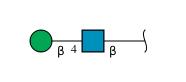
2-acetamido-2-deoxy-beta-D-glucopyranose-(1-4)-2-acetamido-2-deoxy-beta-D-glucopyranose
J [auth F],
L [auth I],
M [auth J],
N [auth K],
O [auth M],
J [auth F],
L [auth I],
M [auth J],
N [auth K],
O [auth M],
P [auth N],
Q [auth O],
R [auth P],
S [auth Q],
W [auth L]
2N-Glycosylation
Glycosylation Resources
GlyTouCan: G42666HT
GlyCosmos: G42666HT
GlyGen: G42666HT
Entity ID: 5
MoleculeChains Length2D Diagram GlycosylationD Interactions
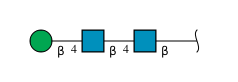
beta-D-mannopyranose-(1-4)-2-acetamido-2-deoxy-beta-D-glucopyranose-(1-4)-2-acetamido-2-deoxy-beta-D-glucopyranoseK [auth G],
U [auth S],
X [auth U],
Y [auth V]
3N-Glycosylation
Glycosylation Resources
GlyTouCan: G15407YE
GlyCosmos: G15407YE
GlyGen: G15407YE
Entity ID: 6
MoleculeChains Length2D Diagram GlycosylationD Interactions
beta-D-mannopyranose-(1-4)-2-acetamido-2-deoxy-beta-D-glucopyranoseT [auth R]2O-Glycosylation
Glycosylation Resources
GlyTouCan: G90333CG
GlyCosmos: G90333CG
GlyGen: G90333CG
Entity ID: 7
MoleculeChains Length2D Diagram GlycosylationD Interactions
2-acetamido-2-deoxy-beta-D-glucopyranose-(1-4)-2-acetamido-2-deoxy-beta-D-glucopyranose-(5-4)-2-acetamido-2-deoxy-beta-D-glucopyranoseV [auth T]3N/AN-Glycosylation

Small Molecules

Ligands 1 Unique
IDChains Name / Formula / InChI Key2D Diagram3D Interactions
NAG

Query on NAG


Download:Ideal Coordinates CCD File
AA [auth B]
AB [auth E]
BA [auth B]
BB [auth E]
CA [auth B]
AA [auth B],
AB [auth E],
BA [auth B],
BB [auth E],
CA [auth B],
DA [auth B],
EA [auth B],
FA [auth B],
GA [auth B],
HA [auth B],
IA [auth B],
JA [auth C],
KA [auth C],
LA [auth C],
MA [auth C],
NA [auth C],
OA [auth C],
PA [auth C],
QA [auth C],
RA [auth C],
SA [auth C],
TA [auth E],
UA [auth E],
VA [auth E],
WA [auth E],
XA [auth E],
YA [auth E],
Z [auth B],
ZA [auth E]
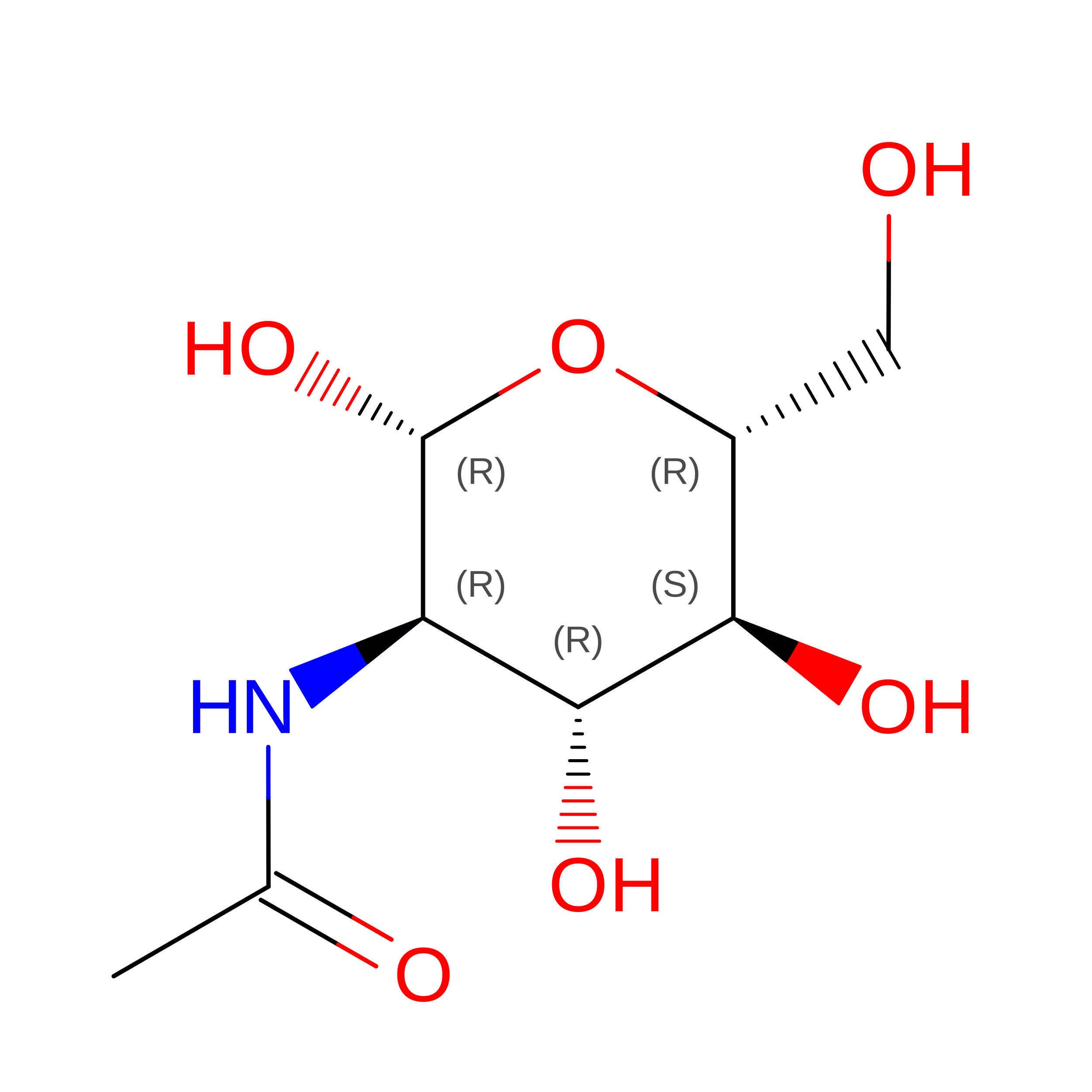
2-acetamido-2-deoxy-beta-D-glucopyranose
C8 H15 N O6
OVRNDRQMDRJTHS-FMDGEEDCSA-N

Experimental Data & Validation

Experimental Data

  • Method: ELECTRON MICROSCOPY
  • Resolution: 2.98 Å
  • Aggregation State: PARTICLE 
  • Reconstruction Method: SINGLE PARTICLE 
EM Software:
TaskSoftware PackageVersion
RECONSTRUCTIONcryoSPARC2.15.0
MODEL REFINEMENTPHENIX1.18.2-3874-000

Structure Validation

View Full Validation Report


Entry History 

& Funding Information

Deposition Data


Funding OrganizationLocationGrant Number
Netherlands Organisation for Scientific Research (NWO)Netherlands722.017.001
Netherlands Organisation for Scientific Research (NWO)Netherlands740.018.016
Swiss National Science FoundationSwitzerland4078P0_198314

Revision History  (Full details and data files)

  • Version 1.0: 2021-08-04
    Type: Initial release
  • Version 1.1: 2022-03-16
    Changes: Data collection, Database references
  • Version 1.2: 2022-04-20
    Changes: Database references
  • Version 1.3: 2024-11-06
    Changes: Data collection, Database references, Refinement description, Structure summary