Download Mendeley
Mapping Molecular Recognition of beta 1,3-1,4-Glucans by a Surface Glycan-Binding Protein from the Human Gut Symbiont Bacteroides ovatus.
Correia, V.G., Trovao, F., Pinheiro, B.A., Bras, J.L.A., Silva, L.M., Nunes, C., Coimbra, M.A., Liu, Y., Feizi, T., Fontes, C.M.G.A., Mulloy, B., Chai, W., Carvalho, A.L., Palma, A.S.(2021) Microbiol Spectr 9: e0182621-e0182621
- PubMed: 34817219 Search on PubMedSearch on PubMed Central
- DOI: https://doi.org/10.1128/Spectrum.01826-21
- Primary Citation Related Structures:
7NOX, 7O8C - PubMed Abstract:
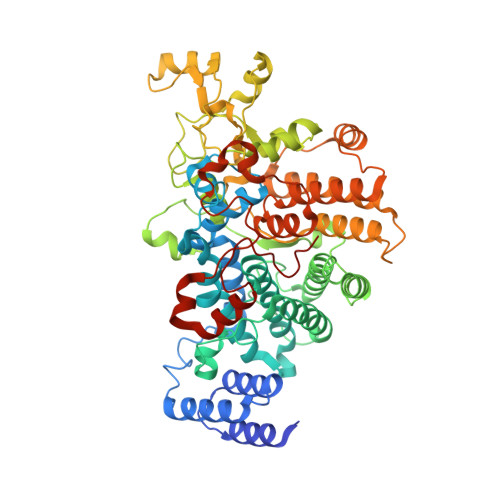
A multigene polysaccharide utilization locus (PUL) encoding enzymes and surface carbohydrate (glycan)-binding proteins (SGBPs) was recently identified in prominent members of Bacteroidetes in the human gut and characterized in Bacteroides ovatus. This PUL-encoded system specifically targets mixed-linkage β1,3-1,4-glucans, a group of diet-derived carbohydrates that promote a healthy microbiota and have potential as prebiotics. The BoSGBP MLG -A protein encoded by the BACOVA_2743 gene is a SusD-like protein that plays a key role in the PUL's specificity and functionality. Here, we perform a detailed analysis of the molecular determinants underlying carbohydrate binding by BoSGBP MLG -A, combining carbohydrate microarray technology with quantitative affinity studies and a high-resolution X-ray crystallography structure of the complex of BoSGBP MLG -A with a β1,3-1,4-nonasaccharide. We demonstrate its unique binding specificity toward β1,3-1,4-gluco-oligosaccharides, with increasing binding affinities up to the octasaccharide and dependency on the number and position of β1,3 linkages. The interaction is defined by a 41-Å-long extended binding site that accommodates the oligosaccharide in a mode distinct from that of previously described bacterial β1,3-1,4-glucan-binding proteins. In addition to the shape complementarity mediated by CH-π interactions, a complex hydrogen bonding network complemented by a high number of key ordered water molecules establishes additional specific interactions with the oligosaccharide. These support the twisted conformation of the β-glucan backbone imposed by the β1,3 linkages and explain the dependency on the oligosaccharide chain length. We propose that the specificity of the PUL conferred by BoSGBP MLG -A to import long β1,3-1,4-glucan oligosaccharides to the bacterial periplasm allows Bacteroidetes to outcompete bacteria that lack this PUL for utilization of β1,3-1,4-glucans. IMPORTANCE With the knowledge of bacterial gene systems encoding proteins that target dietary carbohydrates as a source of nutrients and their importance for human health, major efforts are being made to understand carbohydrate recognition by various commensal bacteria. Here, we describe an integrative strategy that combines carbohydrate microarray technology with structural studies to further elucidate the molecular determinants of carbohydrate recognition by BoSGBP MLG -A, a key protein expressed at the surface of Bacteroides ovatus for utilization of mixed-linkage β1,3-1,4-glucans. We have mapped at high resolution interactions that occur at the binding site of BoSGBP MLG -A and provide evidence for the role of key water-mediated interactions for fine specificity and affinity. Understanding at the molecular level how commensal bacteria, such as prominent members of Bacteroidetes , can differentially utilize dietary carbohydrates with potential prebiotic activities will shed light on possible ways to modulate the microbiome to promote human health.
- UCIBIO, Applied Molecular Biosciences Unit, Department of Chemistry, School of Science and Technology, NOVA University Lisbon, Caparica, Portugal.
Organizational Affiliation: