7N7D | pdb_00007n7d

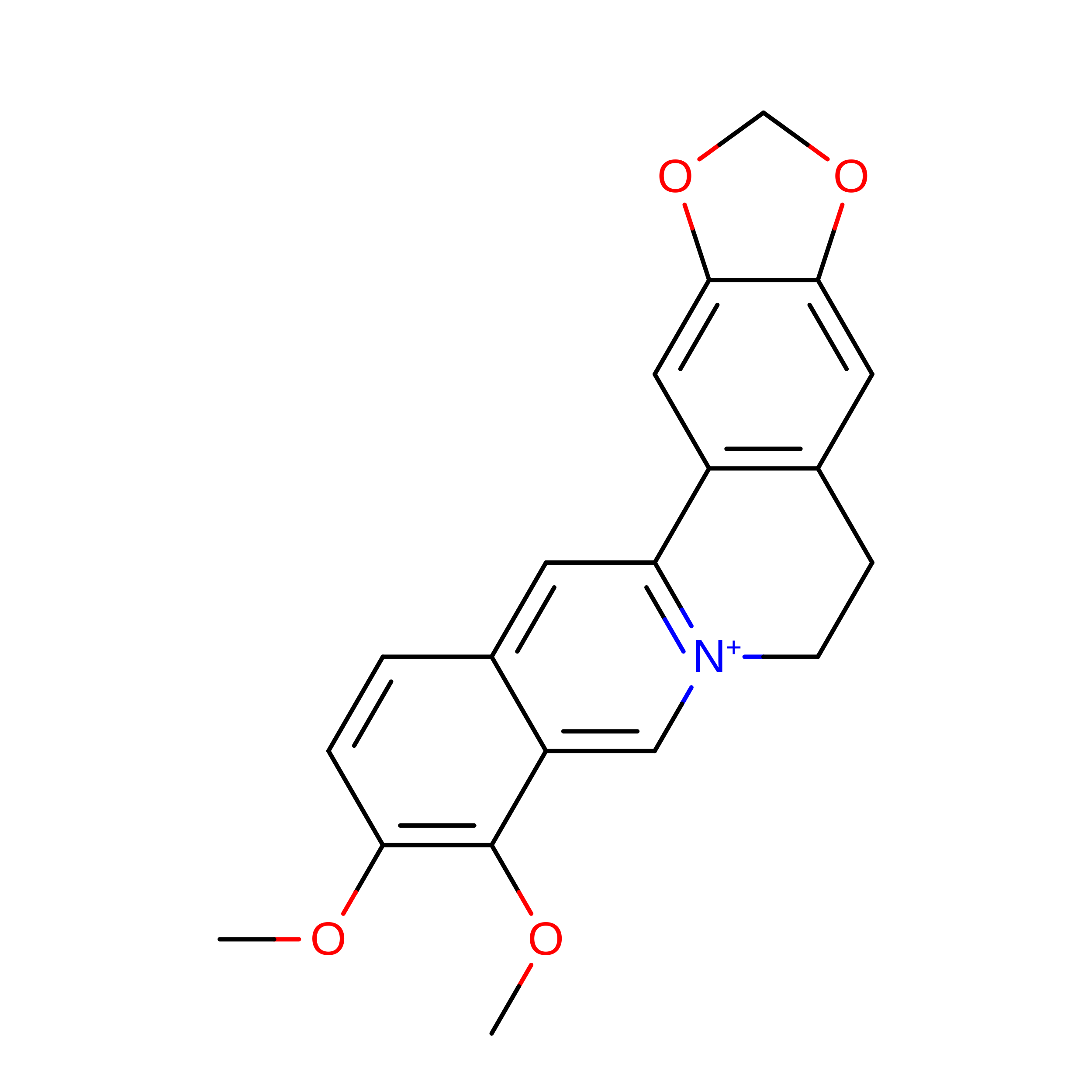
Solution structure of the MYC promoter G-quadruplex in complex with berberine: conformer A

  • Classification: DNA
  • Organism(s): Homo sapiens
  • Mutation(s): No 

  • Deposited: 2021-06-10 Released: 2021-11-03 
  • Deposition Author(s): Dickerhoff, J., Yang, D.
  • Funding Organization(s): National Institutes of Health/National Cancer Institute (NIH/NCI), German Research Foundation (DFG)

Experimental Data Snapshot

  • Method: SOLUTION NMR
  • Conformers Calculated: 20 
  • Conformers Submitted: 10 
  • Selection Criteria: structures with the lowest energy 

wwPDB Validation 3D Report Full Report

Validation slider image for 7N7D

This is version 1.2 of the entry. See complete history

Literature

Berberine Molecular Recognition of the Parallel MYC G-Quadruplex in Solution.

Dickerhoff, J.Brundridge, N.McLuckey, S.A.Yang, D.

(2021) J Med Chem 64: 16205-16212

  • DOI: https://doi.org/10.1021/acs.jmedchem.1c01508
  • Primary Citation Related Structures: 
    7N7D, 7N7E

  • PubMed Abstract: 

    The medicinal natural product berberine is one of the most actively studied and pursued G-quadruplex (G4)-ligands. The major G-quadruplex formed in the promoter region of the MYC oncogene (MycG4) is an attractive drug target and a prominent example and model structure for parallel G-quadruplexes. G4-targeted berberine derivatives have been actively developed; however, the analogue design was based on a previous crystal structure in which berberine binds as a dimer to a parallel G-quadruplex. Herein, we show that in solution, the binding mode and stoichiometry of berberine are substantially different from the crystal structure: berberine binds as a monomer to MycG4 using a base-recruitment mechanism with a reversed orientation in that the positively charged convex side is actually positioned above the tetrad center. Our structure provides a physiologically relevant basis for the future structure-based rational design of G4-targeted berberine derivatives, and this study demonstrates that it is crucial to validate the ligand-DNA interactions.


  • Organizational Affiliation
    • Medicinal Chemistry and Molecular Pharmacology, College of Pharmacy, Purdue University, 575 W Stadium Avenue, West Lafayette, Indiana 47904, United States.

Macromolecule Content 

  • Total Structure Weight: 7.71 kDa 
  • Atom Count: 519 
  • Modeled Residue Count: 22 
  • Deposited Residue Count: 22 
  • Unique nucleic acid chains: 1

Macromolecules

Find similar nucleic acids by:  Sequence
Entity ID: 1
MoleculeChains LengthOrganismImage
Myc234522Homo sapiens
Sequence Annotations
Expand
Reference Sequence

Experimental Data & Validation

Experimental Data

  • Method: SOLUTION NMR
  • Conformers Calculated: 20 
  • Conformers Submitted: 10 
  • Selection Criteria: structures with the lowest energy 

Structure Validation

View Full Validation Report


Entry History 

& Funding Information

Deposition Data


Funding OrganizationLocationGrant Number
National Institutes of Health/National Cancer Institute (NIH/NCI)United StatesR01CA177585
National Institutes of Health/National Cancer Institute (NIH/NCI)United StatesU01CA240346
German Research Foundation (DFG)Germany427347592

Revision History  (Full details and data files)

  • Version 1.0: 2021-11-03
    Type: Initial release
  • Version 1.1: 2021-11-24
    Changes: Database references
  • Version 1.2: 2024-05-15
    Changes: Data collection, Database references