7KZ7 | pdb_00007kz7

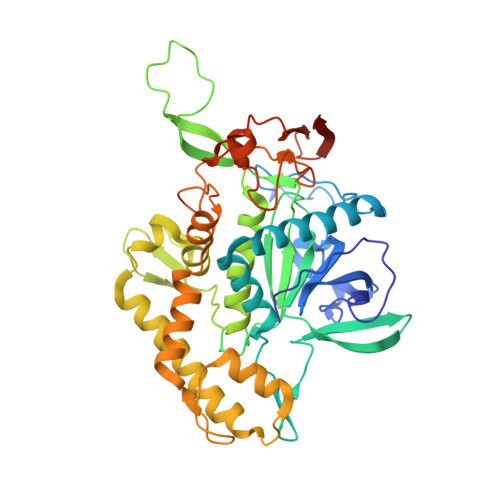
Crystals Structure of the Mutated Protease Domain of Botulinum Neurotoxin X (X4130B1).


Experimental Data Snapshot

  • Method: X-RAY DIFFRACTION
  • Resolution: 1.80 Å
  • R-Value Free: 
    0.185 (Depositor), 0.195 (DCC) 
  • R-Value Work: 
    0.151 (Depositor), 0.164 (DCC) 
  • R-Value Observed: 
    0.152 (Depositor) 

Starting Model: experimental
View more details

wwPDB Validation 3D Report Full Report

Validation slider image for 7KZ7

This is version 1.2 of the entry. See complete history. 

Literature

Phage-assisted evolution of botulinum neurotoxin proteases with reprogrammed specificity.

Blum, T.R., Liu, H., Packer, M.S., Xiong, X., Lee, P.G., Zhang, S., Richter, M., Minasov, G., Satchell, K.J.F., Dong, M., Liu, D.R.

(2021) Science 371: 803-810

  • DOI: https://doi.org/10.1126/science.abf5972
  • Primary Citation Related Structures: 
    7KZ7

  • PubMed Abstract: 

    Although bespoke, sequence-specific proteases have the potential to advance biotechnology and medicine, generation of proteases with tailor-made cleavage specificities remains a major challenge. We developed a phage-assisted protease evolution system with simultaneous positive and negative selection and applied it to three botulinum neurotoxin (BoNT) light-chain proteases. We evolved BoNT/X protease into separate variants that preferentially cleave vesicle-associated membrane protein 4 (VAMP4) and Ykt6, evolved BoNT/F protease to selectively cleave the non-native substrate VAMP7, and evolved BoNT/E protease to cleave phosphatase and tensin homolog (PTEN) but not any natural BoNT protease substrate in neurons. The evolved proteases display large changes in specificity (218- to >11,000,000-fold) and can retain their ability to form holotoxins that self-deliver into primary neurons. These findings establish a versatile platform for reprogramming proteases to selectively cleave new targets of therapeutic interest.


  • Organizational Affiliation: 
    • Merkin Institute of Transformative Technologies in Healthcare, Broad Institute of Harvard and MIT, Cambridge, MA 02142, USA.

Macromolecule Content 

  • Total Structure Weight: 51.46 kDa 
  • Atom Count: 3,926 
  • Modeled Residue Count: 424 
  • Deposited Residue Count: 445 
  • Unique protein chains: 1

Macromolecules

Find similar proteins by:|  3D Structure
Entity ID: 1
MoleculeChains  Sequence LengthOrganismDetailsImage
Botulinum neurotoxin type X445Clostridium botulinumMutation(s): 6 
Gene Names: CBB2_0680
EC: 3.4.24.69
UniProt
Find proteins for P0DPK1 (Clostridium botulinum)
Explore P0DPK1 
Go to UniProtKB:  P0DPK1
Entity Groups
Sequence Clusters30% Identity50% Identity70% Identity90% Identity95% Identity100% Identity
UniProt GroupP0DPK1
Sequence Annotations
Expand
Reference Sequence

Small Molecules

Ligands 3 Unique
IDChains Name / Formula / InChI Key2D Diagram3D Interactions
GOL

Query on GOL


Download:Ideal Coordinates CCD File
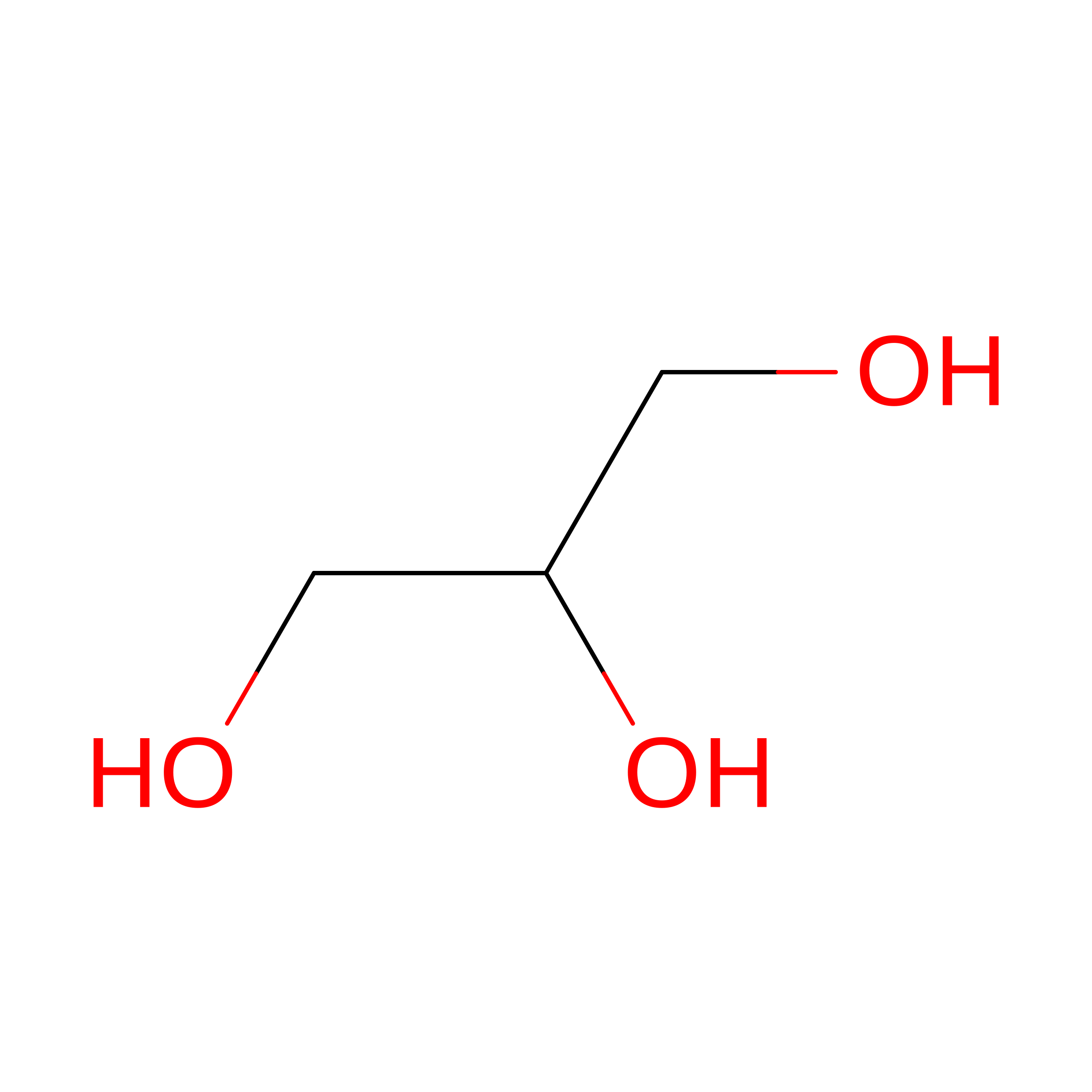
J [auth A],
K [auth A]
GLYCEROL
C3 H8 O3
PEDCQBHIVMGVHV-UHFFFAOYSA-N
ZN
(Subject of Investigation/LOI)

Query on ZN


Download:Ideal Coordinates CCD File
B [auth A]ZINC ION
Zn
PTFCDOFLOPIGGS-UHFFFAOYSA-N
EDO

Query on EDO


Download:Ideal Coordinates CCD File
C [auth A]
D [auth A]
E [auth A]
F [auth A]
G [auth A]
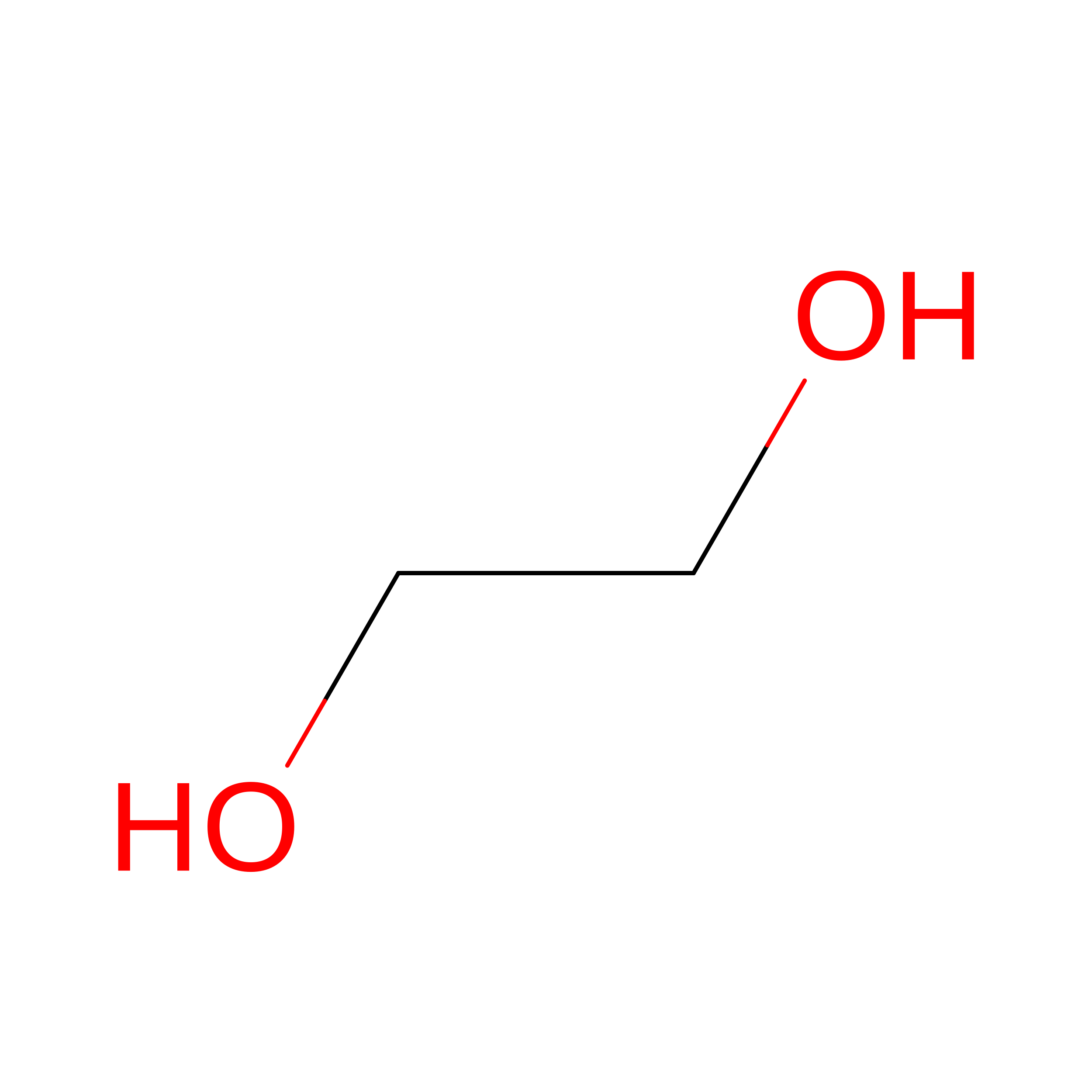
C [auth A],
D [auth A],
E [auth A],
F [auth A],
G [auth A],
H [auth A],
I [auth A]
1,2-ETHANEDIOL
C2 H6 O2
LYCAIKOWRPUZTN-UHFFFAOYSA-N

Experimental Data & Validation

Experimental Data

  • Method: X-RAY DIFFRACTION
  • Resolution: 1.80 Å
  • R-Value Free:  0.185 (Depositor), 0.195 (DCC) 
  • R-Value Work:  0.151 (Depositor), 0.164 (DCC) 
  • R-Value Observed: 0.152 (Depositor) 
Space Group: P 21 21 21
Unit Cell:
Length ( Å )Angle ( ˚ )
a = 59.935α = 90
b = 86.775β = 90
c = 93.557γ = 90
Software Package:
Software NamePurpose
REFMACrefinement
PDB_EXTRACTdata extraction
HKL-3000data reduction
HKL-3000data scaling
PHASERphasing

Structure Validation

View Full Validation Report


Entry History 

Revision History  (Full details and data files)

  • Version 1.0: 2020-12-23
    Type: Initial release
  • Version 1.1: 2021-12-15
    Changes: Database references
  • Version 1.2: 2023-10-18
    Changes: Data collection, Refinement description