7KSP | pdb_00007ksp

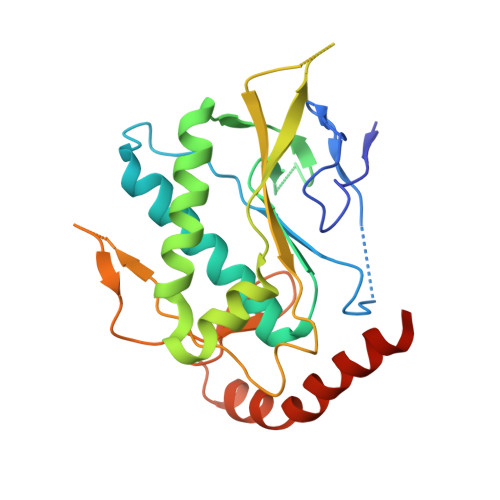
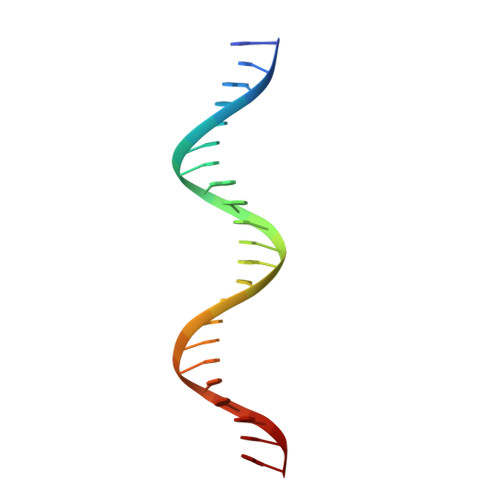
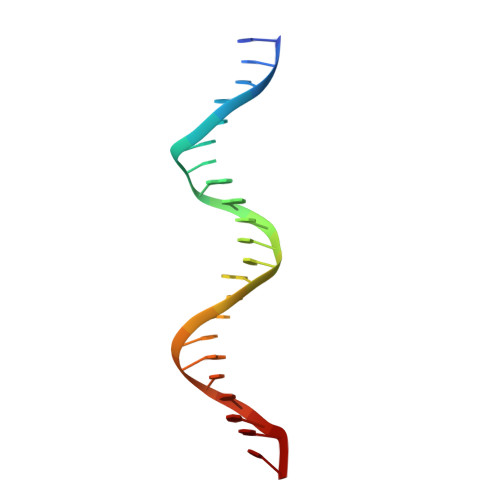
Crystal structure of hSAMD9_DBD with DNA


Experimental Data Snapshot

  • Method: X-RAY DIFFRACTION
  • Resolution: 2.80 Å
  • R-Value Free: 
    0.284 (Depositor), 0.280 (DCC) 
  • R-Value Work: 
    0.208 (Depositor) 
  • R-Value Observed: 
    0.216 (Depositor) 

wwPDB Validation 3D Report Full Report

Validation slider image for 7KSP

This is version 1.3 of the entry. See complete history

Literature

Structure and function of an effector domain in antiviral factors and tumor suppressors SAMD9 and SAMD9L.

Peng, S.Meng, X.Zhang, F.Pathak, P.K.Chaturvedi, J.Coronado, J.Morales, M.Mao, Y.Qian, S.B.Deng, J.Xiang, Y.

(2022) Proc Natl Acad Sci U S A 119

  • DOI: https://doi.org/10.1073/pnas.2116550119
  • Primary Citation Related Structures: 
    7KSP

  • PubMed Abstract: 

    SAMD9 and SAMD9L (SAMD9/9L) are antiviral factors and tumor suppressors, playing a critical role in innate immune defense against poxviruses and the development of myeloid tumors. SAMD9/9L mutations with a gain-of-function (GoF) in inhibiting cell growth cause multisystem developmental disorders including many pediatric myelodysplastic syndromes. Predicted to be multidomain proteins with an architecture like that of the NOD-like receptors, SAMD9/9L molecular functions and domain structures are largely unknown. Here, we identified a SAMD9/9L effector domain that functions by binding to double-stranded nucleic acids (dsNA) and determined the crystal structure of the domain in complex with DNA. Aided with precise mutations that differentially perturb dsNA binding, we demonstrated that the antiviral and antiproliferative functions of the wild-type and GoF SAMD9/9L variants rely on dsNA binding by the effector domain. Furthermore, we showed that GoF variants inhibit global protein synthesis, reduce translation elongation, and induce proteotoxic stress response, which all require dsNA binding by the effector domain. The identification of the structure and function of a SAMD9/9L effector domain provides a therapeutic target for SAMD9/9L-associated human diseases.


  • Organizational Affiliation
    • Department of Biochemistry and Molecular Biology, Oklahoma State University, Stillwater, OK 74078.

Macromolecule Content 

  • Total Structure Weight: 67.02 kDa 
  • Atom Count: 4,408 
  • Modeled Residue Count: 468 
  • Deposited Residue Count: 504 
  • Unique protein chains: 1
  • Unique nucleic acid chains: 2

Macromolecules


Find similar proteins by:|  3D Structure
Entity ID: 1
MoleculeChains  Sequence LengthOrganismDetailsImage
Sterile alpha motif domain-containing protein 9
A, B
230Homo sapiensMutation(s): 0 
Gene Names: SAMD9C7orf5DRIF1KIAA2004OEF1
UniProt & NIH Common Fund Data Resources
Find proteins for Q5K651 (Homo sapiens)
Explore Q5K651 
Go to UniProtKB:  Q5K651
PHAROS:  Q5K651
GTEx:  ENSG00000205413 
Entity Groups
Sequence Clusters30% Identity50% Identity70% Identity90% Identity95% Identity100% Identity
UniProt GroupQ5K651
Sequence Annotations
Expand
Reference Sequence
Find similar nucleic acids by:  Sequence
Entity ID: 2
MoleculeChains LengthOrganismImage
DNA22synthetic construct
Sequence Annotations
Expand
Reference Sequence
Find similar nucleic acids by:  Sequence
Entity ID: 3
MoleculeChains LengthOrganismImage
DNA22synthetic construct
Sequence Annotations
Expand
Reference Sequence

Experimental Data & Validation

Experimental Data

  • Method: X-RAY DIFFRACTION
  • Resolution: 2.80 Å
  • R-Value Free:  0.284 (Depositor), 0.280 (DCC) 
  • R-Value Work:  0.208 (Depositor) 
  • R-Value Observed: 0.216 (Depositor) 
Space Group: P 1 21 1
Unit Cell:
Length ( Å )Angle ( ˚ )
a = 67.796α = 90
b = 59.022β = 97.47
c = 88.383γ = 90
Software Package:
Software NamePurpose
PHENIXrefinement
PDB_EXTRACTdata extraction
HKL-3000data reduction
HKL-3000data scaling
PHENIXphasing

Structure Validation

View Full Validation Report


Entry History 

Deposition Data

Revision History  (Full details and data files)

  • Version 1.0: 2022-01-05
    Type: Initial release
  • Version 1.1: 2022-01-12
    Changes: Structure summary
  • Version 1.2: 2022-04-27
    Changes: Database references
  • Version 1.3: 2024-05-22
    Changes: Data collection, Refinement description