7KBX | pdb_00007kbx

Solution structure of the major MYC promoter G-quadruplex in complex with NSC85697, a quinoline derivative

  • Classification: DNA
  • Organism(s): Homo sapiens
  • Mutation(s): No 

  • Deposited: 2020-10-03 Released: 2021-06-23 
  • Deposition Author(s): Dickerhoff, J., Yang, D.
  • Funding Organization(s): National Institutes of Health/National Cancer Institute (NIH/NCI), German Research Foundation (DFG)

Experimental Data Snapshot

  • Method: SOLUTION NMR
  • Conformers Calculated: 20 
  • Conformers Submitted: 10 
  • Selection Criteria: structures with the lowest energy 

wwPDB Validation 3D Report Full Report

Validation slider image for 7KBX

This is version 1.1 of the entry. See complete history

Literature

Structural recognition of the MYC promoter G-quadruplex by a quinoline derivative: insights into molecular targeting of parallel G-quadruplexes.

Dickerhoff, J.Dai, J.Yang, D.

(2021) Nucleic Acids Res 49: 5905-5915

  • DOI: https://doi.org/10.1093/nar/gkab330
  • Primary Citation Related Structures: 
    7KBV, 7KBW, 7KBX

  • PubMed Abstract: 

    DNA G-Quadruplexes (G4s) formed in oncogene promoters regulate transcription. The oncogene MYC promoter G4 (MycG4) is the most prevalent G4 in human cancers. However, the most studied MycG4 sequence bears a mutated 3'-residue crucial for ligand recognition. Here, we report a new drug-like small molecule PEQ without a large aromatic moiety that specifically binds MycG4. We determined the NMR solution structures of the wild-type MycG4 and its 2:1 PEQ complex, as well as the structure of the 2:1 PEQ complex of the widely used mutant MycG4. Comparison of the two complex structures demonstrates specific molecular recognition of MycG4 and shows the clear effect of the critical 3'-mutation on the drug binding interface. We performed a systematic analysis of the four available complex structures involving the same mutant MycG4, which can be considered a model system for parallel G4s, and revealed for the first time that the flexible flanking residues are recruited in a conserved and sequence-specific way, as well as unused potential for selective ligand-G4 hydrogen-bond interactions. Our results provide the true molecular basis for MycG4-targeting drugs and new critical insights into future rational design of drugs targeting MycG4 and parallel G4s that are prevalent in promoter and RNA G4s.


  • Organizational Affiliation
    • Purdue University, College of Pharmacy, Medicinal Chemistry and Molecular Pharmacology, 575 W Stadium Ave., West Lafayette, IN 47907, USA.

Macromolecule Content 

  • Total Structure Weight: 7.68 kDa 
  • Atom Count: 517 
  • Modeled Residue Count: 22 
  • Deposited Residue Count: 22 
  • Unique nucleic acid chains: 1

Macromolecules

Find similar nucleic acids by:  Sequence
Entity ID: 1
MoleculeChains LengthOrganismImage
Myc2345_T2322Homo sapiens
Sequence Annotations
Expand
Reference Sequence

Small Molecules

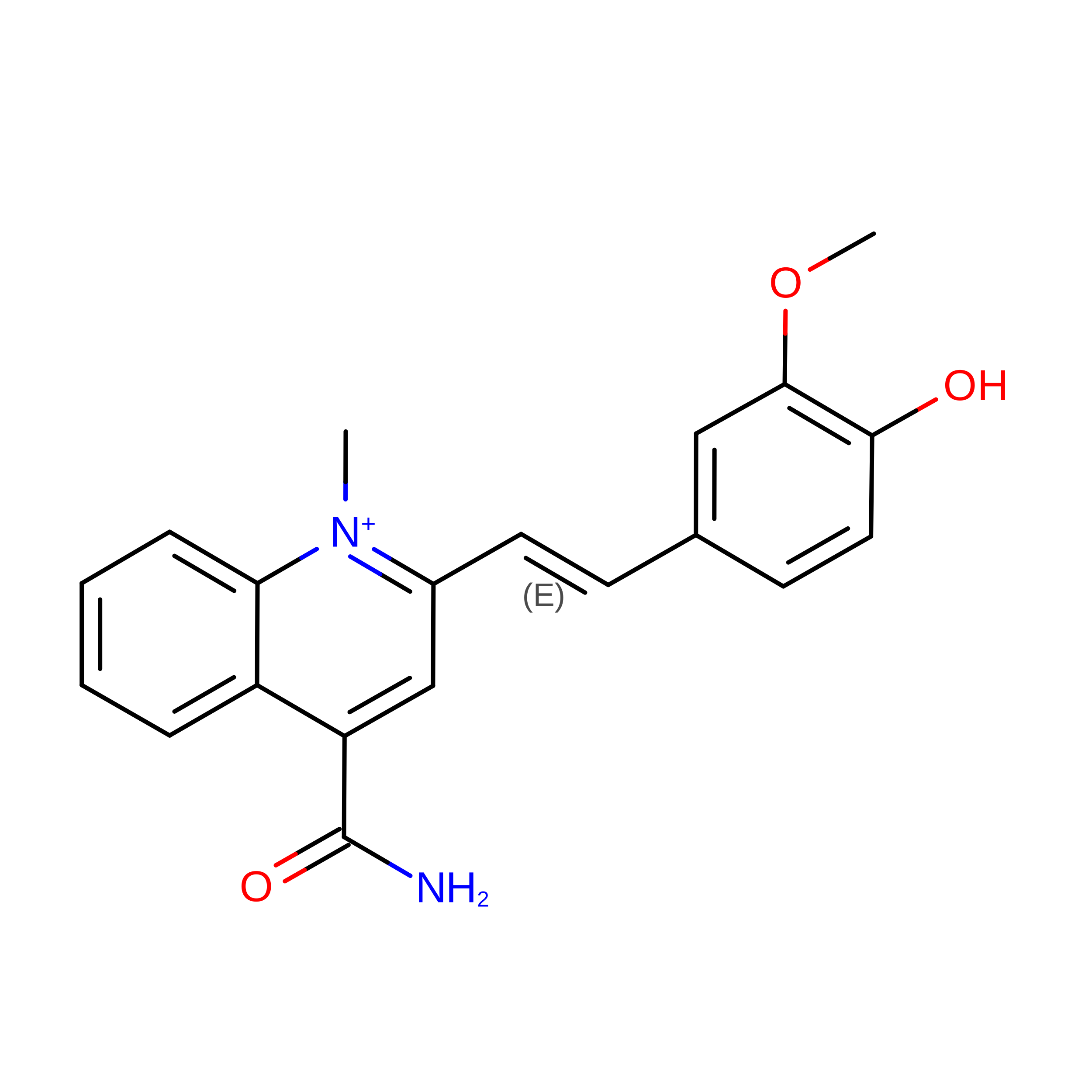
Ligands 1 Unique
IDChains Name / Formula / InChI Key2D Diagram3D Interactions
WAM
(Subject of Investigation/LOI)

Query on WAM


Download:Ideal Coordinates CCD File
B [auth A],
C [auth A]
2-[(~{E})-2-(3-methoxy-4-oxidanyl-phenyl)ethenyl]-1-methyl-quinoline-4-carboxamide
C20 H19 N2 O3
VIXQOJJAMXIXBH-UHFFFAOYSA-O

Experimental Data & Validation

Experimental Data

  • Method: SOLUTION NMR
  • Conformers Calculated: 20 
  • Conformers Submitted: 10 
  • Selection Criteria: structures with the lowest energy 

Structure Validation

View Full Validation Report


Entry History 

& Funding Information

Deposition Data


Funding OrganizationLocationGrant Number
National Institutes of Health/National Cancer Institute (NIH/NCI)United StatesR01CA177585
German Research Foundation (DFG)Germany427347592

Revision History  (Full details and data files)

  • Version 1.0: 2021-06-23
    Type: Initial release
  • Version 1.1: 2024-05-01
    Changes: Data collection, Database references