Download Mendeley
Gut microbiome of the largest living rodent harbors unprecedented enzymatic systems to degrade plant polysaccharides.
Cabral, L., Persinoti, G.F., Paixao, D.A.A., Martins, M.P., Morais, M.A.B., Chinaglia, M., Domingues, M.N., Sforca, M.L., Pirolla, R.A.S., Generoso, W.C., Santos, C.A., Maciel, L.F., Terrapon, N., Lombard, V., Henrissat, B., Murakami, M.T.(2022) Nat Commun 13: 629-629
- PubMed: 35110564 Search on PubMedSearch on PubMed Central
- DOI: https://doi.org/10.1038/s41467-022-28310-y
- Primary Citation Related Structures:
7JVI - PubMed Abstract:
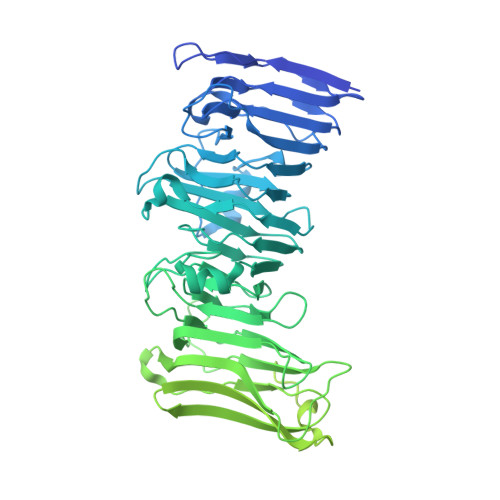
The largest living rodent, capybara, can efficiently depolymerize and utilize lignocellulosic biomass through microbial symbiotic mechanisms yet elusive. Herein, we elucidate the microbial community composition, enzymatic systems and metabolic pathways involved in the conversion of dietary fibers into short-chain fatty acids, a main energy source for the host. In this microbiota, the unconventional enzymatic machinery from Fibrobacteres seems to drive cellulose degradation, whereas a diverse set of carbohydrate-active enzymes from Bacteroidetes, organized in polysaccharide utilization loci, are accounted to tackle complex hemicelluloses typically found in gramineous and aquatic plants. Exploring the genetic potential of this community, we discover a glycoside hydrolase family of β-galactosidases (named as GH173), and a carbohydrate-binding module family (named as CBM89) involved in xylan binding that establishes an unprecedented three-dimensional fold among associated modules to carbohydrate-active enzymes. Together, these results demonstrate how the capybara gut microbiota orchestrates the depolymerization and utilization of plant fibers, representing an untapped reservoir of enzymatic mechanisms to overcome the lignocellulose recalcitrance, a central challenge toward a sustainable and bio-based economy.
- Brazilian Biorenewables National Laboratory, Brazilian Center for Research in Energy and Materials, Campinas, SP, Brazil.
Organizational Affiliation: