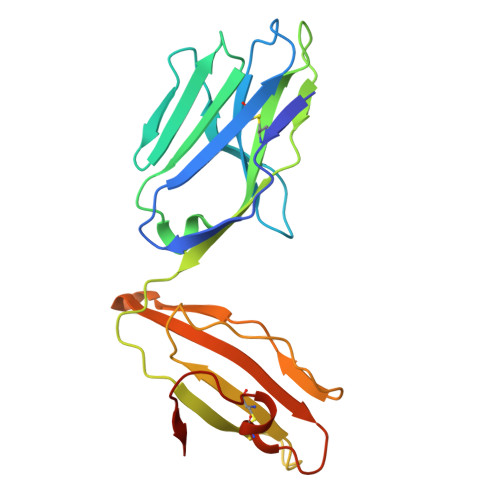
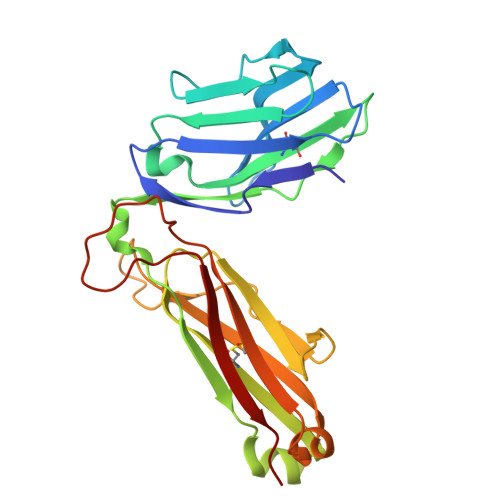
7EA6 | pdb_00007ea6

Crystal structure of TCR-017 ectodomain


Experimental Data Snapshot

  • Method: X-RAY DIFFRACTION
  • Resolution: 2.18 Å
  • R-Value Free: 
    0.276 (Depositor), 0.280 (DCC) 
  • R-Value Work: 
    0.222 (Depositor), 0.220 (DCC) 
  • R-Value Observed: 
    0.224 (Depositor) 

Starting Model: experimental
View more details

wwPDB Validation   3D Report Full Report


This is version 1.3 of the entry. See complete history


Literature

Identification of conserved SARS-CoV-2 spike epitopes that expand public cTfh clonotypes in mild COVID-19 patients.

Lu, X.Hosono, Y.Nagae, M.Ishizuka, S.Ishikawa, E.Motooka, D.Ozaki, Y.Sax, N.Maeda, Y.Kato, Y.Morita, T.Shinnakasu, R.Inoue, T.Onodera, T.Matsumura, T.Shinkai, M.Sato, T.Nakamura, S.Mori, S.Kanda, T.Nakayama, E.E.Shioda, T.Kurosaki, T.Takeda, K.Kumanogoh, A.Arase, H.Nakagami, H.Yamashita, K.Takahashi, Y.Yamasaki, S.

(2021) J Exp Medicine 218

  • DOI: https://doi.org/10.1084/jem.20211327
  • Primary Citation of Related Structures:  
    7EA6

  • PubMed Abstract: 

    Adaptive immunity is a fundamental component in controlling COVID-19. In this process, follicular helper T (Tfh) cells are a subset of CD4+ T cells that mediate the production of protective antibodies; however, the SARS-CoV-2 epitopes activating Tfh cells are not well characterized. Here, we identified and crystallized TCRs of public circulating Tfh (cTfh) clonotypes that are expanded in patients who have recovered from mild symptoms. These public clonotypes recognized the SARS-CoV-2 spike (S) epitopes conserved across emerging variants. The epitope of the most prevalent cTfh clonotype, S864-882, was presented by multiple HLAs and activated T cells in most healthy donors, suggesting that this S region is a universal T cell epitope useful for booster antigen. SARS-CoV-2-specific public cTfh clonotypes also cross-reacted with specific commensal bacteria. In this study, we identified conserved SARS-CoV-2 S epitopes that activate public cTfh clonotypes associated with mild symptoms.


  • Organizational Affiliation
    • Laboratory of Molecular Immunology, Immunology Frontier Research Center, Osaka University, Suita, Japan.

Macromolecules
Find similar proteins by:  (by identity cutoff)  |  3D Structure
Entity ID: 1
MoleculeChains Sequence LengthOrganismDetailsImage
T cell receptor 017 alpha chainA [auth D],
C [auth A]
201Homo sapiensMutation(s): 0 
Entity Groups  
Sequence Clusters30% Identity50% Identity70% Identity90% Identity95% Identity100% Identity
Sequence Annotations
Expand
  • Reference Sequence
Find similar proteins by:  (by identity cutoff)  |  3D Structure
Entity ID: 2
MoleculeChains Sequence LengthOrganismDetailsImage
T cell receptor 017 beta chainB [auth E],
D [auth B]
239Homo sapiensMutation(s): 0 
Entity Groups  
Sequence Clusters30% Identity50% Identity70% Identity90% Identity95% Identity100% Identity
Sequence Annotations
Expand
  • Reference Sequence
Experimental Data & Validation

Experimental Data

  • Method: X-RAY DIFFRACTION
  • Resolution: 2.18 Å
  • R-Value Free:  0.276 (Depositor), 0.280 (DCC) 
  • R-Value Work:  0.222 (Depositor), 0.220 (DCC) 
  • R-Value Observed: 0.224 (Depositor) 
Space Group: C 2 2 21
Unit Cell:
Length ( Å )Angle ( ˚ )
a = 81.049α = 90
b = 81.175β = 90
c = 315.105γ = 90
Software Package:
Software NamePurpose
PHENIXdata reduction
PHENIXrefinement
Cootmodel building
SCALAdata scaling
MOLREPphasing

Structure Validation

View Full Validation Report


Entry History 

Deposition Data

Revision History  (Full details and data files)

  • Version 1.0: 2021-10-13
    Type: Initial release
  • Version 1.1: 2022-02-16
    Changes: Database references
  • Version 1.2: 2023-11-29
    Changes: Data collection, Refinement description
  • Version 1.3: 2024-11-06
    Changes: Structure summary