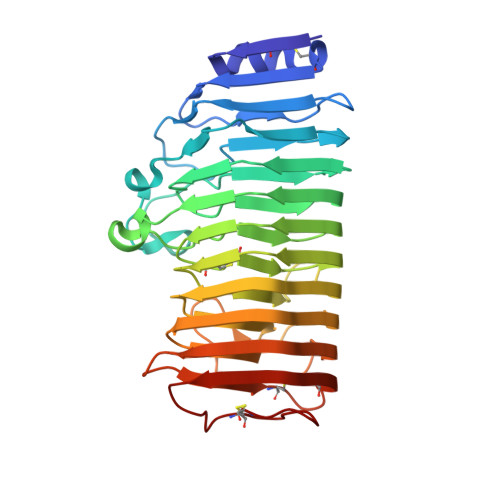
7E56 | pdb_00007e56

The mutant crystal structure of endo-polygalacturonase (T316C/G344C) from Talaromyces leycettanus JCM 12802


Experimental Data Snapshot

  • Method: X-RAY DIFFRACTION
  • Resolution: 1.40 Å
  • R-Value Free: 
    0.173 (Depositor), 0.174 (DCC) 
  • R-Value Work: 
    0.150 (Depositor), 0.151 (DCC) 
  • R-Value Observed: 
    0.151 (Depositor) 

Starting Model: experimental
View more details

wwPDB Validation 3D Report Full Report

Validation slider image for 7E56

This is version 1.3 of the entry. See complete history

Literature

Cysteine Engineering of an Endo-polygalacturonase from Talaromyces leycettanus JCM 12802 to Improve Its Thermostability.

Wang, S.Meng, K.Su, X.Hakulinen, N.Wang, Y.Zhang, J.Luo, H.Yao, B.Huang, H.Tu, T.

(2021) J Agric Food Chem 69: 6351-6359

  • DOI: https://doi.org/10.1021/acs.jafc.1c01618
  • Primary Citation Related Structures: 
    7E56

  • PubMed Abstract: 

    Thermostable enzymes have many advantages for industrial applications. Therefore, in this study, computer-aided design technology was used to improve the thermostability of a highly active endo-polygalacturonase from Talaromyces leycettanus JCM12802 at an optimal temperature of 70 °C. The melting temperature and specific activity of the obtained mutant T316C/G344C were increased by 10 °C and 36.5%, respectively, compared with the wild-type enzyme. The crystal structure of the T316C/G344C mutant showed no formation of a disulfide bond between the introduced cysteines, indicating a different mechanism than the conventional mechanism underlying improved enzyme thermostability. The cysteine substitutions directly formed a new alkyl hydrophobic interaction and caused conformational changes in the side chains of the adjacent residues Asn315 and Thr343, which in turn caused a local reconstruction of hydrogen bonds. This method greatly improved the thermostability of the enzyme without affecting its activity; thus, our findings are of great significance for both theoretical research and practical applications.


  • Organizational Affiliation
    • State Key Laboratory of Animal Nutrition, Institute of Animal Sciences, Chinese Academy of Agricultural Sciences, Beijing 100193, China.

Macromolecule Content 

  • Total Structure Weight: 34.43 kDa 
  • Atom Count: 2,878 
  • Modeled Residue Count: 336 
  • Deposited Residue Count: 336 
  • Unique protein chains: 1

Macromolecules

Find similar proteins by:|  3D Structure
Entity ID: 1
MoleculeChains  Sequence LengthOrganismDetailsImage
Endo-polygalacturonase336Evansstolkia leycettanaMutation(s): 2 
Gene Names: TlPGA
EC: 3.2.1.15
UniProt
Find proteins for A0A6M9BP13 (Evansstolkia leycettana)
Explore A0A6M9BP13 
Go to UniProtKB:  A0A6M9BP13
Entity Groups
Sequence Clusters30% Identity50% Identity70% Identity90% Identity95% Identity100% Identity
UniProt GroupA0A6M9BP13
Sequence Annotations
Expand
Reference Sequence

Experimental Data & Validation

Experimental Data

  • Method: X-RAY DIFFRACTION
  • Resolution: 1.40 Å
  • R-Value Free:  0.173 (Depositor), 0.174 (DCC) 
  • R-Value Work:  0.150 (Depositor), 0.151 (DCC) 
  • R-Value Observed: 0.151 (Depositor) 
Space Group: P 21 21 21
Unit Cell:
Length ( Å )Angle ( ˚ )
a = 44.547α = 90
b = 68.707β = 90
c = 88.319γ = 90
Software Package:
Software NamePurpose
PHENIXrefinement
HKL-2000data reduction
HKL-2000data scaling
PHASERphasing

Structure Validation

View Full Validation Report


Entry History 

& Funding Information

Deposition Data


Funding OrganizationLocationGrant Number
National Natural Science Foundation of China (NSFC)China31702145

Revision History  (Full details and data files)

  • Version 1.0: 2021-08-25
    Type: Initial release
  • Version 1.1: 2022-03-09
    Changes: Database references
  • Version 1.2: 2023-11-29
    Changes: Data collection, Refinement description
  • Version 1.3: 2024-11-13
    Changes: Structure summary