7E0X | pdb_00007e0x

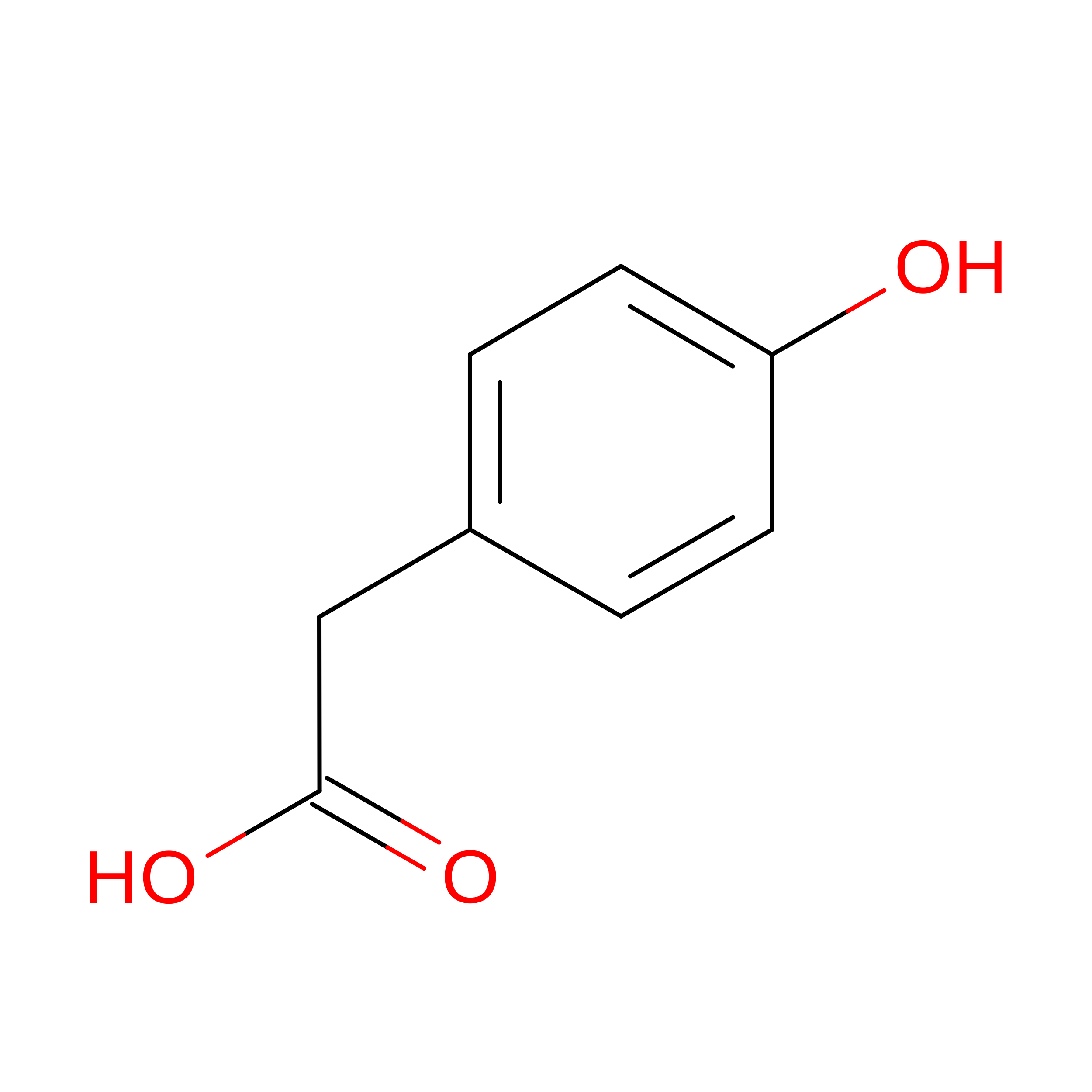
Crystal structure of Arabidopsis thaliana HPPD complexed with 4-hydroxyphenylacetic acid


Experimental Data Snapshot

  • Method: X-RAY DIFFRACTION
  • Resolution: 1.89 Å
  • R-Value Free: 
    0.243 (Depositor), 0.272 (DCC) 
  • R-Value Work: 
    0.205 (Depositor) 
  • R-Value Observed: 
    0.207 (Depositor) 

Starting Model: experimental
View more details

wwPDB Validation 3D Report Full Report

Validation slider image for 7E0X

Ligand Structure Quality Assessment 


This is version 1.2 of the entry. See complete history

Literature

Rational Redesign of Enzyme via the Combination of Quantum Mechanics/Molecular Mechanics, Molecular Dynamics, and Structural Biology Study.

Lin, H.Y.Chen, X.Dong, J.Yang, J.F.Xiao, H.Ye, Y.Li, L.H.Zhan, C.G.Yang, W.C.Yang, G.F.

(2021) J Am Chem Soc 143: 15674-15687

  • DOI: https://doi.org/10.1021/jacs.1c06227
  • Primary Citation Related Structures: 
    7E0X

  • PubMed Abstract: 

    Increasing demands for efficient and versatile chemical reactions have prompted innovations in enzyme engineering. A major challenge in engineering α-ketoglutarate-dependent oxygenases is to develop a rational strategy which can be widely used for directly evolving the desired mutant to generate new products. Herein, we report a strategy for rational redesign of a model enzyme, 4-hydroxyphenylpyruvate dioxygenase (HPPD), based on quantum mechanics/molecular mechanics (QM/MM) calculation and molecular dynamic simulations. This strategy enriched our understanding of the HPPD catalytic reaction pathway and led to the discovery of a series of HPPD mutants producing hydroxyphenylacetate (HPA) as the alternative product other than the native product homogentisate. The predicted HPPD-Fe(IV)═O-HPA intermediate was further confirmed by the crystal structure of Arabidopsis thaliana HPPD/S267W complexed with HPA. These findings not only provide a good understanding of the structure-function relationship of HPPD but also demonstrate a generally applicable platform for the development of biocatalysts.


  • Organizational Affiliation
    • Key Laboratory of Pesticide & Chemical Biology of Ministry of Education, International Joint Research Center for Intelligent Biosensor Technology and Health, College of Chemistry, Central China Normal University, Wuhan 430079, P.R. China.

Macromolecule Content 

  • Total Structure Weight: 45 kDa 
  • Atom Count: 3,051 
  • Modeled Residue Count: 384 
  • Deposited Residue Count: 405 
  • Unique protein chains: 1

Macromolecules

Find similar proteins by:|  3D Structure
Entity ID: 1
MoleculeChains  Sequence LengthOrganismDetailsImage
4-hydroxyphenylpyruvate dioxygenase405Arabidopsis thalianaMutation(s): 1 
Gene Names: HPDPDS1At1g06570F12K11.9
EC: 1.13.11.27
UniProt
Find proteins for P93836 (Arabidopsis thaliana)
Explore P93836 
Go to UniProtKB:  P93836
Entity Groups
Sequence Clusters30% Identity50% Identity70% Identity90% Identity95% Identity100% Identity
UniProt GroupP93836
Sequence Annotations
Expand
Reference Sequence

Small Molecules

Ligands 2 Unique
IDChains Name / Formula / InChI Key2D Diagram3D Interactions
4HP
(Subject of Investigation/LOI)

Query on 4HP


Download:Ideal Coordinates CCD File
C [auth A]4-HYDROXYPHENYLACETATE
C8 H8 O3
XQXPVVBIMDBYFF-UHFFFAOYSA-N
CO
(Subject of Investigation/LOI)

Query on CO


Download:Ideal Coordinates CCD File
B [auth A]COBALT (II) ION
Co
XLJKHNWPARRRJB-UHFFFAOYSA-N

Experimental Data & Validation

Experimental Data

  • Method: X-RAY DIFFRACTION
  • Resolution: 1.89 Å
  • R-Value Free:  0.243 (Depositor), 0.272 (DCC) 
  • R-Value Work:  0.205 (Depositor) 
  • R-Value Observed: 0.207 (Depositor) 
Space Group: C 1 2 1
Unit Cell:
Length ( Å )Angle ( ˚ )
a = 77.026α = 90
b = 83.889β = 99.95
c = 62.753γ = 90
Software Package:
Software NamePurpose
PHENIXrefinement
HKL-2000data reduction
HKL-2000data scaling
PHASERphasing

Structure Validation

View Full Validation Report


Ligand Structure Quality Assessment 


Entry History 

Deposition Data

Revision History  (Full details and data files)

  • Version 1.0: 2021-12-08
    Type: Initial release
  • Version 1.1: 2023-11-29
    Changes: Data collection, Refinement description
  • Version 1.2: 2024-10-16
    Changes: Structure summary