7DLW | pdb_00007dlw

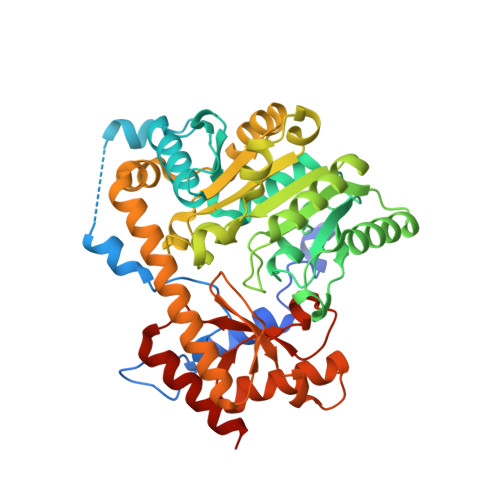
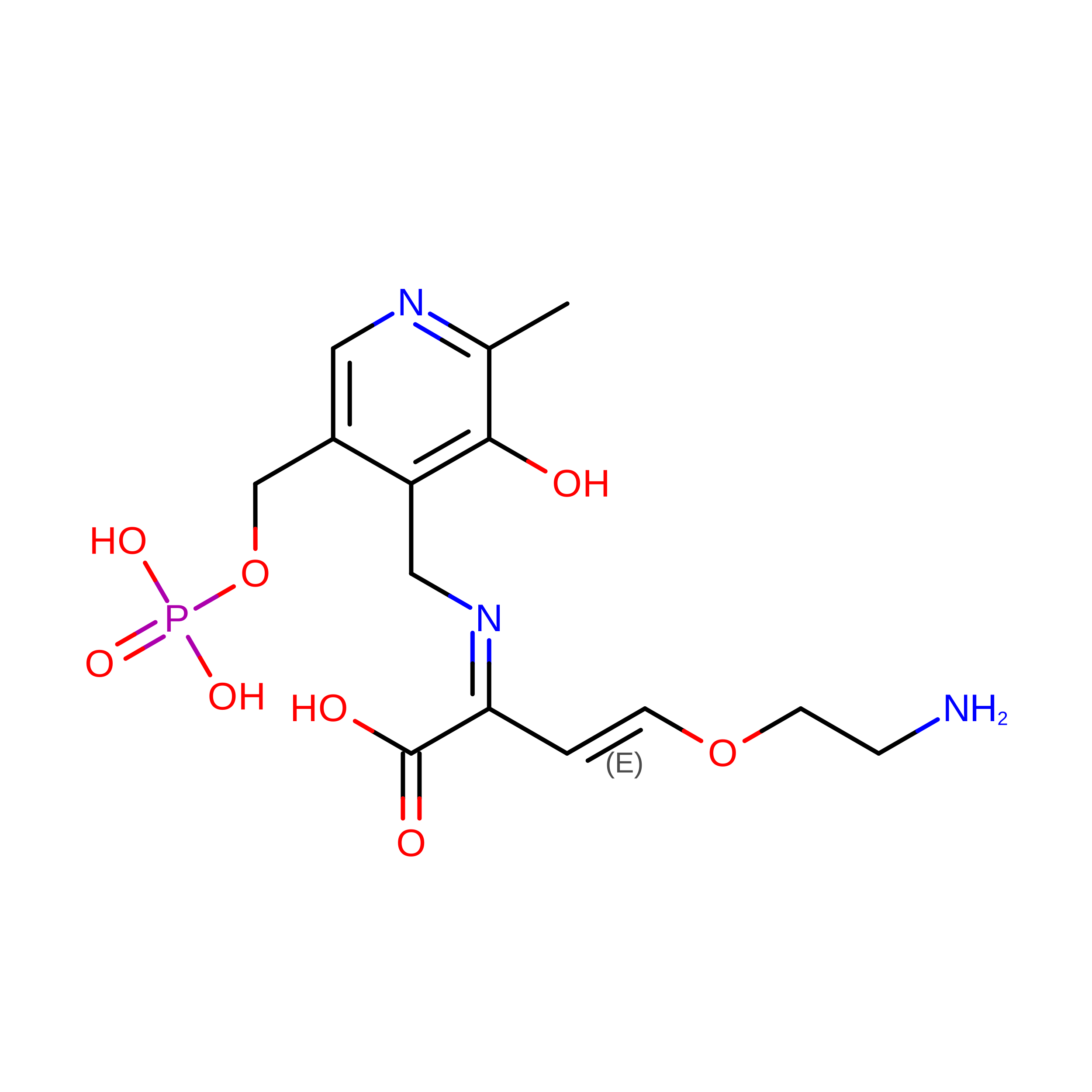
Crystal structure of Arabidopsis ACS7 in complex with PPG


Experimental Data Snapshot

  • Method: X-RAY DIFFRACTION
  • Resolution: 2.19 Å
  • R-Value Free: 
    0.241 (Depositor), 0.241 (DCC) 
  • R-Value Work: 
    0.193 (Depositor), 0.193 (DCC) 
  • R-Value Observed: 
    0.195 (Depositor) 

Starting Model: experimental
View more details

wwPDB Validation 3D Report Full Report

Validation slider image for 7DLW

Ligand Structure Quality Assessment 


This is version 1.2 of the entry. See complete history

Literature

Dual activities of ACC synthase: Novel clues regarding the molecular evolution of ACS genes.

Xu, C.Hao, B.Sun, G.Mei, Y.Sun, L.Sun, Y.Wang, Y.Zhang, Y.Zhang, W.Zhang, M.Zhang, Y.Wang, D.Rao, Z.Li, X.Shen, Q.J.Wang, N.N.

(2021) Sci Adv 7: eabg8752-eabg8752

  • DOI: https://doi.org/10.1126/sciadv.abg8752
  • Primary Citation Related Structures: 
    7DLW, 7DLY

  • PubMed Abstract: 

    Ethylene plays profound roles in plant development. The rate-limiting enzyme of ethylene biosynthesis is 1-aminocyclopropane-1-carboxylate (ACC) synthase (ACS), which is generally believed to be a single-activity enzyme evolving from aspartate aminotransferases. Here, we demonstrate that, in addition to catalyzing the conversion of S -adenosyl-methionine to the ethylene precursor ACC, genuine ACSs widely have C β -S lyase activity. Two N-terminal motifs, including a glutamine residue, are essential for conferring ACS activity to ACS-like proteins. Motif and activity analyses of ACS-like proteins from plants at different evolutionary stages suggest that the ACC-dependent pathway is uniquely developed in seed plants. A putative catalytic mechanism for the dual activities of ACSs is proposed on the basis of the crystal structure and biochemical data. These findings not only expand our current understanding of ACS functions but also provide novel insights into the evolutionary origin of ACS genes.


  • Organizational Affiliation
    • Department of Plant Biology and Ecology, Tianjin Key Laboratory of Protein Sciences, College of Life Sciences, Nankai University, Tianjin 300071, China.

Macromolecule Content 

  • Total Structure Weight: 204.57 kDa 
  • Atom Count: 13,595 
  • Modeled Residue Count: 1,654 
  • Deposited Residue Count: 1,788 
  • Unique protein chains: 1

Macromolecules

Find similar proteins by:|  3D Structure
Entity ID: 1
MoleculeChains  Sequence LengthOrganismDetailsImage
1-aminocyclopropane-1-carboxylate synthase 7
A, B, C, D
447Arabidopsis thalianaMutation(s): 0 
Gene Names: ACS7At4g26200T25K17.10
EC: 4.4.1.14
UniProt
Find proteins for Q9STR4 (Arabidopsis thaliana)
Explore Q9STR4 
Go to UniProtKB:  Q9STR4
Entity Groups
Sequence Clusters30% Identity50% Identity70% Identity90% Identity95% Identity100% Identity
UniProt GroupQ9STR4
Sequence Annotations
Expand
Reference Sequence

Experimental Data & Validation

Experimental Data

  • Method: X-RAY DIFFRACTION
  • Resolution: 2.19 Å
  • R-Value Free:  0.241 (Depositor), 0.241 (DCC) 
  • R-Value Work:  0.193 (Depositor), 0.193 (DCC) 
  • R-Value Observed: 0.195 (Depositor) 
Space Group: P 1
Unit Cell:
Length ( Å )Angle ( ˚ )
a = 66.877α = 97.7
b = 69.353β = 94.97
c = 85.4γ = 106.5
Software Package:
Software NamePurpose
PHENIXrefinement
PDB_EXTRACTdata extraction
HKL-2000data reduction
HKL-2000data scaling
PHENIXphasing

Structure Validation

View Full Validation Report


Ligand Structure Quality Assessment 


Entry History 

Deposition Data

Revision History  (Full details and data files)

  • Version 1.0: 2021-09-29
    Type: Initial release
  • Version 1.1: 2022-02-23
    Changes: Database references
  • Version 1.2: 2023-11-29
    Changes: Data collection, Refinement description