7C0N | pdb_00007c0n

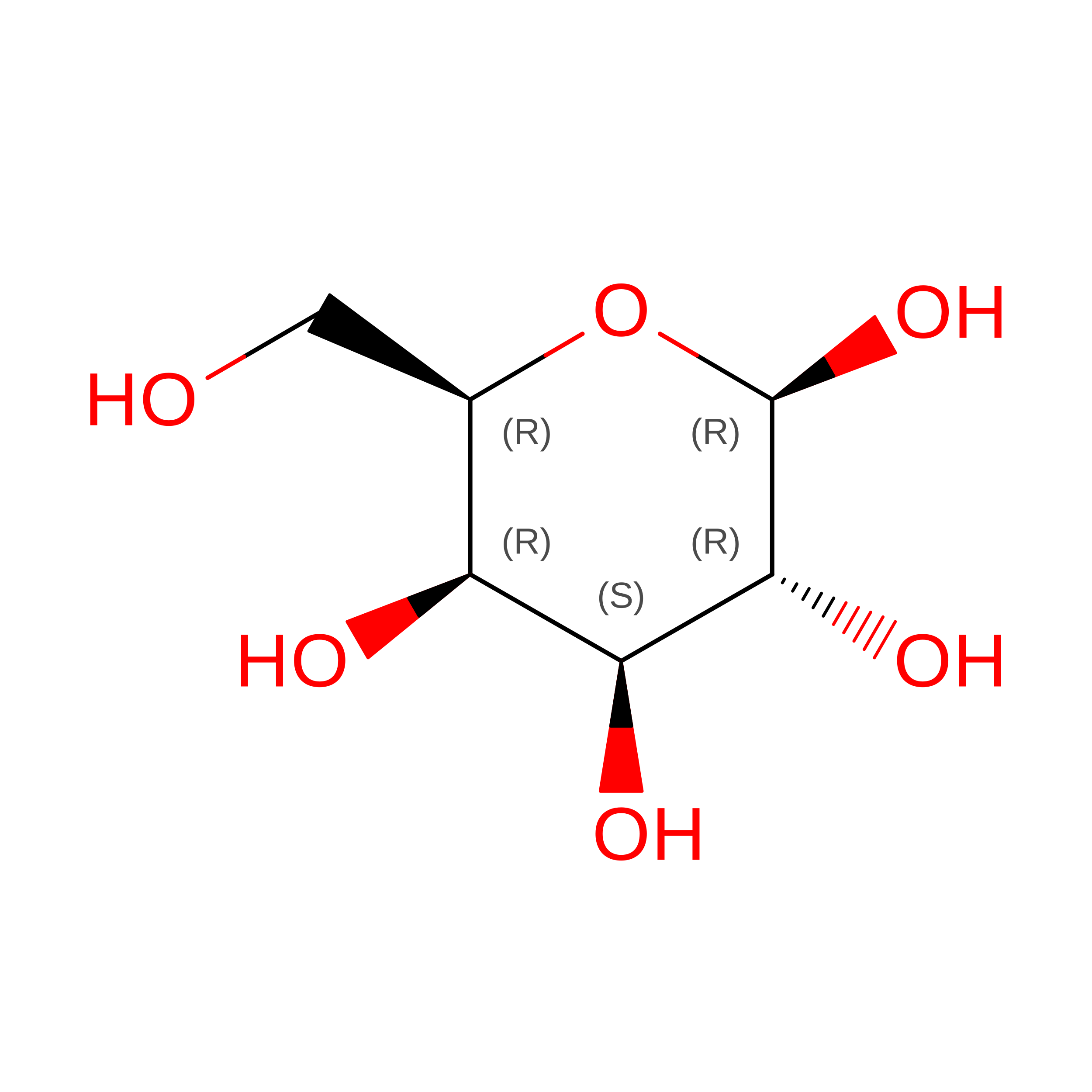
Crystal structure of a self-assembling galactosylated peptide homodimer


Experimental Data Snapshot

  • Method: X-RAY DIFFRACTION
  • Resolution: 1.55 Å
  • R-Value Free: 
    0.249 (Depositor), 0.258 (DCC) 
  • R-Value Work: 
    0.234 (Depositor), 0.233 (DCC) 

wwPDB Validation 3D Report Full Report

Validation slider image for 7C0N

Ligand Structure Quality Assessment 


This is version 1.2 of the entry. See complete history

Literature

Glycopeptide Self-Assembly Modulated by Glycan Stereochemistry through Glycan-Aromatic Interactions.

He, C.Wu, S.Liu, D.Chi, C.Zhang, W.Ma, M.Lai, L.Dong, S.

(2020) J Am Chem Soc 142: 17015-17023

  • DOI: https://doi.org/10.1021/jacs.0c06360
  • Primary Citation Related Structures: 
    7C0N

  • PubMed Abstract: 

    Carbohydrates are often utilized to provide hydrophilicity and hydroxyl-based hydrogen bonds in self-assembling glycopeptides, affording versatile scaffolds with wide applicability in biomedical research. However, how stereochemistry of carbohydrates impacts the self-assembly process remains unclear. Here we have established a dimeric tyrosine-rich glycopeptide system for probing the corresponding hydrogelating behavior under the influence of site- and stereospecific glycosylations. Comparison of 18 glycoforms bearing monosaccharides at Tyr 4 and Tyr 4' shows that the glycopeptides with either α- or β-anomers exhibit contrary gelating abilities, when the glycan moieties contain axial hydroxyl groups. A high-resolution X-ray crystallographic structure of the β-galactose-containing gelator, along with other results from spectroscopic, microscopic, and rheological experiments, indicate an unusual carbohydrate-aromatic CH-π bonding that promotes glycopeptide self-assembly. These mechanistic findings, particularly evidence obtained at the angstrom scale, illuminate an unconventional role that carbohydrates can play in building supramolecules. Potential biomaterials exploiting the CH-π bond-based stabilization, as exemplified by an enzyme-resistant hydrogel, may thus be developed.

Macromolecule Content 

  • Total Structure Weight: 2 kDa 
  • Atom Count: 138 
  • Modeled Residue Count: 10 
  • Deposited Residue Count: 10 
  • Unique protein chains: 1

Macromolecules

Find similar proteins by:  Sequence   |   3D Structure  
Entity ID: 1
MoleculeChains  Sequence LengthOrganismDetailsImage
Self-assembling galactosylated tyrosine-rich peptide
A, B
5synthetic constructMutation(s): 0 

Experimental Data & Validation

Experimental Data

  • Method: X-RAY DIFFRACTION
  • Resolution: 1.55 Å
  • R-Value Free:  0.249 (Depositor), 0.258 (DCC) 
  • R-Value Work:  0.234 (Depositor), 0.233 (DCC) 
Space Group: F 41 3 2
Unit Cell:
Length ( Å )Angle ( ˚ )
a = 72.837α = 90
b = 72.837β = 90
c = 72.837γ = 90
Software Package:
Software NamePurpose
PHENIXrefinement
HKL-2000data reduction
HKL-2000data scaling
PHENIXphasing

Structure Validation

View Full Validation Report


Ligand Structure Quality Assessment 


Entry History 

& Funding Information

Deposition Data


Funding OrganizationLocationGrant Number
Ministry of Science and Technology (MoST, China)China2018YFA0507602
Ministry of Science and Technology (MoST, China)China2019ZX09301-106
National Natural Science Foundation of China (NSFC)China21822701

Revision History  (Full details and data files)

  • Version 1.0: 2020-10-07
    Type: Initial release
  • Version 1.1: 2020-10-21
    Changes: Database references
  • Version 1.2: 2024-10-23
    Changes: Data collection, Database references, Structure summary