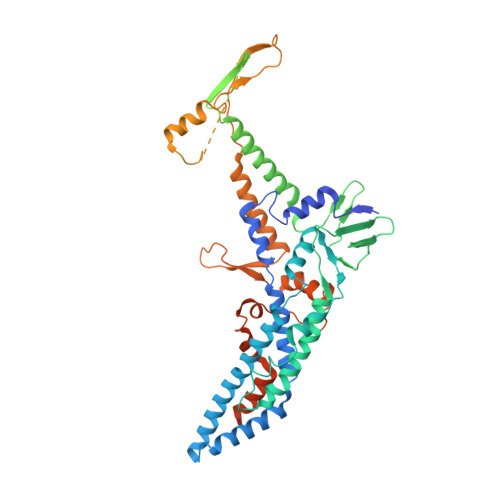
7BQT | pdb_00007bqt

Epstein-Barr virus, C12 portal dodecamer

  • Classification: VIRAL PROTEIN
  • Organism(s): Human herpesvirus 4 strain B95-8
  • Mutation(s): No 

  • Deposited: 2020-03-25 Released: 2020-09-30 
  • Deposition Author(s): Li, Z., Yu, X.
  • Funding Organization(s): National Natural Science Foundation of China (NSFC), Ministry of Science and Technology (MoST, China)

Experimental Data Snapshot

  • Method: ELECTRON MICROSCOPY
  • Resolution: 4.80 Å
  • Aggregation State: PARTICLE 
  • Reconstruction Method: SINGLE PARTICLE 

wwPDB Validation 3D Report Full Report

Validation slider image for 7BQT

This is version 1.3 of the entry. See complete history

Literature

CryoEM structure of the tegumented capsid of Epstein-Barr virus.

Li, Z.Zhang, X.Dong, L.Pang, J.Xu, M.Zhong, Q.Zeng, M.S.Yu, X.

(2020) Cell Res 30: 873-884

  • DOI: https://doi.org/10.1038/s41422-020-0363-0
  • Primary Citation Related Structures: 
    7BQT, 7BQX, 7BR7, 7BR8, 7BSI

  • PubMed Abstract: 

    Epstein-Barr virus (EBV) is the primary cause of infectious mononucleosis and has been shown to be closely associated with various malignancies. Here, we present a complete atomic model of EBV, including the icosahedral capsid, the dodecameric portal and the capsid-associated tegument complex (CATC). Our in situ portal from the tegumented capsid adopts a closed conformation with its channel valve holding the terminal viral DNA and with its crown region firmly engaged by three layers of ring-like dsDNA, which, together with the penton flexibility, effectively alleviates the capsid inner pressure placed on the portal cap. In contrast, the CATCs, through binding to the flexible penton vertices in a stoichiometric manner, accurately increase the inner capsid pressure to facilitate the pressure-driven genome delivery. Together, our results provide important insights into the mechanism by which the EBV capsid, portal, packaged genome and the CATCs coordinately achieve a pressure balance to simultaneously benefit both viral genome retention and ejection.


  • Organizational Affiliation
    • Cryo-Electron Microscopy Research Center, The CAS Key Laboratory of Receptor Research, Shanghai Institute of Materia Medica, Chinese Academy of Sciences, Shanghai, 201203, China.

Macromolecule Content 

  • Total Structure Weight: 822.48 kDa 
  • Atom Count: 39,180 
  • Modeled Residue Count: 4,860 
  • Deposited Residue Count: 7,356 
  • Unique protein chains: 1

Macromolecules

Find similar proteins by:|  3D Structure
Entity ID: 1
MoleculeChains  Sequence LengthOrganismDetailsImage
Portal protein613Human herpesvirus 4 strain B95-8Mutation(s): 0 
UniProt
Find proteins for P03213 (Epstein-Barr virus (strain B95-8))
Explore P03213 
Go to UniProtKB:  P03213
Entity Groups
Sequence Clusters30% Identity50% Identity70% Identity90% Identity95% Identity100% Identity
UniProt GroupP03213
Sequence Annotations
Expand
Reference Sequence

Experimental Data & Validation

Experimental Data

  • Method: ELECTRON MICROSCOPY
  • Resolution: 4.80 Å
  • Aggregation State: PARTICLE 
  • Reconstruction Method: SINGLE PARTICLE 
EM Software:
TaskSoftware PackageVersion
MODEL REFINEMENTPHENIX
RECONSTRUCTIONRELION3.0

Structure Validation

View Full Validation Report


Entry History 

& Funding Information

Deposition Data

  • Released Date: 2020-09-30 
  • Deposition Author(s): Li, Z., Yu, X.

Funding OrganizationLocationGrant Number
National Natural Science Foundation of China (NSFC)China31900869
National Natural Science Foundation of China (NSFC)China81830090
National Natural Science Foundation of China (NSFC)China81702001
Ministry of Science and Technology (MoST, China)China2017YFA0505600
Ministry of Science and Technology (MoST, China)China2016YFA0502101

Revision History  (Full details and data files)

  • Version 1.0: 2020-09-30
    Type: Initial release
  • Version 1.1: 2020-10-14
    Changes: Database references
  • Version 1.2: 2024-03-27
    Changes: Data collection, Database references
  • Version 1.3: 2025-07-02
    Changes: Data collection, Structure summary