7BNT | pdb_00007bnt

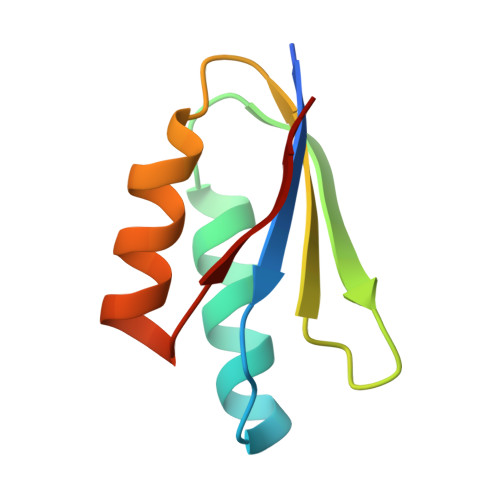
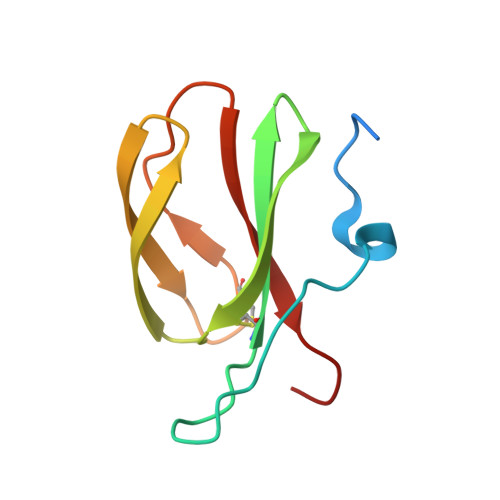
Complex of rice blast (Magnaporthe oryzae) effector protein AVR-PikD with a predicted ancestral HMA domain of Pik-1 from Oryza spp.


Experimental Data Snapshot

  • Method: X-RAY DIFFRACTION
  • Resolution: 1.32 Å
  • R-Value Free: 
    0.184 (Depositor), 0.192 (DCC) 
  • R-Value Work: 
    0.145 (Depositor) 
  • R-Value Observed: 
    0.147 (Depositor) 

Starting Model: experimental
View more details

wwPDB Validation 3D Report Full Report

Validation slider image for 7BNT

This is version 1.3 of the entry. See complete history

Literature

Two NLR immune receptors acquired high-affinity binding to a fungal effector through convergent evolution of their integrated domain.

Bialas, A.Langner, T.Harant, A.Contreras, M.P.Stevenson, C.E.Lawson, D.M.Sklenar, J.Kellner, R.Moscou, M.J.Terauchi, R.Banfield, M.J.Kamoun, S.

(2021) Elife 10

  • DOI: https://doi.org/10.7554/eLife.66961
  • Primary Citation Related Structures: 
    7BNT

  • PubMed Abstract: 

    A subset of plant NLR immune receptors carry unconventional integrated domains in addition to their canonical domain architecture. One example is rice Pik-1 that comprises an integrated heavy metal-associated (HMA) domain. Here, we reconstructed the evolutionary history of Pik-1 and its NLR partner, Pik-2, and tested hypotheses about adaptive evolution of the HMA domain. Phylogenetic analyses revealed that the HMA domain integrated into Pik-1 before Oryzinae speciation over 15 million years ago and has been under diversifying selection. Ancestral sequence reconstruction coupled with functional studies showed that two Pik-1 allelic variants independently evolved from a weakly binding ancestral state to high-affinity binding of the blast fungus effector AVR-PikD. We conclude that for most of its evolutionary history the Pik-1 HMA domain did not sense AVR-PikD, and that different Pik-1 receptors have recently evolved through distinct biochemical paths to produce similar phenotypic outcomes. These findings highlight the dynamic nature of the evolutionary mechanisms underpinning NLR adaptation to plant pathogens.


  • Organizational Affiliation
    • The Sainsbury Laboratory, University of East Anglia, Norwich Research Park, Norwich, United Kingdom.

Macromolecule Content 

  • Total Structure Weight: 26.57 kDa 
  • Atom Count: 2,054 
  • Modeled Residue Count: 230 
  • Deposited Residue Count: 244 
  • Unique protein chains: 2

Macromolecules

Find similar proteins by:|  3D Structure
Entity ID: 1
MoleculeChains  Sequence LengthOrganismDetailsImage
Predicted ancestral HMA domain of Pik-1 from Oryza spp.
A, B
75synthetic constructMutation(s): 0 
Find similar proteins by:|  3D Structure
Entity ID: 2
MoleculeChains  Sequence LengthOrganismDetailsImage
AVR-Pik protein94Pyricularia oryzaeMutation(s): 0 
Gene Names: AVR-PikAvrPikPikmPikp
UniProt
Find proteins for C4B8B8 (Pyricularia oryzae)
Explore C4B8B8 
Go to UniProtKB:  C4B8B8
Entity Groups
Sequence Clusters30% Identity50% Identity70% Identity90% Identity95% Identity100% Identity
UniProt GroupC4B8B8
Sequence Annotations
Expand
Reference Sequence

Experimental Data & Validation

Experimental Data

  • Method: X-RAY DIFFRACTION
  • Resolution: 1.32 Å
  • R-Value Free:  0.184 (Depositor), 0.192 (DCC) 
  • R-Value Work:  0.145 (Depositor) 
  • R-Value Observed: 0.147 (Depositor) 
Space Group: P 41 21 2
Unit Cell:
Length ( Å )Angle ( ˚ )
a = 119.486α = 90
b = 119.486β = 90
c = 35.974γ = 90
Software Package:
Software NamePurpose
REFMACrefinement
Aimlessdata reduction
DIALSdata reduction
DIALSdata scaling
REFMACphasing

Structure Validation

View Full Validation Report


Entry History 

& Funding Information

Deposition Data


Funding OrganizationLocationGrant Number
European Research Council (ERC)Belgium743165
Biotechnology and Biological Sciences Research Council (BBSRC)United KingdomBB/M011216/1
Biotechnology and Biological Sciences Research Council (BBSRC)United KingdomBB/P012574/1

Revision History  (Full details and data files)

  • Version 1.0: 2021-02-17
    Type: Initial release
  • Version 1.1: 2021-08-04
    Changes: Database references
  • Version 1.2: 2024-01-31
    Changes: Data collection, Database references, Derived calculations, Refinement description
  • Version 1.3: 2024-10-09
    Changes: Structure summary