7B1I | pdb_00007b1i

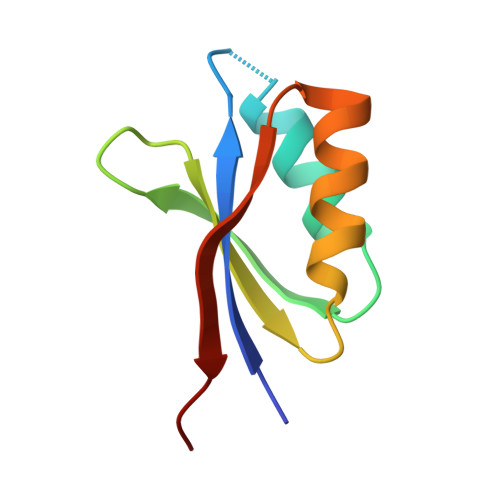
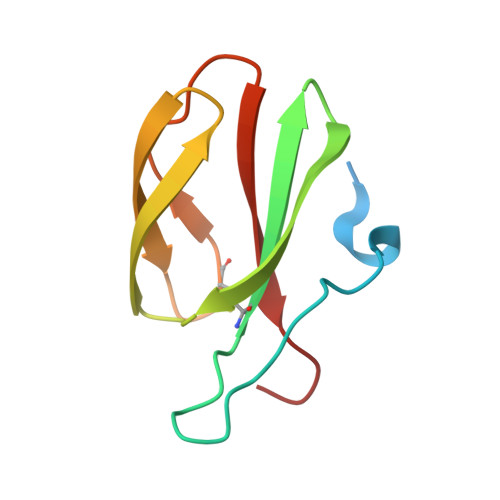
Complex of rice blast (Magnaporthe oryzae) effector protein AVR-PikF with the HMA domain of OsHIPP19 from rice (Oryza sativa)


Experimental Data Snapshot

  • Method: X-RAY DIFFRACTION
  • Resolution: 1.90 Å
  • R-Value Free: 
    0.233 (Depositor), 0.239 (DCC) 
  • R-Value Work: 
    0.196 (Depositor), 0.204 (DCC) 
  • R-Value Observed: 
    0.198 (Depositor) 

Starting Model: experimental
View more details

wwPDB Validation 3D Report Full Report

Validation slider image for 7B1I

This is version 1.4 of the entry. See complete history

Literature

Multiple variants of the fungal effector AVR-Pik bind the HMA domain of the rice protein OsHIPP19, providing a foundation to engineer plant defense.

Maidment, J.H.R.Franceschetti, M.Maqbool, A.Saitoh, H.Jantasuriyarat, C.Kamoun, S.Terauchi, R.Banfield, M.J.

(2021) J Biological Chem 296: 100371-100371

  • DOI: https://doi.org/10.1016/j.jbc.2021.100371
  • Primary Citation Related Structures: 
    7B1I

  • PubMed Abstract: 

    Microbial plant pathogens secrete effector proteins, which manipulate the host to promote infection. Effectors can be recognized by plant intracellular nucleotide-binding leucine-rich repeat (NLR) receptors, initiating an immune response. The AVR-Pik effector from the rice blast fungus Magnaporthe oryzae is recognized by a pair of rice NLR receptors, Pik-1 and Pik-2. Pik-1 contains a noncanonical integrated heavy-metal-associated (HMA) domain, which directly binds AVR-Pik to activate plant defenses. The host targets of AVR-Pik are also HMA-domain-containing proteins, namely heavy-metal-associated isoprenylated plant proteins (HIPPs) and heavy-metal-associated plant proteins (HPPs). Here, we demonstrate that one of these targets interacts with a wider set of AVR-Pik variants compared with the Pik-1 HMA domains. We define the biochemical and structural basis of the interaction between AVR-Pik and OsHIPP19 and compare the interaction to that formed with the HMA domain of Pik-1. Using analytical gel filtration and surface plasmon resonance, we show that multiple AVR-Pik variants, including the stealthy variants AVR-PikC and AVR-PikF, which do not interact with any characterized Pik-1 alleles, bind to OsHIPP19 with nanomolar affinity. The crystal structure of OsHIPP19 in complex with AVR-PikF reveals differences at the interface that underpin high-affinity binding of OsHIPP19-HMA to a wider set of AVR-Pik variants than achieved by the integrated HMA domain of Pik-1. Our results provide a foundation for engineering the HMA domain of Pik-1 to extend binding to currently unrecognized AVR-Pik variants and expand disease resistance in rice to divergent pathogen strains.


  • Organizational Affiliation
    • Department of Biological Chemistry, John Innes Centre, Norwich Research Park, Norwich, UK.

Macromolecule Content 

  • Total Structure Weight: 19.19 kDa 
  • Atom Count: 1,294 
  • Modeled Residue Count: 155 
  • Deposited Residue Count: 172 
  • Unique protein chains: 2

Macromolecules

Find similar proteins by:|  3D Structure
Entity ID: 1
MoleculeChains  Sequence LengthOrganismDetailsImage
OSIGBa0128P10.9 proteinA [auth B]78Oryza sativaMutation(s): 0 
Gene Names: OSIGBa0150F01.4OSIGBa0128P10.9
UniProt
Find proteins for Q01IL6 (Oryza sativa)
Explore Q01IL6 
Go to UniProtKB:  Q01IL6
Entity Groups
Sequence Clusters30% Identity50% Identity70% Identity90% Identity95% Identity100% Identity
UniProt GroupQ01IL6
Sequence Annotations
Expand
Reference Sequence
Find similar proteins by:|  3D Structure
Entity ID: 2
MoleculeChains  Sequence LengthOrganismDetailsImage
AVR-Pik proteinB [auth C]94Pyricularia oryzaeMutation(s): 0 
Gene Names: AVR-PikAvrPikPikmPikp
UniProt
Find proteins for A0A219T3Y8 (Pyricularia oryzae)
Explore A0A219T3Y8 
Go to UniProtKB:  A0A219T3Y8
Entity Groups
Sequence Clusters30% Identity50% Identity70% Identity90% Identity95% Identity100% Identity
UniProt GroupA0A219T3Y8
Sequence Annotations
Expand
Reference Sequence

Experimental Data & Validation

Experimental Data

  • Method: X-RAY DIFFRACTION
  • Resolution: 1.90 Å
  • R-Value Free:  0.233 (Depositor), 0.239 (DCC) 
  • R-Value Work:  0.196 (Depositor), 0.204 (DCC) 
  • R-Value Observed: 0.198 (Depositor) 
Space Group: P 21 21 21
Unit Cell:
Length ( Å )Angle ( ˚ )
a = 29.783α = 90
b = 53.782β = 90
c = 98.026γ = 90
Software Package:
Software NamePurpose
XDSdata reduction
Aimlessdata scaling
PHASERphasing
REFMACrefinement
PDB_EXTRACTdata extraction

Structure Validation

View Full Validation Report


Entry History 

& Funding Information

Deposition Data


Funding OrganizationLocationGrant Number
Biotechnology and Biological Sciences Research Council (BBSRC)United KingdomBB/M011216/1

Revision History  (Full details and data files)

  • Version 1.0: 2021-02-03
    Type: Initial release
  • Version 1.1: 2021-02-24
    Changes: Database references
  • Version 1.2: 2021-07-21
    Changes: Database references
  • Version 1.3: 2024-01-31
    Changes: Data collection, Database references, Refinement description
  • Version 1.4: 2024-11-13
    Changes: Structure summary