7ABR | pdb_00007abr

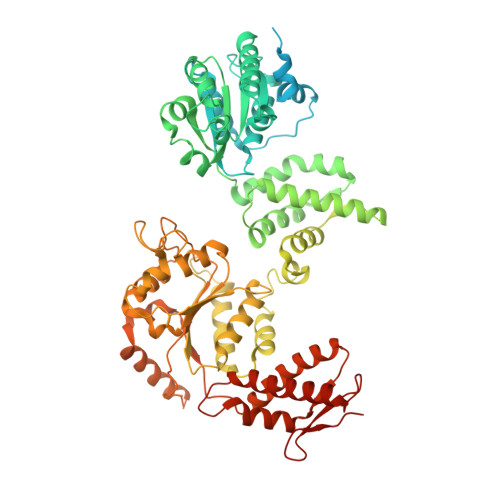
Cryo-EM structure of B. subtilis ClpC (DWB mutant) hexamer bound to a substrate polypeptide


Experimental Data Snapshot

  • Method: ELECTRON MICROSCOPY
  • Resolution: 3.70 Å
  • Aggregation State: PARTICLE 
  • Reconstruction Method: SINGLE PARTICLE 

wwPDB Validation 3D Report Full Report

Validation slider image for 7ABR

This is version 1.3 of the entry. See complete history

Literature

BacPROTACs mediate targeted protein degradation in bacteria.

Morreale, F.E.Kleine, S.Leodolter, J.Junker, S.Hoi, D.M.Ovchinnikov, S.Okun, A.Kley, J.Kurzbauer, R.Junk, L.Guha, S.Podlesainski, D.Kazmaier, U.Boehmelt, G.Weinstabl, H.Rumpel, K.Schmiedel, V.M.Hartl, M.Haselbach, D.Meinhart, A.Kaiser, M.Clausen, T.

(2022) Cell 185: 2338

  • DOI: https://doi.org/10.1016/j.cell.2022.05.009
  • Primary Citation Related Structures: 
    7AA4, 7ABR

  • PubMed Abstract: 

    Hijacking the cellular protein degradation system offers unique opportunities for drug discovery, as exemplified by proteolysis-targeting chimeras. Despite their great promise for medical chemistry, so far, it has not been possible to reprogram the bacterial degradation machinery to interfere with microbial infections. Here, we develop small-molecule degraders, so-called BacPROTACs, that bind to the substrate receptor of the ClpC:ClpP protease, priming neo-substrates for degradation. In addition to their targeting function, BacPROTACs activate ClpC, transforming the resting unfoldase into its functional state. The induced higher-order oligomer was visualized by cryo-EM analysis, providing a structural snapshot of activated ClpC unfolding a protein substrate. Finally, drug susceptibility and degradation assays performed in mycobacteria demonstrate in vivo activity of BacPROTACs, allowing selective targeting of endogenous proteins via fusion to an established degron. In addition to guiding antibiotic discovery, the BacPROTAC technology presents a versatile research tool enabling the inducible degradation of bacterial proteins.


  • Organizational Affiliation
    • Research Institute of Molecular Pathology, Vienna Biocenter, 1030 Vienna, Austria.

Macromolecule Content 

  • Total Structure Weight: 554.73 kDa 
  • Atom Count: 27,209 
  • Modeled Residue Count: 3,445 
  • Deposited Residue Count: 4,934 
  • Unique protein chains: 2

Macromolecules

Find similar proteins by:|  3D Structure
Entity ID: 1
MoleculeChains  Sequence LengthOrganismDetailsImage
Negative regulator of genetic competence ClpC/MecB
A, B, C, D, E
A, B, C, D, E, F
818Bacillus subtilis subsp. subtilis str. 168Mutation(s): 2 
Gene Names: clpCmecBBSU00860
UniProt
Find proteins for P37571 (Bacillus subtilis (strain 168))
Explore P37571 
Go to UniProtKB:  P37571
Entity Groups
Sequence Clusters30% Identity50% Identity70% Identity90% Identity95% Identity100% Identity
UniProt GroupP37571
Sequence Annotations
Expand
Reference Sequence
Find similar proteins by:|  3D Structure
Entity ID: 2
MoleculeChains  Sequence LengthOrganismDetailsImage
substrate polypeptideG [auth S]26unidentifiedMutation(s): 0 

Small Molecules

Ligands 2 Unique
IDChains Name / Formula / InChI Key2D Diagram3D Interactions
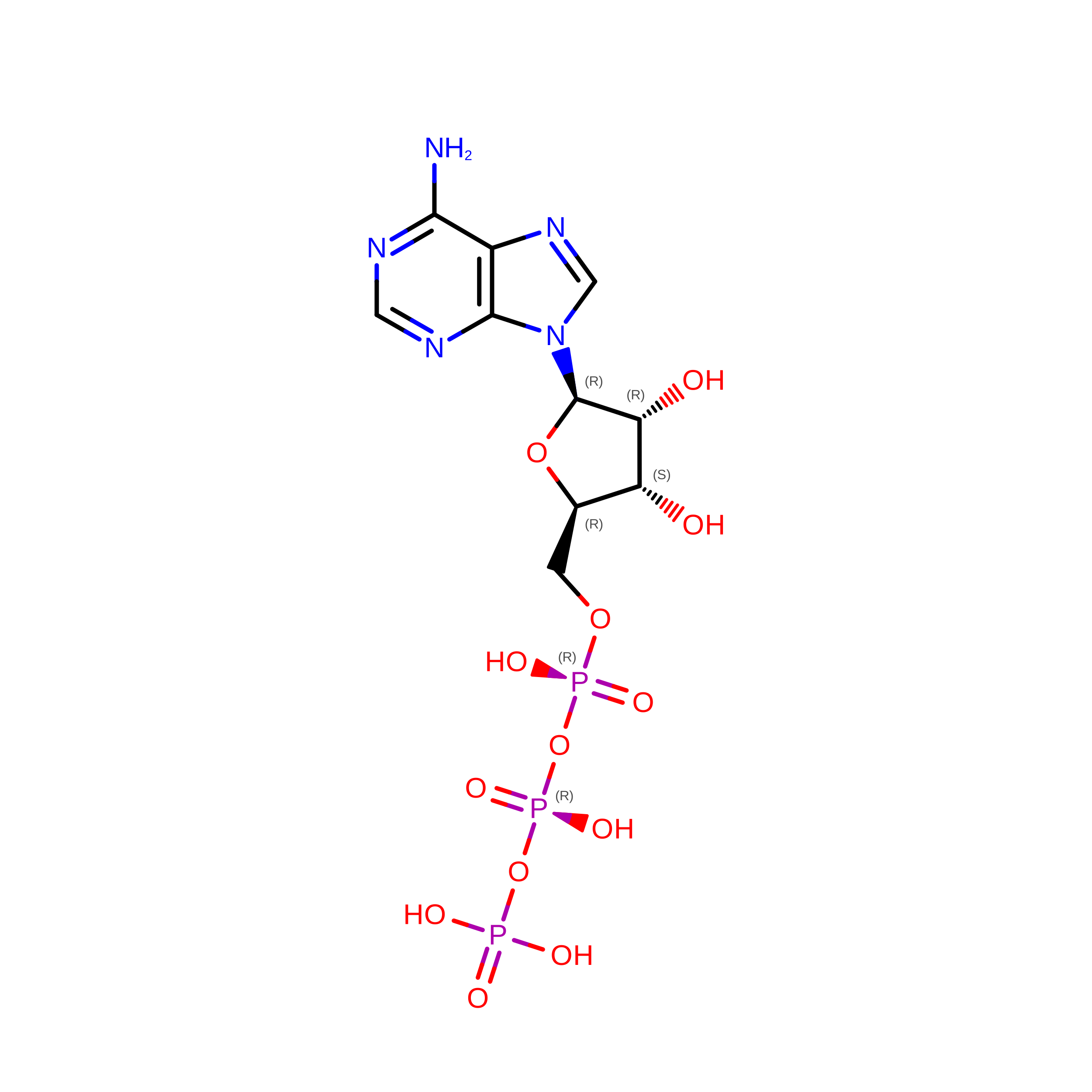
ATP

Query on ATP


Download:Ideal Coordinates CCD File
J [auth A]
L [auth C]
M [auth C]
N [auth D]
O [auth D]
J [auth A],
L [auth C],
M [auth C],
N [auth D],
O [auth D],
P [auth D],
Q [auth E]
ADENOSINE-5'-TRIPHOSPHATE
C10 H16 N5 O13 P3
ZKHQWZAMYRWXGA-KQYNXXCUSA-N
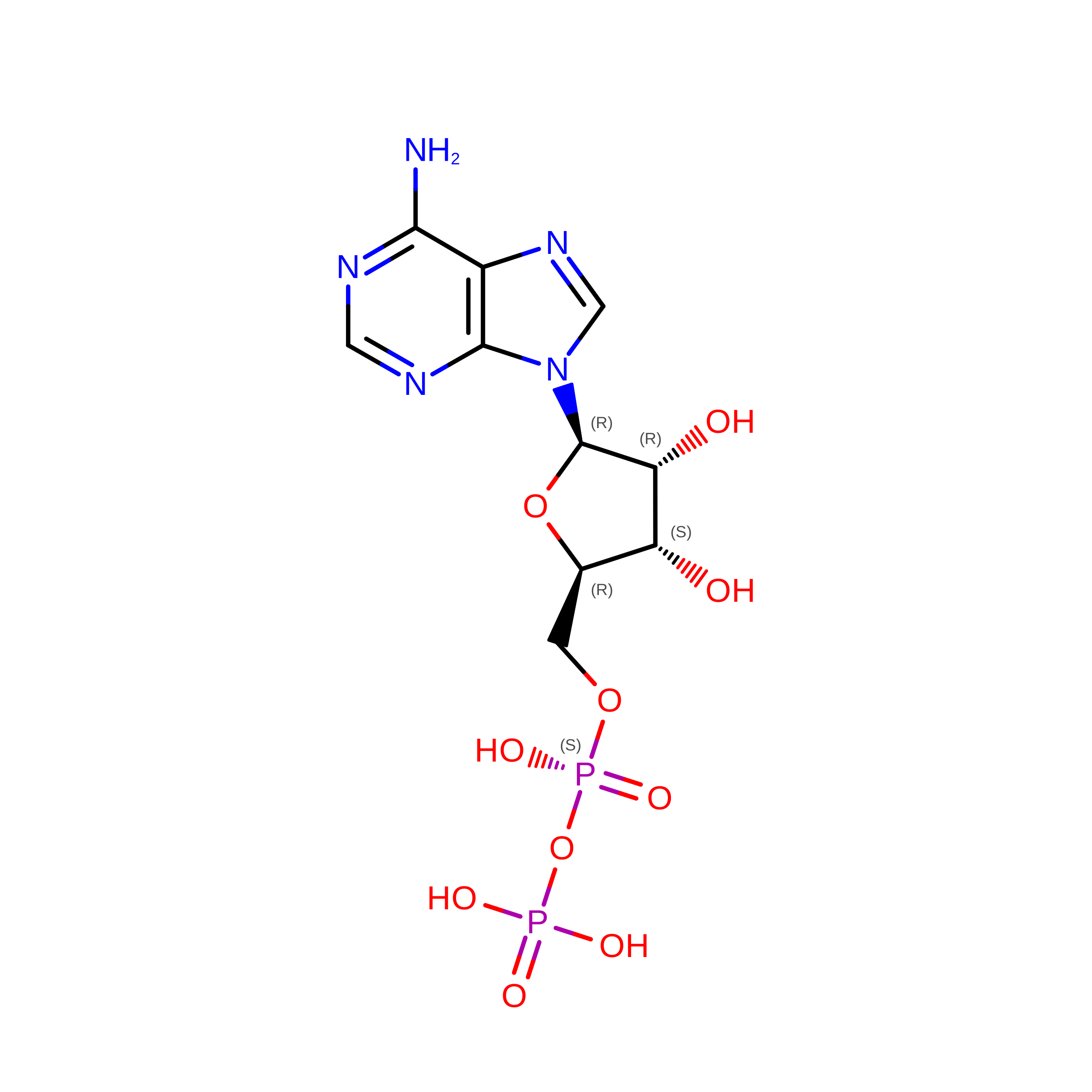
ADP

Query on ADP


Download:Ideal Coordinates CCD File
H [auth A],
I [auth A],
K [auth B],
R [auth F]
ADENOSINE-5'-DIPHOSPHATE
C10 H15 N5 O10 P2
XTWYTFMLZFPYCI-KQYNXXCUSA-N

Experimental Data & Validation

Experimental Data

  • Method: ELECTRON MICROSCOPY
  • Resolution: 3.70 Å
  • Aggregation State: PARTICLE 
  • Reconstruction Method: SINGLE PARTICLE 
EM Software:
TaskSoftware PackageVersion
MODEL REFINEMENTPHENIX
RECONSTRUCTIONRELION3.0

Structure Validation

View Full Validation Report


Entry History 

& Funding Information

Deposition Data


Funding OrganizationLocationGrant Number
Vienna Science and Technology Fund (WWTF)AustriaWWTF // LS17-29

Revision History  (Full details and data files)

  • Version 1.0: 2021-10-06
    Type: Initial release
  • Version 1.1: 2022-06-15
    Changes: Database references
  • Version 1.2: 2022-07-06
    Changes: Database references
  • Version 1.3: 2025-10-01
    Changes: Advisory, Data collection, Derived calculations, Structure summary