7A9J | pdb_00007a9j

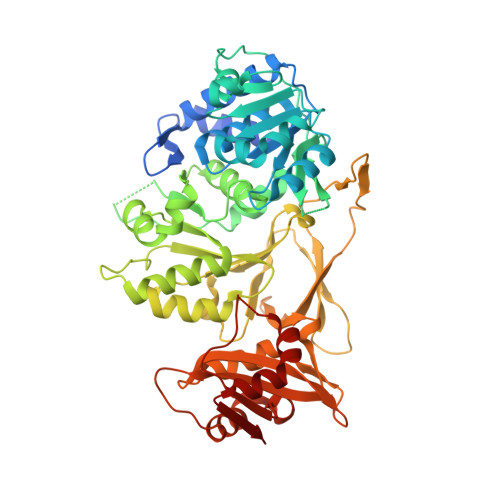
Crystal structure of the R395G mutant form of Coronafacic Acid Ligase from Pectobacterium brasiliense


Experimental Data Snapshot

  • Method: X-RAY DIFFRACTION
  • Resolution: 1.72 Å
  • R-Value Free: 
    0.208 (Depositor), 0.229 (DCC) 
  • R-Value Work: 
    0.172 (Depositor) 
  • R-Value Observed: 
    0.174 (Depositor) 

Starting Model: other
View more details

wwPDB Validation 3D Report Full Report

Validation slider image for 7A9J

Ligand Structure Quality Assessment 


This is version 1.2 of the entry. See complete history

Literature

Discovery, characterization and engineering of ligases for amide synthesis.

Winn, M.Rowlinson, M.Wang, F.Bering, L.Francis, D.Levy, C.Micklefield, J.

(2021) Nature 593: 391-398

  • DOI: https://doi.org/10.1038/s41586-021-03447-w
  • Primary Citation Related Structures: 
    7A9I, 7A9J

  • PubMed Abstract: 

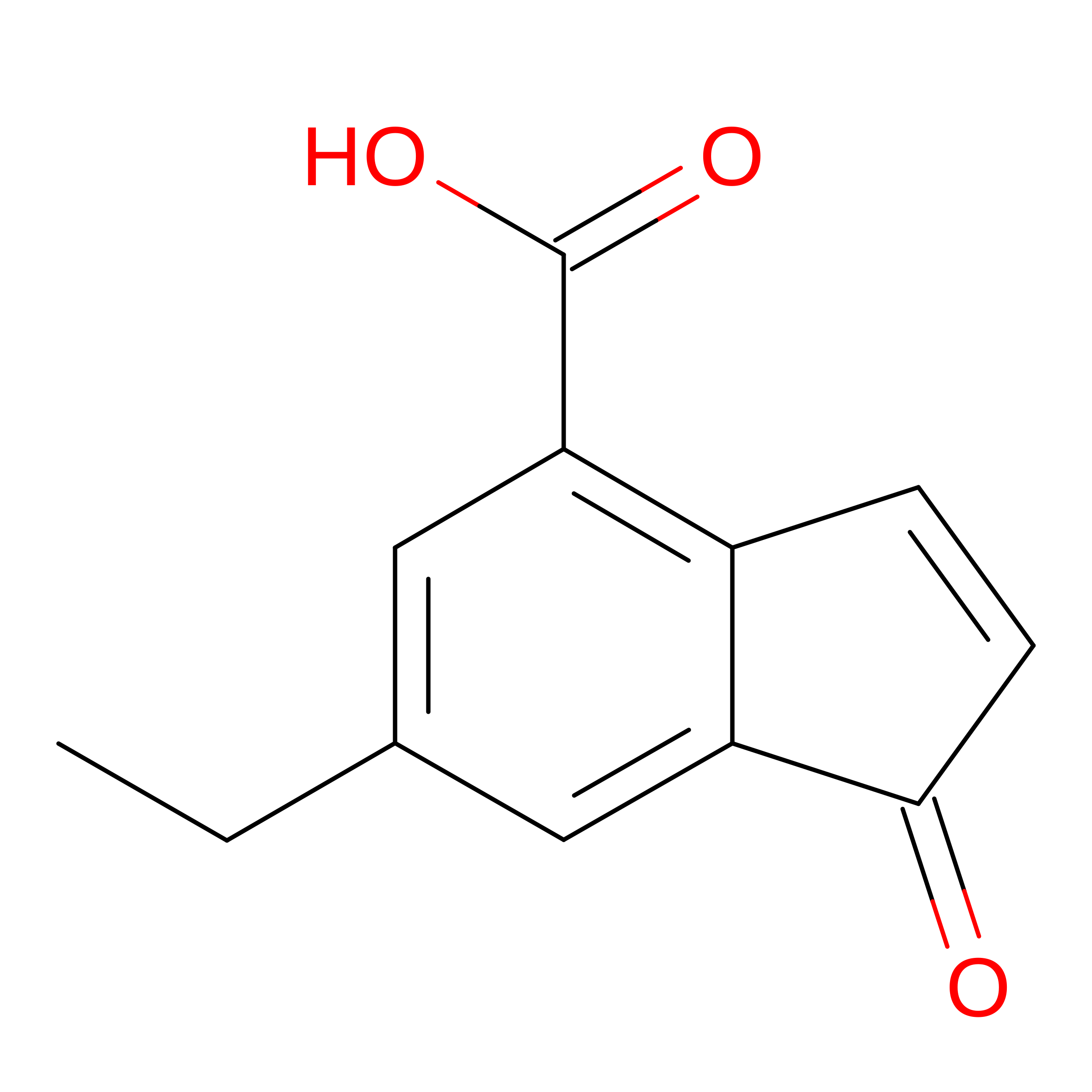
    Coronatine and related bacterial phytotoxins are mimics of the hormone jasmonyl-L-isoleucine (JA-Ile), which mediates physiologically important plant signalling pathways 1-4 . Coronatine-like phytotoxins disrupt these essential pathways and have potential in the development of safer, more selective herbicides. Although the biosynthesis of coronatine has been investigated previously, the nature of the enzyme that catalyses the crucial coupling of coronafacic acid to amino acids remains unknown 1,2 . Here we characterize a family of enzymes, coronafacic acid ligases (CfaLs), and resolve their structures. We found that CfaL can also produce JA-Ile, despite low similarity with the Jar1 enzyme that is responsible for ligation of JA and L-Ile in plants 5 . This suggests that Jar1 and CfaL evolved independently to catalyse similar reactions-Jar1 producing a compound essential for plant development 4,5 , and the bacterial ligases producing analogues toxic to plants. We further demonstrate how CfaL enzymes can be used to synthesize a diverse array of amides, obviating the need for protecting groups. Highly selective kinetic resolutions of racemic donor or acceptor substrates were achieved, affording homochiral products. We also used structure-guided mutagenesis to engineer improved CfaL variants. Together, these results show that CfaLs can deliver a wide range of amides for agrochemical, pharmaceutical and other applications.


  • Organizational Affiliation
    • Department of Chemistry, Manchester Institute of Biotechnology, The University of Manchester, Manchester, UK.

Macromolecule Content 

  • Total Structure Weight: 60.7 kDa 
  • Atom Count: 4,388 
  • Modeled Residue Count: 503 
  • Deposited Residue Count: 537 
  • Unique protein chains: 1

Macromolecules

Find similar proteins by:|  3D Structure
Entity ID: 1
MoleculeChains  Sequence LengthOrganismDetailsImage
Cfl537Pectobacterium brasilienseMutation(s): 1 
Gene Names: cflKCO_08370KU74_07105
UniProt
Find proteins for M4GWN4 (Pectobacterium brasiliense)
Explore M4GWN4 
Go to UniProtKB:  M4GWN4
Entity Groups
Sequence Clusters30% Identity50% Identity70% Identity90% Identity95% Identity100% Identity
UniProt GroupM4GWN4
Sequence Annotations
Expand
Reference Sequence

Experimental Data & Validation

Experimental Data

  • Method: X-RAY DIFFRACTION
  • Resolution: 1.72 Å
  • R-Value Free:  0.208 (Depositor), 0.229 (DCC) 
  • R-Value Work:  0.172 (Depositor) 
  • R-Value Observed: 0.174 (Depositor) 
Space Group: P 21 21 2
Unit Cell:
Length ( Å )Angle ( ˚ )
a = 77.611α = 90
b = 115.167β = 90
c = 71.013γ = 90
Software Package:
Software NamePurpose
PHENIXrefinement
DIALSdata reduction
xia2data scaling
PHASERphasing

Structure Validation

View Full Validation Report


Ligand Structure Quality Assessment 


Entry History 

& Funding Information

Deposition Data

  • Released Date: 2021-05-05 
  • Deposition Author(s): Levy, C.W.

Funding OrganizationLocationGrant Number
Biotechnology and Biological Sciences Research Council (BBSRC)United KingdomBB/K002341/1

Revision History  (Full details and data files)

  • Version 1.0: 2021-05-05
    Type: Initial release
  • Version 1.1: 2021-06-02
    Changes: Database references
  • Version 1.2: 2024-05-01
    Changes: Data collection, Database references, Refinement description