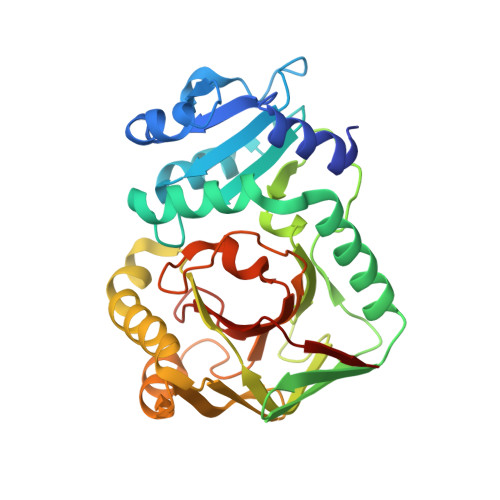
6ZSV | pdb_00006zsv

Structure of crocagin biosynthetic protein CgnB


Experimental Data Snapshot

  • Method: X-RAY DIFFRACTION
  • Resolution: 2.30 Å
  • R-Value Free: 
    0.305 (Depositor), 0.307 (DCC) 
  • R-Value Work: 
    0.283 (Depositor), 0.286 (DCC) 
  • R-Value Observed: 
    0.284 (Depositor) 

Starting Model: experimental
View more details

wwPDB Validation 3D Report Full Report

Validation slider image for 6ZSV

This is version 1.3 of the entry. See complete history

Literature

Unusual peptide-binding proteins guide pyrroloindoline alkaloid formation in crocagin biosynthesis.

Adam, S.Zheng, D.Klein, A.Volz, C.Mullen, W.Shirran, S.L.Smith, B.O.Kalinina, O.V.Muller, R.Koehnke, J.

(2023) Nat Chem 15: 560-568

  • DOI: https://doi.org/10.1038/s41557-023-01153-w
  • Primary Citation Related Structures: 
    6ZSU, 6ZSV, 7PD7, 8A2N

  • PubMed Abstract: 

    Ribosomally synthesized and post-translationally modified peptide natural products have provided many highly unusual scaffolds. This includes the intriguing alkaloids crocagins, which possess a tetracyclic core structure and whose biosynthesis has remained enigmatic. Here we use in vitro experiments to demonstrate that three proteins, CgnB, CgnC and CgnE, are sufficient for the production of the hallmark tetracyclic crocagin core from the precursor peptide CgnA. The crystal structures of the homologues CgnB and CgnE reveal them to be the founding members of a peptide-binding protein family and allow us to rationalize their distinct functions. We further show that the hydrolase CgnD liberates the crocagin core scaffold, which is subsequently N-methylated by CgnL. These insights allow us to propose a biosynthetic scheme for crocagins. Bioinformatic analyses based on these data led to the discovery of related biosynthetic pathways that may provide access to a structurally diverse family of peptide-derived pyrroloindoline alkaloids.


  • Organizational Affiliation
    • Workgroup Structural Biology of Biosynthetic Enzymes, Helmholtz Institute for Pharmaceutical Research Saarland (HIPS), Helmholtz Centre for Infection Research (HZI), Saarland University, Saarbrücken, Germany.

Macromolecule Content 

  • Total Structure Weight: 71.19 kDa 
  • Atom Count: 4,899 
  • Modeled Residue Count: 614 
  • Deposited Residue Count: 634 
  • Unique protein chains: 1

Macromolecules

Find similar proteins by:|  3D Structure
Entity ID: 1
MoleculeChains  Sequence LengthOrganismDetailsImage
Uncharacterized protein
A, B
317Chondromyces crocatusMutation(s): 0 
Gene Names: CMC5_025570
UniProt
Find proteins for A0A0K1EBZ5 (Chondromyces crocatus)
Explore A0A0K1EBZ5 
Go to UniProtKB:  A0A0K1EBZ5
Entity Groups
Sequence Clusters30% Identity50% Identity70% Identity90% Identity95% Identity100% Identity
UniProt GroupA0A0K1EBZ5
Sequence Annotations
Expand
Reference Sequence

Experimental Data & Validation

Experimental Data

  • Method: X-RAY DIFFRACTION
  • Resolution: 2.30 Å
  • R-Value Free:  0.305 (Depositor), 0.307 (DCC) 
  • R-Value Work:  0.283 (Depositor), 0.286 (DCC) 
  • R-Value Observed: 0.284 (Depositor) 
Space Group: P 1 21 1
Unit Cell:
Length ( Å )Angle ( ˚ )
a = 52.448α = 90
b = 67.5β = 95.99
c = 86.152γ = 90
Software Package:
Software NamePurpose
Cootmodel building
PHENIXrefinement
Cootmodel building
XDSdata reduction
SCALAdata scaling
PHASERphasing

Structure Validation

View Full Validation Report


Entry History 

& Funding Information

Deposition Data


Funding OrganizationLocationGrant Number
German Research Foundation (DFG)GermanyKO 4116/3-2

Revision History  (Full details and data files)

  • Version 1.0: 2022-07-20
    Type: Initial release
  • Version 1.1: 2023-02-22
    Changes: Database references
  • Version 1.2: 2024-02-07
    Changes: Data collection, Refinement description
  • Version 1.3: 2024-02-28
    Changes: Database references