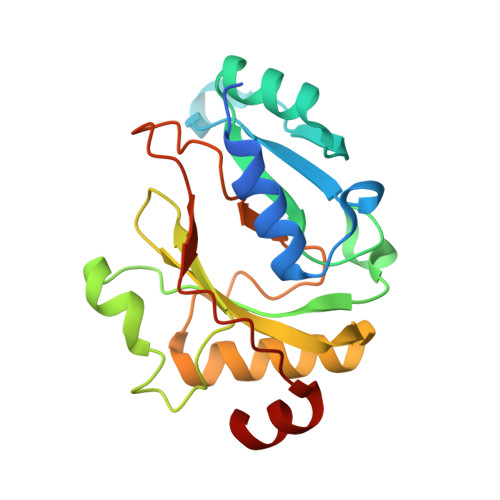
6ZP9 | pdb_00006zp9

Cyanophage S-2L Primase-Polymerase (PrimPol), AEP domain (PP-N190)


Experimental Data Snapshot

  • Method: X-RAY DIFFRACTION
  • Resolution: 1.50 Å
  • R-Value Free: 
    0.173 (Depositor), 0.173 (DCC) 
  • R-Value Work: 
    0.166 (Depositor), 0.166 (DCC) 
  • R-Value Observed: 
    0.166 (Depositor) 

wwPDB Validation 3D Report Full Report

Validation slider image for 6ZP9

This is version 1.2 of the entry. See complete history

Literature

How cyanophage S-2L rejects adenine and incorporates 2-aminoadenine to saturate hydrogen bonding in its DNA.

Czernecki, D.Legrand, P.Tekpinar, M.Rosario, S.Kaminski, P.A.Delarue, M.

(2021) Nat Commun 12: 2420-2420

  • DOI: https://doi.org/10.1038/s41467-021-22626-x
  • Primary Citation Related Structures: 
    6ZP9, 6ZPA, 6ZPB, 6ZPC

  • PubMed Abstract: 

    Bacteriophages have long been known to use modified bases in their DNA to prevent cleavage by the host's restriction endonucleases. Among them, cyanophage S-2L is unique because its genome has all its adenines (A) systematically replaced by 2-aminoadenines (Z). Here, we identify a member of the PrimPol family as the sole possible polymerase of S-2L and we find it can incorporate both A and Z in front of a T. Its crystal structure at 1.5 Å resolution confirms that there is no structural element in the active site that could lead to the rejection of A in front of T. To resolve this contradiction, we show that a nearby gene is a triphosphohydolase specific of dATP (DatZ), that leaves intact all other dNTPs, including dZTP. This explains the absence of A in S-2L genome. Crystal structures of DatZ with various ligands, including one at sub-angstrom resolution, allow to describe its mechanism as a typical two-metal-ion mechanism and to set the stage for its engineering.


  • Organizational Affiliation
    • Unit of Structural Dynamics of Biological Macromolecules, CNRS UMR 3528, 25-28 rue du Docteur Roux, Institut Pasteur, Paris, France.

Macromolecule Content 

  • Total Structure Weight: 43.21 kDa 
  • Atom Count: 3,505 
  • Modeled Residue Count: 370 
  • Deposited Residue Count: 392 
  • Unique protein chains: 1

Macromolecules

Find similar proteins by:|  3D Structure
Entity ID: 1
MoleculeChains  Sequence LengthOrganismDetailsImage
PrimPol AEP domain (PP-N190)
A, B
196Cyanophage S-2LMutation(s): 0 
UniProt
Find proteins for A0ACD6BAW9 (Cyanophage S-2L)
Explore A0ACD6BAW9 
Go to UniProtKB:  A0ACD6BAW9
Entity Groups
Sequence Clusters30% Identity50% Identity70% Identity90% Identity95% Identity100% Identity
UniProt GroupA0ACD6BAW9
Sequence Annotations
Expand
Reference Sequence

Experimental Data & Validation

Experimental Data

  • Method: X-RAY DIFFRACTION
  • Resolution: 1.50 Å
  • R-Value Free:  0.173 (Depositor), 0.173 (DCC) 
  • R-Value Work:  0.166 (Depositor), 0.166 (DCC) 
  • R-Value Observed: 0.166 (Depositor) 
Space Group: P 1 21 1
Unit Cell:
Length ( Å )Angle ( ˚ )
a = 59.177α = 90
b = 47.686β = 97.111
c = 66.155γ = 90
Software Package:
Software NamePurpose
PHENIXrefinement
XDSdata reduction
XDSdata scaling
SHELXCDphasing

Structure Validation

View Full Validation Report


Entry History 

Deposition Data

Revision History  (Full details and data files)

  • Version 1.0: 2021-03-03
    Type: Initial release
  • Version 1.1: 2021-05-05
    Changes: Database references
  • Version 1.2: 2024-05-15
    Changes: Data collection, Database references