6ZMG | pdb_00006zmg

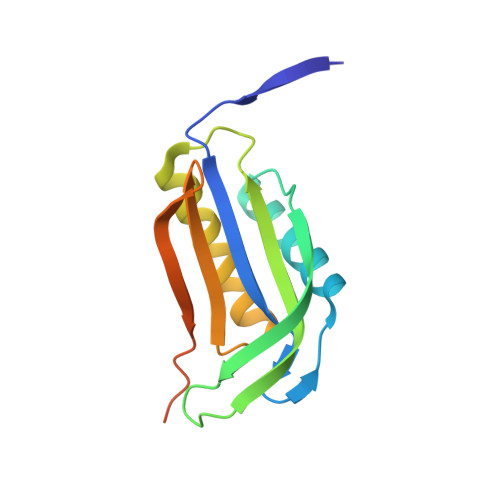
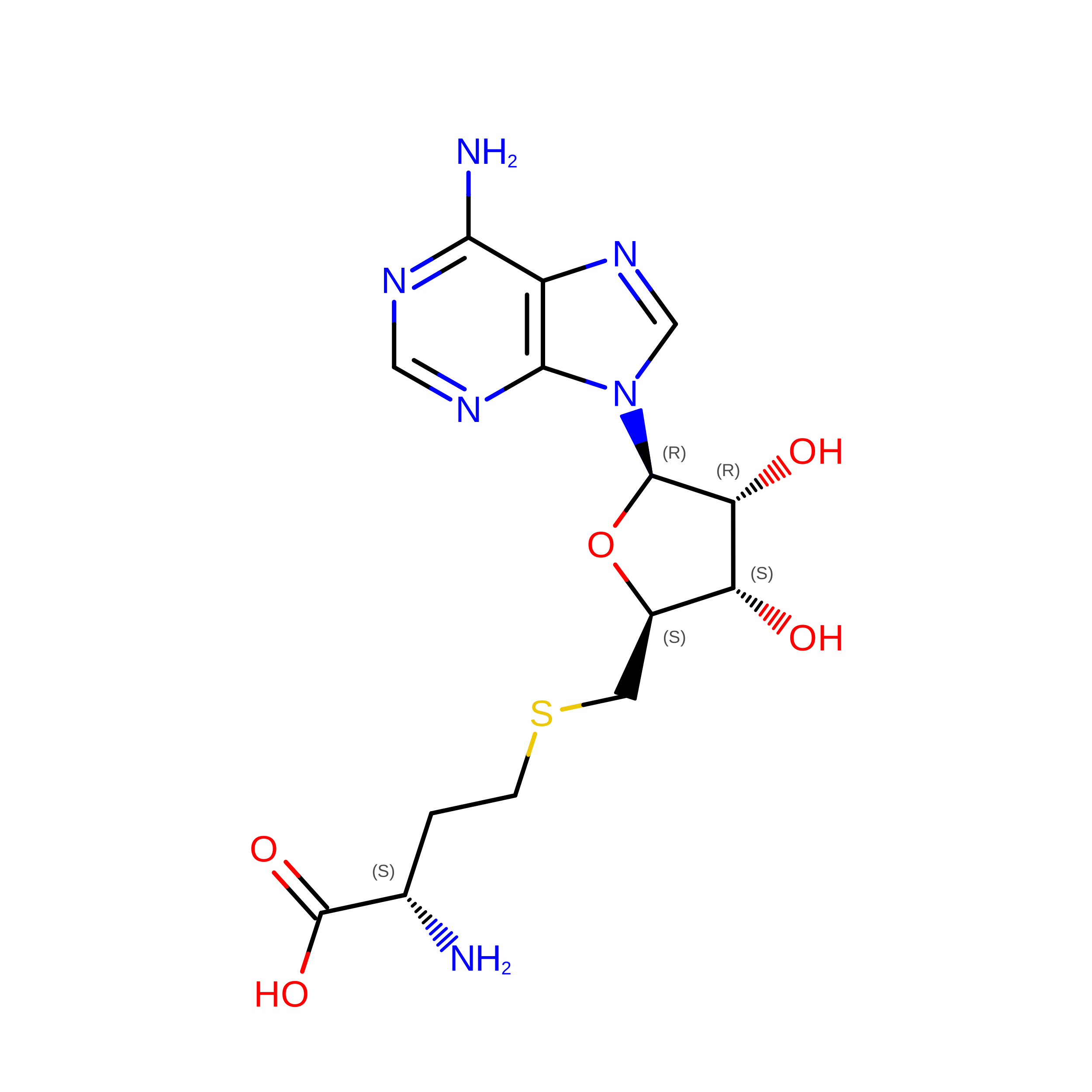
PHAGE SAM LYASE IN COMPLEX WITH S-ADENOSYL-L-HOMOCYSTEINE


Experimental Data Snapshot

  • Method: X-RAY DIFFRACTION
  • Resolution: 1.48 Å
  • R-Value Free: 
    0.172 (Depositor), 0.179 (DCC) 
  • R-Value Work: 
    0.141 (Depositor), 0.152 (DCC) 
  • R-Value Observed: 
    0.142 (Depositor) 

Starting Model: experimental
View more details

wwPDB Validation 3D Report Full Report

Validation slider image for 6ZMG

Ligand Structure Quality Assessment 


This is version 2.0 of the entry. See complete history

Literature

Structure and mechanism of a phage-encoded SAM lyase revises catalytic function of enzyme family.

Guo, X.Soderholm, A.Kanchugal P, S.Isaksen, G.V.Warsi, O.Eckhard, U.Triguis, S.Gogoll, A.Jerlstrom-Hultqvist, J.Aqvist, J.Andersson, D.I.Selmer, M.

(2021) Elife 10

  • DOI: https://doi.org/10.7554/eLife.61818
  • Primary Citation Related Structures: 
    6ZM9, 6ZMG, 6ZNB

  • PubMed Abstract: 

    The first S-adenosyl methionine (SAM) degrading enzyme (SAMase) was discovered in bacteriophage T3, as a counter-defense against the bacterial restriction-modification system, and annotated as a SAM hydrolase forming 5'-methyl-thioadenosine (MTA) and L-homoserine. From environmental phages, we recently discovered three SAMases with barely detectable sequence similarity to T3 SAMase and without homology to proteins of known structure. Here, we present the very first phage SAMase structures, in complex with a substrate analogue and the product MTA. The structure shows a trimer of alpha-beta sandwiches similar to the GlnB-like superfamily, with active sites formed at the trimer interfaces. Quantum-mechanical calculations, thin-layer chromatography, and nuclear magnetic resonance spectroscopy demonstrate that this family of enzymes are not hydrolases but lyases forming MTA and L-homoserine lactone in a unimolecular reaction mechanism. Sequence analysis and in vitro and in vivo mutagenesis support that T3 SAMase belongs to the same structural family and utilizes the same reaction mechanism.


  • Organizational Affiliation
    • Department of Cell and Molecular Biology, Uppsala University, Uppsala, Sweden.

Macromolecule Content 

  • Total Structure Weight: 16.88 kDa 
  • Atom Count: 1,223 
  • Modeled Residue Count: 129 
  • Deposited Residue Count: 146 
  • Unique protein chains: 1

Macromolecules

Find similar proteins by:|  3D Structure
Entity ID: 1
MoleculeChains  Sequence LengthOrganismDetailsImage
Chains: A146unidentifiedMutation(s): 0 

Experimental Data & Validation

Experimental Data

  • Method: X-RAY DIFFRACTION
  • Resolution: 1.48 Å
  • R-Value Free:  0.172 (Depositor), 0.179 (DCC) 
  • R-Value Work:  0.141 (Depositor), 0.152 (DCC) 
  • R-Value Observed: 0.142 (Depositor) 
Space Group: F 41 3 2
Unit Cell:
Length ( Å )Angle ( ˚ )
a = 154.473α = 90
b = 154.473β = 90
c = 154.473γ = 90
Software Package:
Software NamePurpose
PHENIXrefinement
PHENIXrefinement
XDSdata reduction
XSCALEdata scaling
PHENIXphasing

Structure Validation

View Full Validation Report


Ligand Structure Quality Assessment 


Entry History 

& Funding Information

Deposition Data


Funding OrganizationLocationGrant Number
Knut and Alice Wallenberg FoundationSwedenEvolution of new genes and proteins
Swedish Research CouncilSweden2017-03827

Revision History  (Full details and data files)

  • Version 1.0: 2021-02-24
    Type: Initial release
  • Version 1.1: 2024-01-31
    Changes: Data collection, Database references, Refinement description
  • Version 2.0: 2025-12-10
    Changes: Atomic model, Data collection, Structure summary