Download Mendeley
Intrinsically disordered RNA-binding motifs cooperate to catalyze RNA folding and drive phase separation.
Niedner-Boblenz, A., Monecke, T., Hennig, J., Klostermann, M., Hofweber, M., Davydova, E., Gerber, A.P., Anosova, I., Mayer, W., Muller, M., Heym, R.G., Janowski, R., Paillart, J.C., Dormann, D., Zarnack, K., Sattler, M., Niessing, D.(2024) Nucleic Acids Res 52: 14205-14228
- PubMed: 39558160 Search on PubMedSearch on PubMed Central
- DOI: https://doi.org/10.1093/nar/gkae1107
- Primary Citation Related Structures:
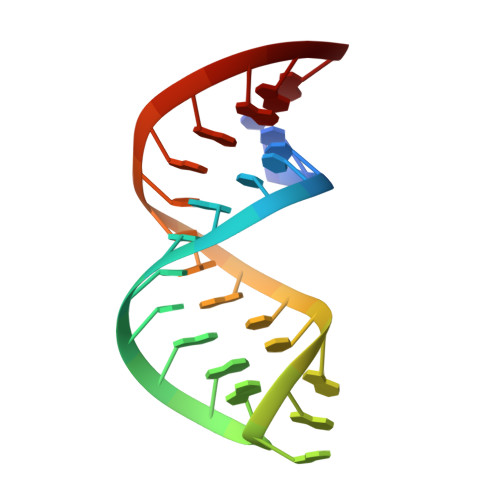
6YMC - PubMed Abstract:
RNA-binding proteins are essential for gene regulation and the spatial organization of cells. Here, we report that the yeast ribosome biogenesis factor Loc1p is an intrinsically disordered RNA-binding protein with eight repeating positively charged, unstructured nucleic acid binding (PUN) motifs. While a single of these previously undefined motifs stabilizes folded RNAs, multiple copies strongly cooperate to catalyze RNA folding. In the presence of RNA, these multivalent PUN motifs drive phase separation. Proteome-wide searches in pro- and eukaryotes for proteins with similar arrays of PUN motifs reveal a strong enrichment in RNA-mediated processes and DNA remodeling. Thus, PUN motifs are potentially involved in a large variety of RNA- and DNA-related processes by concentrating them in membraneless organelles. The general function and wide distribution of PUN motifs across species suggest that in an ancient 'RNA world' PUN-like motifs may have supported the correct folding of early ribozymes.
- Institute of Structural Biology, Molecular Targets and Therapeutics Center, Helmholtz Munich, Ingolstädter Landstrasse 1, 85764 Neuherberg, Germany.
Organizational Affiliation: