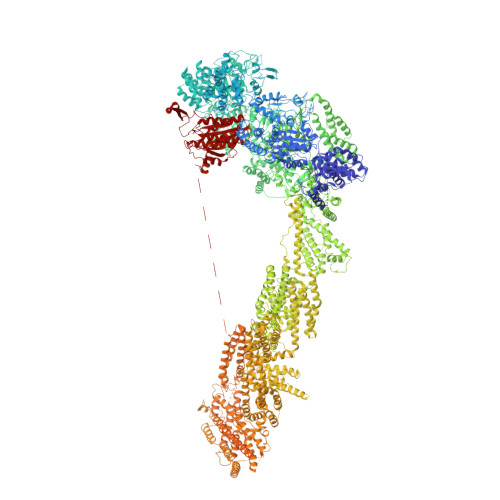
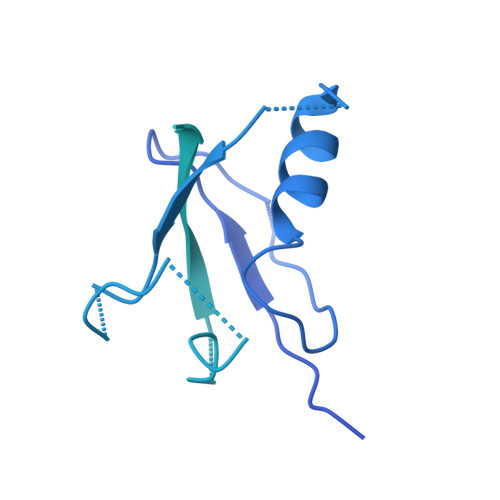
6YLF | pdb_00006ylf

Rix1-Rea1 pre-60S particle - Rea1, body 3 (rigid body refinement, composite structure of Rea1 ring and tail)


Experimental Data Snapshot

  • Method: ELECTRON MICROSCOPY
  • Resolution: 4.20 Å
  • Aggregation State: PARTICLE 
  • Reconstruction Method: SINGLE PARTICLE 

Starting Models: experimental
View more details

wwPDB Validation 3D Report Full Report

Validation slider image for 6YLF

This is version 1.2 of the entry. See complete history

Literature

Construction of the Central Protuberance and L1 Stalk during 60S Subunit Biogenesis.

Kater, L.Mitterer, V.Thoms, M.Cheng, J.Berninghausen, O.Beckmann, R.Hurt, E.

(2020) Mol Cell 79: 615-628.e5

  • DOI: https://doi.org/10.1016/j.molcel.2020.06.032
  • Primary Citation Related Structures: 
    6YLE, 6YLF, 6YLG, 6YLH, 6YLX, 6YLY

  • PubMed Abstract: 

    Ribosome assembly is driven by numerous assembly factors, including the Rix1 complex and the AAA ATPase Rea1. These two assembly factors catalyze 60S maturation at two distinct states, triggering poorly understood large-scale structural transitions that we analyzed by cryo-electron microscopy. Two nuclear pre-60S intermediates were discovered that represent previously unknown states after Rea1-mediated removal of the Ytm1-Erb1 complex and reveal how the L1 stalk develops from a pre-mature nucleolar to a mature-like nucleoplasmic state. A later pre-60S intermediate shows how the central protuberance arises, assisted by the nearby Rix1-Rea1 machinery, which was solved in its pre-ribosomal context to molecular resolution. This revealed a Rix1 2 -Ipi3 2 tetramer anchored to the pre-60S via Ipi1, strategically positioned to monitor this decisive remodeling. These results are consistent with a general underlying principle that temporarily stabilized immature RNA domains are successively remodeled by assembly factors, thereby ensuring failsafe assembly progression.


  • Organizational Affiliation
    • Gene Center Munich and Center of Integrated Protein Science-Munich (CiPS-M), Department of Biochemistry, Feodor-Lynen-Str. 25, University of Munich, 81377 Munich, Germany.

Macromolecule Content 

  • Total Structure Weight: 617.06 kDa 
  • Atom Count: 18,362 
  • Modeled Residue Count: 3,700 
  • Deposited Residue Count: 5,425 
  • Unique protein chains: 2

Macromolecules

Find similar proteins by:|  3D Structure
Entity ID: 1
MoleculeChains  Sequence LengthOrganismDetailsImage
MidasinA [auth AP1]4,910Saccharomyces cerevisiaeMutation(s): 0 
UniProt
Find proteins for Q12019 (Saccharomyces cerevisiae (strain ATCC 204508 / S288c))
Explore Q12019 
Go to UniProtKB:  Q12019
Entity Groups
Sequence Clusters30% Identity50% Identity70% Identity90% Identity95% Identity100% Identity
UniProt GroupQ12019
Sequence Annotations
Expand
Reference Sequence
Find similar proteins by:|  3D Structure
Entity ID: 2
MoleculeChains  Sequence LengthOrganismDetailsImage
Ribosome assembly protein 4B [auth xP1]515Saccharomyces cerevisiaeMutation(s): 0 
UniProt
Find proteins for P25382 (Saccharomyces cerevisiae (strain ATCC 204508 / S288c))
Explore P25382 
Go to UniProtKB:  P25382
Entity Groups
Sequence Clusters30% Identity50% Identity70% Identity90% Identity95% Identity100% Identity
UniProt GroupP25382
Sequence Annotations
Expand
Reference Sequence

Experimental Data & Validation

Experimental Data

  • Method: ELECTRON MICROSCOPY
  • Resolution: 4.20 Å
  • Aggregation State: PARTICLE 
  • Reconstruction Method: SINGLE PARTICLE 
EM Software:
TaskSoftware PackageVersion
RECONSTRUCTIONRELION3.0.8
MODEL REFINEMENTPHENIX

Structure Validation

View Full Validation Report


Entry History 

Deposition Data

Revision History  (Full details and data files)

  • Version 1.0: 2020-07-29
    Type: Initial release
  • Version 1.1: 2020-09-02
    Changes: Database references
  • Version 1.2: 2024-05-22
    Changes: Data collection, Database references, Refinement description