6YF4 | pdb_00006yf4

[FeFe]-hydrogenase I from Clostridium pasteurianum (CpI), variant E279D


Experimental Data Snapshot

  • Method: X-RAY DIFFRACTION
  • Resolution: 1.77 Å
  • R-Value Free: 
    0.234 (Depositor), 0.240 (DCC) 
  • R-Value Work: 
    0.200 (Depositor), 0.200 (DCC) 

Starting Model: experimental
View more details

wwPDB Validation   3D Report Full Report


Ligand Structure Quality Assessment 


This is version 1.1 of the entry. See complete history


Literature

The roles of long-range proton-coupled electron transfer in the directionality and efficiency of [FeFe]-hydrogenases.

Lampret, O.Duan, J.Hofmann, E.Winkler, M.Armstrong, F.A.Happe, T.

(2020) Proc Natl Acad Sci U S A 117: 20520-20529

  • DOI: https://doi.org/10.1073/pnas.2007090117
  • Primary Citation of Related Structures:  
    6YF4

  • PubMed Abstract: 

    As paradigms for proton-coupled electron transfer in enzymes and benchmarks for a fully renewable H 2 technology, [FeFe]-hydrogenases behave as highly reversible electrocatalysts when immobilized on an electrode, operating in both catalytic directions with minimal overpotential requirement. Using the [FeFe]-hydrogenases from Clostridium pasteurianum (CpI) and Chlamydomonas reinhardtii (CrHydA1) we have conducted site-directed mutagenesis and protein film electrochemistry to determine how efficient catalysis depends on the long-range coupling of electron and proton transfer steps. Importantly, the electron and proton transfer pathways in [FeFe]-hydrogenases are well separated from each other in space. Variants with conservative substitutions (glutamate to aspartate) in either of two positions in the proton-transfer pathway retain significant activity and reveal the consequences of slowing down proton transfer for both catalytic directions over a wide range of pH and potential values. Proton reduction in the variants is impaired mainly by limiting the turnover rate, which drops sharply as the pH is raised, showing that proton capture from bulk solvent becomes critical. In contrast, hydrogen oxidation is affected in two ways: by limiting the turnover rate and by a large overpotential requirement that increases as the pH is raised, consistent with the accumulation of a reduced and protonated intermediate. A unique observation having fundamental significance is made under conditions where the variants still retain sufficient catalytic activity in both directions: An inflection appears as the catalytic current switches direction at the 2H + /H 2 thermodynamic potential, clearly signaling a departure from electrocatalytic reversibility as electron and proton transfers begin to be decoupled.


  • Organizational Affiliation
    • Fakultät für Biologie und Biotechnologie, AG Photobiotechnologie, Ruhr-Universität Bochum, 44801 Bochum, Germany.

Macromolecules
Find similar proteins by:  (by identity cutoff)  |  3D Structure
Entity ID: 1
MoleculeChains Sequence LengthOrganismDetailsImage
Iron hydrogenase 1
A, B
584Clostridium pasteurianumMutation(s): 1 
EC: 1.12.7.2
UniProt
Find proteins for P29166 (Clostridium pasteurianum)
Explore P29166 
Go to UniProtKB:  P29166
Entity Groups  
Sequence Clusters30% Identity50% Identity70% Identity90% Identity95% Identity100% Identity
UniProt GroupP29166
Sequence Annotations
Expand
  • Reference Sequence
Small Molecules
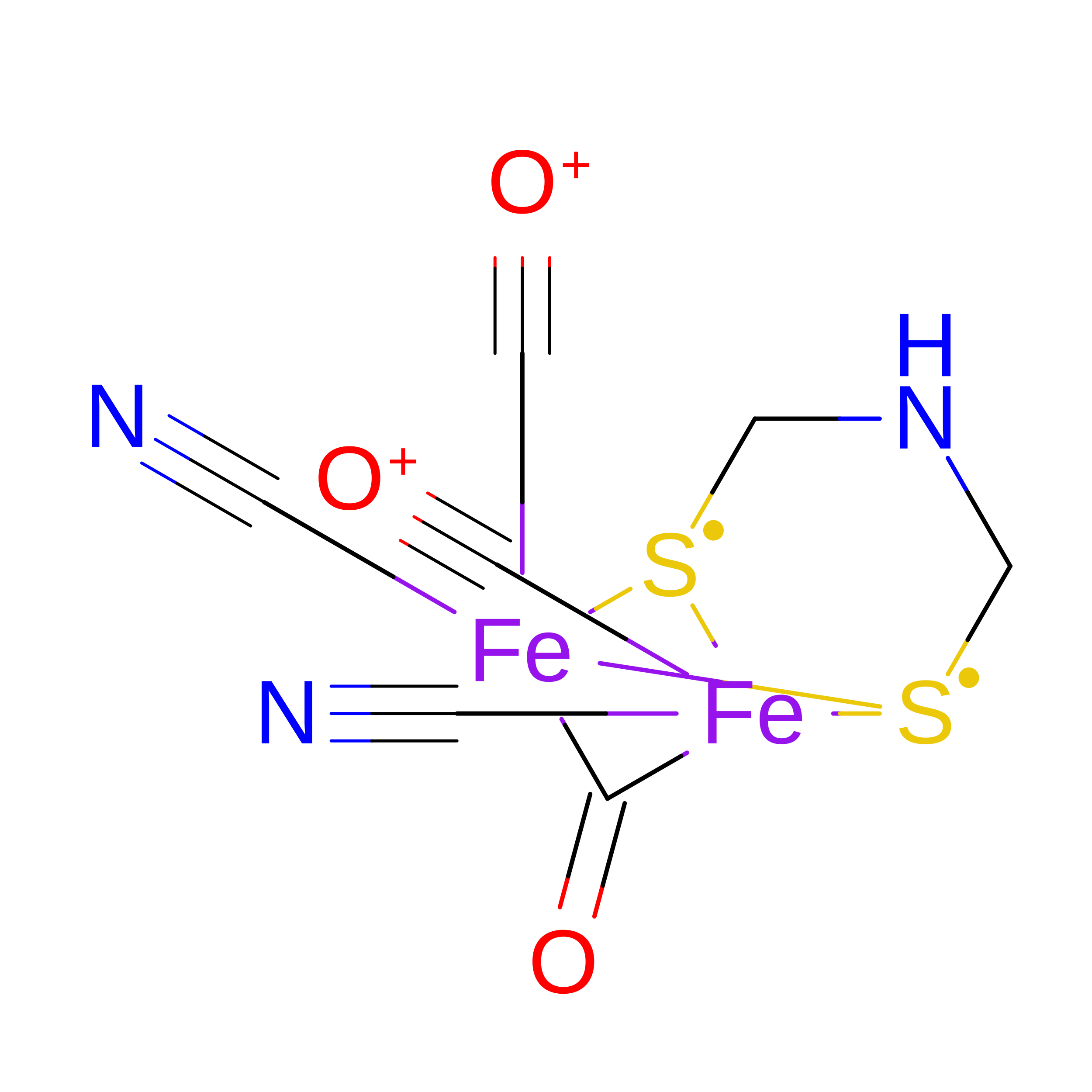
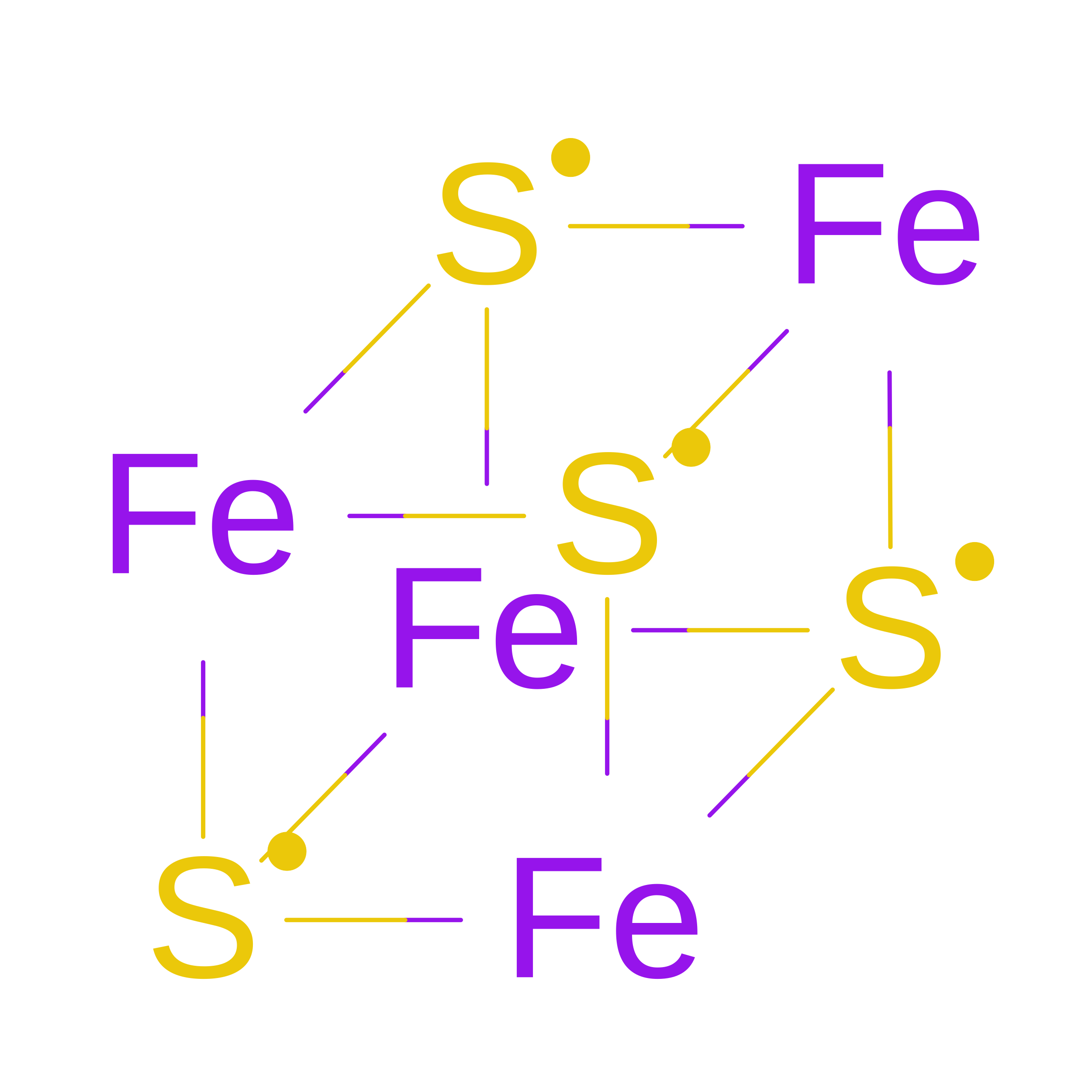
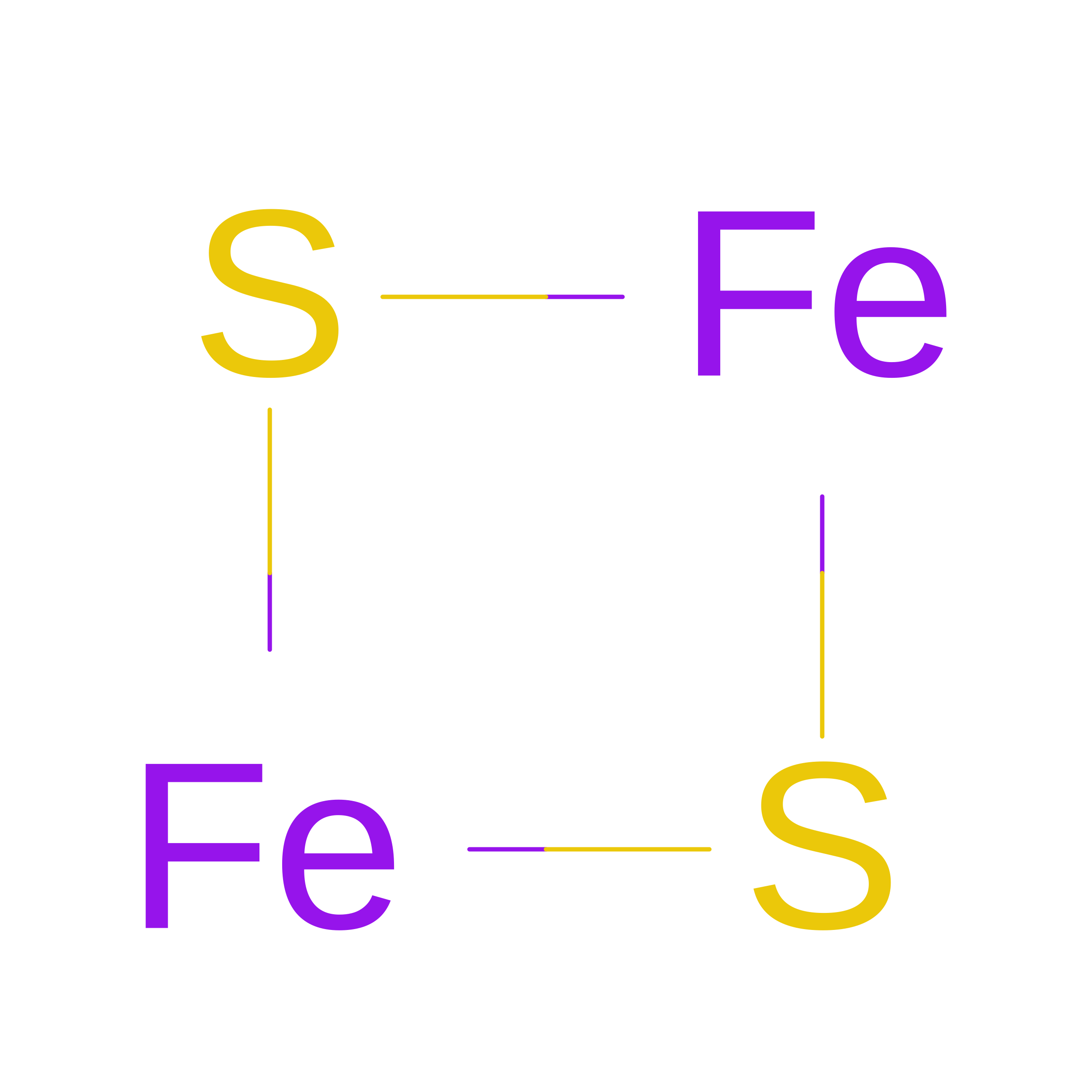
Ligands 4 Unique
IDChains Name / Formula / InChI Key2D Diagram3D Interactions
402
Query on 402

Download Ideal Coordinates CCD File 
C [auth A],
K [auth B]
dicarbonyl[bis(cyanide-kappaC)]-mu-(iminodimethanethiolatato-1kappaS:2kappaS)-mu-(oxomethylidene)diiron(2+)
C7 H5 Fe2 N3 O3 S2
LJPDYWPSPOWMIB-UHFFFAOYSA-N
SF4
Query on SF4

Download Ideal Coordinates CCD File 
D [auth A]
E [auth A]
F [auth A]
G [auth A]
L [auth B]
D [auth A],
E [auth A],
F [auth A],
G [auth A],
L [auth B],
M [auth B],
N [auth B],
O [auth B]
IRON/SULFUR CLUSTER
Fe4 S4
LJBDFODJNLIPKO-UHFFFAOYSA-N
FES
Query on FES

Download Ideal Coordinates CCD File 
H [auth A],
P [auth B]
FE2/S2 (INORGANIC) CLUSTER
Fe2 S2
NIXDOXVAJZFRNF-UHFFFAOYSA-N
MG
Query on MG

Download Ideal Coordinates CCD File 
I [auth A],
J [auth A],
Q [auth B]
MAGNESIUM ION
Mg
JLVVSXFLKOJNIY-UHFFFAOYSA-N
Experimental Data & Validation

Experimental Data

  • Method: X-RAY DIFFRACTION
  • Resolution: 1.77 Å
  • R-Value Free:  0.234 (Depositor), 0.240 (DCC) 
  • R-Value Work:  0.200 (Depositor), 0.200 (DCC) 
Space Group: P 1 21 1
Unit Cell:
Length ( Å )Angle ( ˚ )
a = 89.81α = 90
b = 72.02β = 97.48
c = 102.93γ = 90
Software Package:
Software NamePurpose
PHENIXrefinement
XDSdata reduction

Structure Validation

View Full Validation Report


Ligand Structure Quality Assessment 


Entry History 

Deposition Data

Revision History  (Full details and data files)

  • Version 1.0: 2020-09-02
    Type: Initial release
  • Version 1.1: 2024-01-24
    Changes: Data collection, Database references, Refinement description