6XXV | pdb_00006xxv

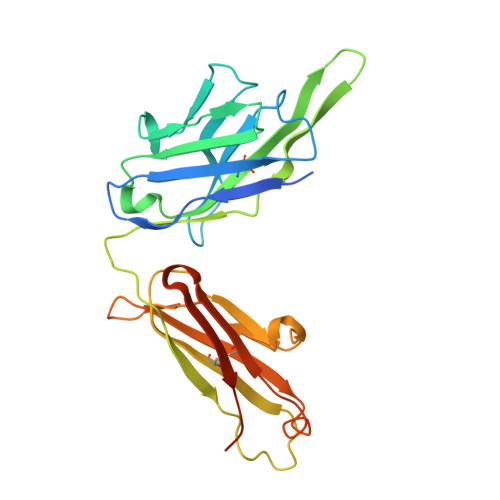
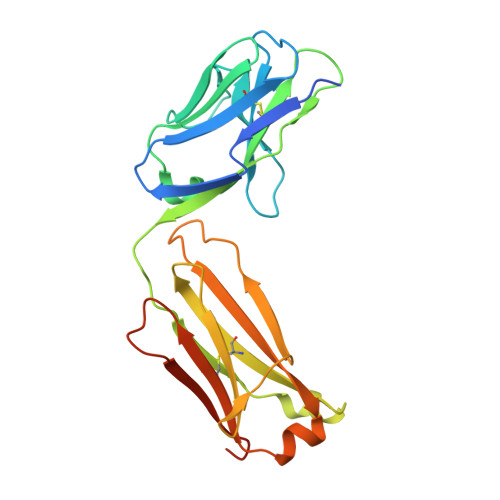
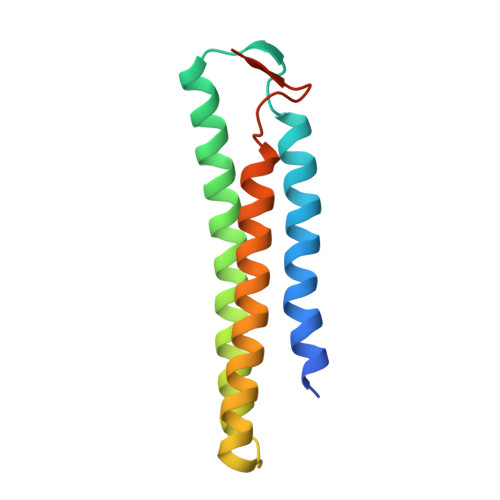
Crystal Structure of a computationally designed Immunogen S2_1.2 in complex with its elicited antibody C57


Experimental Data Snapshot

  • Method: X-RAY DIFFRACTION
  • Resolution: 2.20 Å
  • R-Value Free: 
    0.244 (Depositor), 0.246 (DCC) 
  • R-Value Work: 
    0.209 (Depositor), 0.211 (DCC) 
  • R-Value Observed: 
    0.210 (Depositor) 

Starting Model: experimental
View more details

wwPDB Validation 3D Report Full Report

Validation slider image for 6XXV

This is version 1.4 of the entry. See complete history

Literature

De novo protein design enables the precise induction of RSV-neutralizing antibodies.

Sesterhenn, F.Yang, C.Bonet, J.Cramer, J.T.Wen, X.Wang, Y.Chiang, C.I.Abriata, L.A.Kucharska, I.Castoro, G.Vollers, S.S.Galloux, M.Dheilly, E.Rosset, S.Corthesy, P.Georgeon, S.Villard, M.Richard, C.A.Descamps, D.Delgado, T.Oricchio, E.Rameix-Welti, M.A.Mas, V.Ervin, S.Eleouet, J.F.Riffault, S.Bates, J.T.Julien, J.P.Li, Y.Jardetzky, T.Krey, T.Correia, B.E.

(2020) Science 368

  • DOI: https://doi.org/10.1126/science.aay5051
  • Primary Citation Related Structures: 
    6S3D, 6VTW, 6XWI, 6XXV

  • PubMed Abstract: 

    De novo protein design has been successful in expanding the natural protein repertoire. However, most de novo proteins lack biological function, presenting a major methodological challenge. In vaccinology, the induction of precise antibody responses remains a cornerstone for next-generation vaccines. Here, we present a protein design algorithm called TopoBuilder, with which we engineered epitope-focused immunogens displaying complex structural motifs. In both mice and nonhuman primates, cocktails of three de novo-designed immunogens induced robust neutralizing responses against the respiratory syncytial virus. Furthermore, the immunogens refocused preexisting antibody responses toward defined neutralization epitopes. Overall, our design approach opens the possibility of targeting specific epitopes for the development of vaccines and therapeutic antibodies and, more generally, will be applicable to the design of de novo proteins displaying complex functional motifs.


  • Organizational Affiliation
    • Institute of Bioengineering, École Polytechnique Fédérale de Lausanne, Lausanne CH-1015, Switzerland.

Macromolecule Content 

  • Total Structure Weight: 134.01 kDa 
  • Atom Count: 8,736 
  • Modeled Residue Count: 1,095 
  • Deposited Residue Count: 1,216 
  • Unique protein chains: 3

Macromolecules

Find similar proteins by:|  3D Structure
Entity ID: 1
MoleculeChains  Sequence LengthOrganismDetailsImage
Antibody C57, Heavy Chain
A, D
251Homo sapiensMutation(s): 0 
Find similar proteins by:|  3D Structure
Entity ID: 2
MoleculeChains  Sequence LengthOrganismDetailsImage
Antibody C57, Light Chain
B, E
233Homo sapiensMutation(s): 0 
Find similar proteins by:|  3D Structure
Entity ID: 3
MoleculeChains  Sequence LengthOrganismDetailsImage
S2_1.2
C, F
124Homo sapiensMutation(s): 0 

Experimental Data & Validation

Experimental Data

  • Method: X-RAY DIFFRACTION
  • Resolution: 2.20 Å
  • R-Value Free:  0.244 (Depositor), 0.246 (DCC) 
  • R-Value Work:  0.209 (Depositor), 0.211 (DCC) 
  • R-Value Observed: 0.210 (Depositor) 
Space Group: C 1 2 1
Unit Cell:
Length ( Å )Angle ( ˚ )
a = 241.019α = 90
b = 66.89β = 110.811
c = 91.384γ = 90
Software Package:
Software NamePurpose
PHENIXrefinement
PHENIXrefinement
XDSdata reduction
XDSdata scaling
PHASERphasing

Structure Validation

View Full Validation Report


Entry History 

& Funding Information

Deposition Data


Funding OrganizationLocationGrant Number
Swiss National Science FoundationSwitzerland2015/333
European CommissionEuropean Union716058
Swiss National Science FoundationSwitzerland310030-163139

Revision History  (Full details and data files)

  • Version 1.0: 2020-04-22
    Type: Initial release
  • Version 1.1: 2020-05-06
    Changes: Database references
  • Version 1.2: 2020-05-27
    Changes: Database references
  • Version 1.3: 2024-01-24
    Changes: Data collection, Database references, Refinement description
  • Version 1.4: 2024-10-23
    Changes: Structure summary