6XQW | pdb_00006xqw

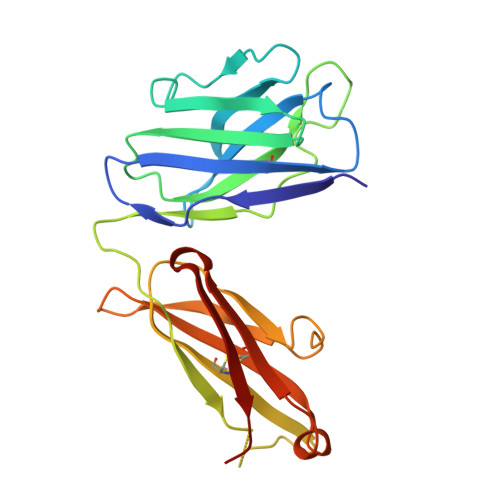
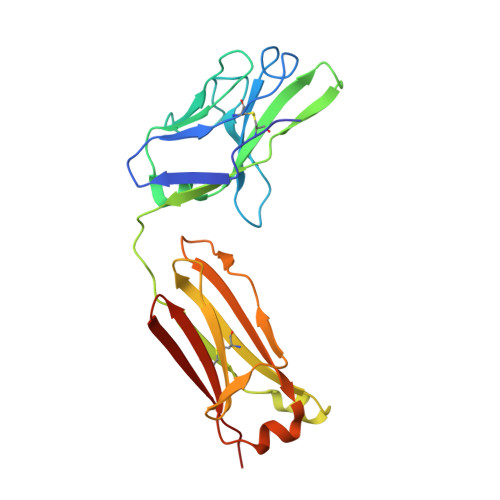
Crystal Structure of MaliM03 Fab in complex with Pfmsp1-19


Experimental Data Snapshot

  • Method: X-RAY DIFFRACTION
  • Resolution: 2.99 Å
  • R-Value Free: 
    0.309 (Depositor), 0.307 (DCC) 
  • R-Value Work: 
    0.252 (Depositor), 0.255 (DCC) 
  • R-Value Observed: 
    0.255 (Depositor) 

Starting Model: experimental
View more details

wwPDB Validation 3D Report Full Report

Validation slider image for 6XQW

This is version 1.3 of the entry. See complete history

Literature

Multimeric antibodies from antigen-specific human IgM+ memory B cells restrict Plasmodium parasites.

Thouvenel, C.D.Fontana, M.F.Netland, J.Krishnamurty, A.T.Takehara, K.K.Chen, Y.Singh, S.Miura, K.Keitany, G.J.Lynch, E.M.Portugal, S.Miranda, M.C.King, N.P.Kollman, J.M.Crompton, P.D.Long, C.A.Pancera, M.Rawlings, D.J.Pepper, M.

(2021) J Exp Medicine 218

  • DOI: https://doi.org/10.1084/jem.20200942
  • Primary Citation Related Structures: 
    6XQW

  • PubMed Abstract: 

    Multimeric immunoglobulin-like molecules arose early in vertebrate evolution, yet the unique contributions of multimeric IgM antibodies to infection control are not well understood. This is partially due to the difficulty of distinguishing low-affinity IgM, secreted rapidly by plasmablasts, from high-affinity antibodies derived from later-arising memory cells. We developed a pipeline to express B cell receptors (BCRs) from Plasmodium falciparum-specific IgM+ and IgG+ human memory B cells (MBCs) as both IgM and IgG molecules. BCRs from both subsets were somatically hypermutated and exhibited comparable monomeric affinity. Crystallization of one IgM+ MBC-derived antibody complexed with antigen defined a linear epitope within a conserved Plasmodium protein. In its physiological multimeric state, this antibody displayed exponentially higher antigen binding than a clonally identical IgG monomer, and more effectively inhibited P. falciparum invasion. Forced multimerization of this IgG significantly improved both antigen binding and parasite restriction, underscoring how avidity can alter antibody function. This work demonstrates the potential of high-avidity IgM in both therapeutics and vaccines.


  • Organizational Affiliation
    • Center for Immunity and Immunotherapies, Seattle Children's Research Institute, Seattle, WA.

Macromolecule Content 

  • Total Structure Weight: 57.97 kDa 
  • Atom Count: 3,633 
  • Modeled Residue Count: 507 
  • Deposited Residue Count: 538 
  • Unique protein chains: 3

Macromolecules

Find similar proteins by:|  3D Structure
Entity ID: 1
MoleculeChains  Sequence LengthOrganismDetailsImage
MaliM03 Fab Heavy ChainA [auth H]223Homo sapiensMutation(s): 0 
Find similar proteins by:|  3D Structure
Entity ID: 2
MoleculeChains  Sequence LengthOrganismDetailsImage
MaliM03 Fab Light ChainB [auth L]216Homo sapiensMutation(s): 0 
Find similar proteins by:|  3D Structure
Entity ID: 3
MoleculeChains  Sequence LengthOrganismDetailsImage
Pfmsp1-19C [auth E]99Plasmodium falciparumMutation(s): 0 
Gene Names: MSP-1
UniProt
Find proteins for A0A345FAI3 (Plasmodium falciparum)
Explore A0A345FAI3 
Go to UniProtKB:  A0A345FAI3
Entity Groups
Sequence Clusters30% Identity50% Identity70% Identity90% Identity95% Identity100% Identity
UniProt GroupA0A345FAI3
Sequence Annotations
Expand
Reference Sequence

Experimental Data & Validation

Experimental Data

  • Method: X-RAY DIFFRACTION
  • Resolution: 2.99 Å
  • R-Value Free:  0.309 (Depositor), 0.307 (DCC) 
  • R-Value Work:  0.252 (Depositor), 0.255 (DCC) 
  • R-Value Observed: 0.255 (Depositor) 
Space Group: C 1 2 1
Unit Cell:
Length ( Å )Angle ( ˚ )
a = 119.737α = 90
b = 69.451β = 108.24
c = 65.834γ = 90
Software Package:
Software NamePurpose
HKL-2000data scaling
PHENIXrefinement
PDB_EXTRACTdata extraction
HKL-2000data reduction
PHASERphasing

Structure Validation

View Full Validation Report


Entry History 

& Funding Information

Deposition Data


Funding OrganizationLocationGrant Number
National Institutes of Health/National Institute Of Allergy and Infectious Diseases (NIH/NIAID)United StatesR01A1118803

Revision History  (Full details and data files)

  • Version 1.0: 2021-03-03
    Type: Initial release
  • Version 1.1: 2021-09-15
    Changes: Database references
  • Version 1.2: 2023-10-18
    Changes: Data collection, Refinement description
  • Version 1.3: 2024-10-09
    Changes: Structure summary