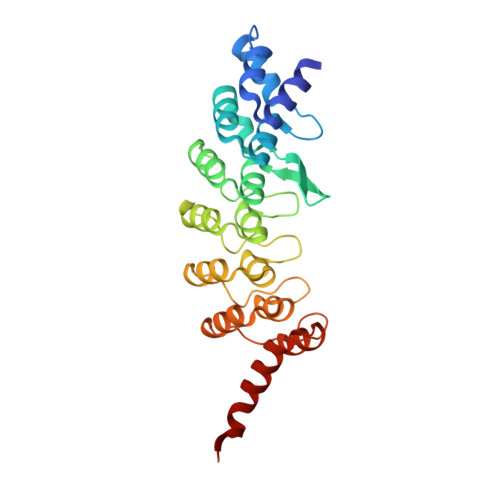
6XKC | pdb_00006xkc

Crystal structure of E3 ligase


Experimental Data Snapshot

  • Method: X-RAY DIFFRACTION
  • Resolution: 2.03 Å
  • R-Value Free: 
    0.242 (Depositor), 0.257 (DCC) 
  • R-Value Work: 
    0.218 (Depositor), 0.227 (DCC) 
  • R-Value Observed: 
    0.219 (Depositor) 

Starting Model: experimental
View more details

wwPDB Validation 3D Report Full Report

Validation slider image for 6XKC

This is version 1.4 of the entry. See complete history

Literature

Molecular basis for ubiquitin ligase CRL2 FEM1C -mediated recognition of C-degron.

Yan, X.Wang, X.Li, Y.Zhou, M.Li, Y.Song, L.Mi, W.Min, J.Dong, C.

(2021) Nat Chem Biol 17: 263-271

  • DOI: https://doi.org/10.1038/s41589-020-00703-4
  • Primary Citation Related Structures: 
    6XKC, 7JYA

  • PubMed Abstract: 

    Proteome integrity depends on the ubiquitin-proteasome system to degrade unwanted or abnormal proteins. In addition to the N-degrons, C-terminal residues of proteins can also serve as degradation signals (C-degrons) that are recognized by specific cullin-RING ubiquitin ligases (CRLs) for proteasomal degradation. FEM1C is a CRL2 substrate receptor that targets the C-terminal arginine degron (Arg/C-degron), but the molecular mechanism of substrate recognition remains largely elusive. Here, we present crystal structures of FEM1C in complex with Arg/C-degron and show that FEM1C utilizes a semi-open binding pocket to capture the C-terminal arginine and that the extreme C-terminal arginine is the major structural determinant in recognition by FEM1C. Together with biochemical and mutagenesis studies, we provide a framework for understanding molecular recognition of the Arg/C-degron by the FEM family of proteins.


  • Organizational Affiliation
    • Department of Biochemistry and Molecular Biology, The Province and Ministry Co-sponsored Collaborative Innovation Center for Medical Epigenetics, School of Basic Medical Sciences, Tianjin Medical University, Tianjin, China.

Macromolecule Content 

  • Total Structure Weight: 159.75 kDa 
  • Atom Count: 13,062 
  • Modeled Residue Count: 1,458 
  • Deposited Residue Count: 1,476 
  • Unique protein chains: 1

Macromolecules

Find similar proteins by:|  3D Structure
Entity ID: 1
MoleculeChains  Sequence LengthOrganismDetailsImage
Protein fem-1 homolog C
A, B, C, D, E
A, B, C, D, E, F
246Homo sapiensMutation(s): 0 
Gene Names: FEM1CKIAA1785
UniProt & NIH Common Fund Data Resources
Find proteins for Q96JP0 (Homo sapiens)
Explore Q96JP0 
Go to UniProtKB:  Q96JP0
PHAROS:  Q96JP0
GTEx:  ENSG00000145780 
Entity Groups
Sequence Clusters30% Identity50% Identity70% Identity90% Identity95% Identity100% Identity
UniProt GroupQ96JP0
Sequence Annotations
Expand
Reference Sequence

Experimental Data & Validation

Experimental Data

  • Method: X-RAY DIFFRACTION
  • Resolution: 2.03 Å
  • R-Value Free:  0.242 (Depositor), 0.257 (DCC) 
  • R-Value Work:  0.218 (Depositor), 0.227 (DCC) 
  • R-Value Observed: 0.219 (Depositor) 
Space Group: P 31
Unit Cell:
Length ( Å )Angle ( ˚ )
a = 97.003α = 90
b = 97.003β = 90
c = 148.341γ = 120
Software Package:
Software NamePurpose
SCALEPACKdata scaling
BUSTERrefinement
PDB_EXTRACTdata extraction
HKL-3000data reduction
PHASERphasing

Structure Validation

View Full Validation Report


Entry History 

Deposition Data

Revision History  (Full details and data files)

  • Version 1.0: 2020-10-14
    Type: Initial release
  • Version 1.1: 2020-12-23
    Changes: Database references
  • Version 1.2: 2021-01-20
    Changes: Database references
  • Version 1.3: 2021-03-10
    Changes: Database references
  • Version 1.4: 2023-10-18
    Changes: Data collection, Database references, Refinement description