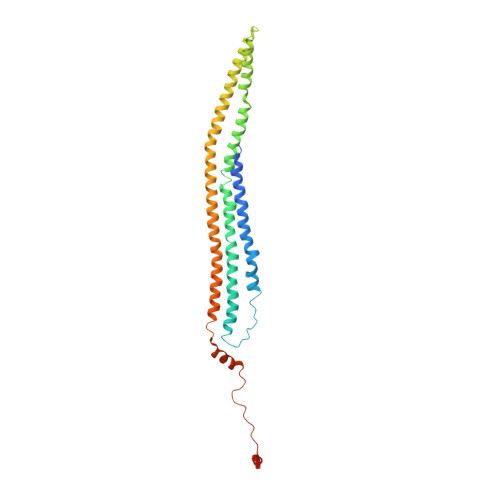
6XJ1 | pdb_00006xj1

Crystal Structure of CDC15 F-BAR Domain from Schizosaccharomyces pombe


Experimental Data Snapshot

  • Method: X-RAY DIFFRACTION
  • Resolution: 3.52 Å
  • R-Value Free: 
    0.310 (Depositor), 0.307 (DCC) 
  • R-Value Work: 
    0.267 (Depositor), 0.269 (DCC) 
  • R-Value Observed: 
    0.269 (Depositor) 

Starting Model: experimental
View more details

wwPDB Validation 3D Report Full Report

Validation slider image for 6XJ1

This is version 1.2 of the entry. See complete history

Literature

Opposite Surfaces of the Cdc15 F-BAR Domain Create a Membrane Platform That Coordinates Cytoskeletal and Signaling Components for Cytokinesis.

Snider, C.E.Chandra, M.McDonald, N.A.Willet, A.H.Collier, S.E.Ohi, M.D.Jackson, L.P.Gould, K.L.

(2020) Cell Rep 33: 108526-108526

  • DOI: https://doi.org/10.1016/j.celrep.2020.108526
  • Primary Citation Related Structures: 
    6XJ1

  • PubMed Abstract: 

    Many eukaryotes assemble an actin- and myosin-based cytokinetic ring (CR) on the plasma membrane (PM) for cell division, but how it is anchored there remains unclear. In Schizosaccharomyces pombe, the F-BAR protein Cdc15 links the PM via its F-BAR domain to proteins in the CR's interior via its SH3 domain. However, Cdc15's F-BAR domain also directly binds formin Cdc12, suggesting that Cdc15 may polymerize a protein network directly adjacent to the membrane. Here, we determine that the F-BAR domain binds Cdc12 using residues on the face opposite its membrane-binding surface. These residues also bind paxillin-like Pxl1, promoting its recruitment with calcineurin to the CR. Mutation of these F-BAR domain residues results in a shallower CR, with components localizing ∼35% closer to the PM than in wild type, and aberrant CR constriction. Thus, F-BAR domains serve as oligomeric membrane-bound platforms that can modulate the architecture of an entire actin structure.


  • Organizational Affiliation
    • Department of Cell and Developmental Biology, Vanderbilt University, Nashville, TN 37232, USA.

Macromolecule Content 

  • Total Structure Weight: 68.07 kDa 
  • Atom Count: 4,458 
  • Modeled Residue Count: 543 
  • Deposited Residue Count: 588 
  • Unique protein chains: 1

Macromolecules

Find similar proteins by:|  3D Structure
Entity ID: 1
MoleculeChains  Sequence LengthOrganismDetailsImage
Cell division control protein 15
A, B
294Schizosaccharomyces pombe 972h-Mutation(s): 2 
Gene Names: cdc15SPAC20G8.05c
UniProt
Find proteins for Q09822 (Schizosaccharomyces pombe (strain 972 / ATCC 24843))
Explore Q09822 
Go to UniProtKB:  Q09822
Entity Groups
Sequence Clusters30% Identity50% Identity70% Identity90% Identity95% Identity100% Identity
UniProt GroupQ09822
Sequence Annotations
Expand
Reference Sequence

Experimental Data & Validation

Experimental Data

  • Method: X-RAY DIFFRACTION
  • Resolution: 3.52 Å
  • R-Value Free:  0.310 (Depositor), 0.307 (DCC) 
  • R-Value Work:  0.267 (Depositor), 0.269 (DCC) 
  • R-Value Observed: 0.269 (Depositor) 
Space Group: P 1 21 1
Unit Cell:
Length ( Å )Angle ( ˚ )
a = 54.777α = 90
b = 75.171β = 95.33
c = 93.239γ = 90
Software Package:
Software NamePurpose
PHENIXrefinement
PDB_EXTRACTdata extraction
HKL-2000data reduction
HKL-2000data scaling
PHASERphasing

Structure Validation

View Full Validation Report


Entry History 

& Funding Information

Deposition Data


Funding OrganizationLocationGrant Number
National Institutes of Health/National Institute of General Medical Sciences (NIH/NIGMS)United StatesNIH R35GM119525

Revision History  (Full details and data files)

  • Version 1.0: 2020-12-16
    Type: Initial release
  • Version 1.1: 2021-06-30
    Changes: Database references
  • Version 1.2: 2023-10-18
    Changes: Data collection, Database references, Refinement description