6WSJ | pdb_00006wsj

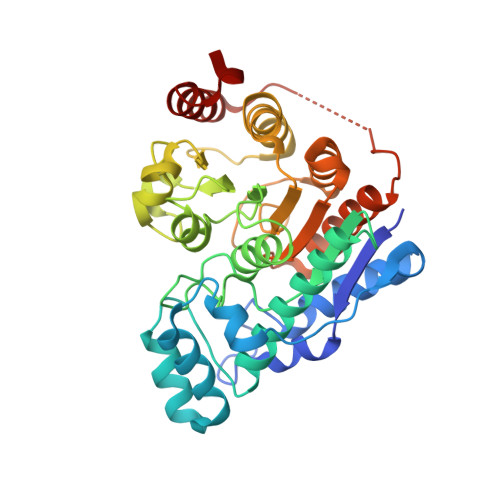
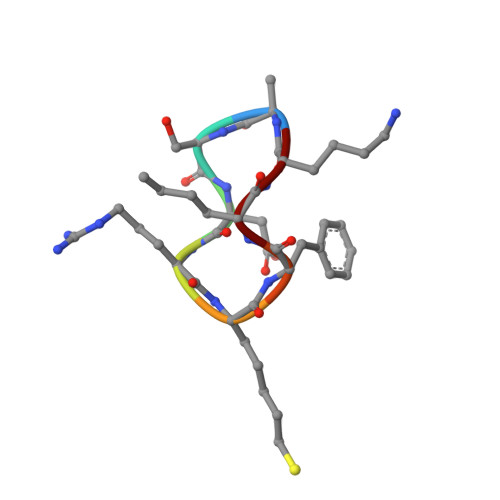
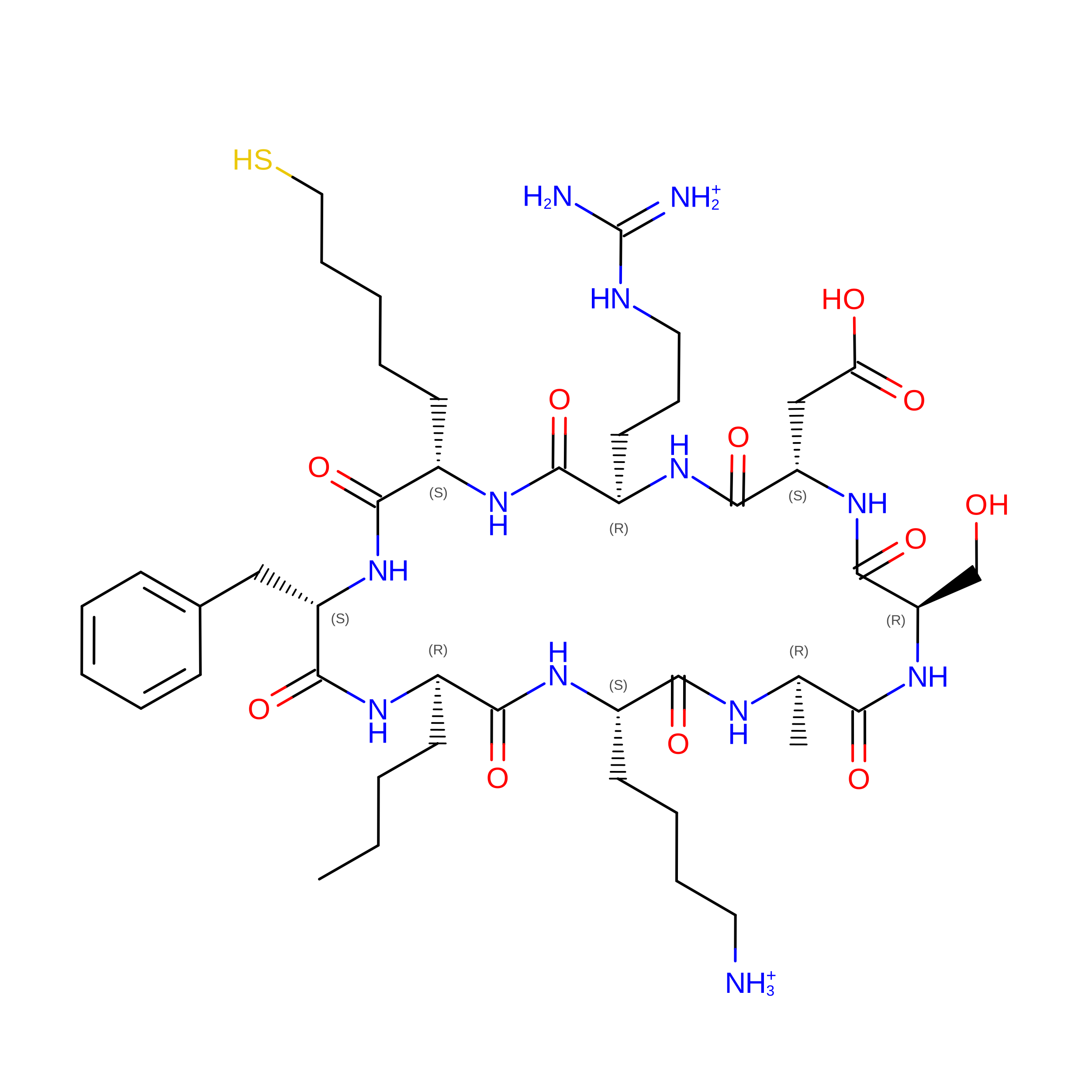
Crystal Structure of Danio rerio histone deacetylase 6 catalytic domain 2 complexed with cyclopeptide des4.3.1


Experimental Data Snapshot

  • Method: X-RAY DIFFRACTION
  • Resolution: 1.70 Å
  • R-Value Free: 
    0.176 (Depositor), 0.178 (DCC) 
  • R-Value Work: 
    0.154 (Depositor), 0.156 (DCC) 
  • R-Value Observed: 
    0.155 (Depositor) 

Starting Model: experimental
View more details

wwPDB Validation 3D Report Full Report

Validation slider image for 6WSJ

This is version 1.3 of the entry. See complete history

Literature

Anchor extension: a structure-guided approach to design cyclic peptides targeting enzyme active sites.

Hosseinzadeh, P.Watson, P.R.Craven, T.W.Li, X.Rettie, S.Pardo-Avila, F.Bera, A.K.Mulligan, V.K.Lu, P.Ford, A.S.Weitzner, B.D.Stewart, L.J.Moyer, A.P.Di Piazza, M.Whalen, J.G.Greisen, P.J.Christianson, D.W.Baker, D.

(2021) Nat Commun 12: 3384-3384

  • DOI: https://doi.org/10.1038/s41467-021-23609-8
  • Primary Citation Related Structures: 
    6WHN, 6WHO, 6WHQ, 6WHZ, 6WI3, 6WSJ

  • PubMed Abstract: 

    Despite recent success in computational design of structured cyclic peptides, de novo design of cyclic peptides that bind to any protein functional site remains difficult. To address this challenge, we develop a computational "anchor extension" methodology for targeting protein interfaces by extending a peptide chain around a non-canonical amino acid residue anchor. To test our approach using a well characterized model system, we design cyclic peptides that inhibit histone deacetylases 2 and 6 (HDAC2 and HDAC6) with enhanced potency compared to the original anchor (IC 50 values of 9.1 and 4.4 nM for the best binders compared to 5.4 and 0.6 µM for the anchor, respectively). The HDAC6 inhibitor is among the most potent reported so far. These results highlight the potential for de novo design of high-affinity protein-peptide interfaces, as well as the challenges that remain.


  • Organizational Affiliation
    • University of Washington, Department of Biochemistry, Institute for Protein Design, Seattle, WA, USA.

Macromolecule Content 

  • Total Structure Weight: 41.55 kDa 
  • Atom Count: 3,062 
  • Modeled Residue Count: 361 
  • Deposited Residue Count: 372 
  • Unique protein chains: 2

Macromolecules

Find similar proteins by:|  3D Structure
Entity ID: 1
MoleculeChains  Sequence LengthOrganismDetailsImage
Hdac6 protein364Danio rerioMutation(s): 0 
Gene Names: hdac6
UniProt
Find proteins for F8W4B7 (Danio rerio)
Explore F8W4B7 
Go to UniProtKB:  F8W4B7
Entity Groups
Sequence Clusters30% Identity50% Identity70% Identity90% Identity95% Identity100% Identity
UniProt GroupF8W4B7
Sequence Annotations
Expand
Reference Sequence
Find similar proteins by:  Sequence   |   3D Structure  
Entity ID: 2
MoleculeChains  Sequence LengthOrganismDetailsImage
cyclopeptide des4.3.1B [auth I]8synthetic constructMutation(s): 0 

Biologically Interesting Molecules (External Reference) 

1 Unique

Experimental Data & Validation

Experimental Data

  • Method: X-RAY DIFFRACTION
  • Resolution: 1.70 Å
  • R-Value Free:  0.176 (Depositor), 0.178 (DCC) 
  • R-Value Work:  0.154 (Depositor), 0.156 (DCC) 
  • R-Value Observed: 0.155 (Depositor) 
Space Group: P 2 21 21
Unit Cell:
Length ( Å )Angle ( ˚ )
a = 51.5α = 90
b = 84β = 90
c = 94.42γ = 90
Software Package:
Software NamePurpose
PHENIXrefinement
iMOSFLMdata reduction
Aimlessdata scaling
PHASERphasing

Structure Validation

View Full Validation Report


Entry History 

& Funding Information

Deposition Data


Funding OrganizationLocationGrant Number
National Institutes of Health/National Institute of General Medical Sciences (NIH/NIGMS)United StatesGM49758

Revision History  (Full details and data files)

  • Version 1.0: 2021-04-28
    Type: Initial release
  • Version 1.1: 2021-09-01
    Changes: Database references
  • Version 1.2: 2023-10-18
    Changes: Data collection, Refinement description
  • Version 1.3: 2023-11-15
    Changes: Data collection