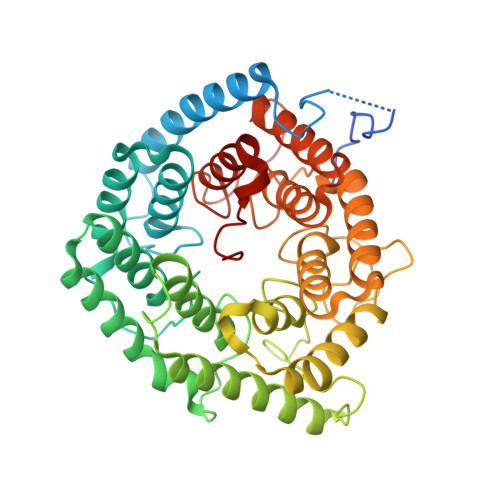
6WQ1 | pdb_00006wq1

Eukaryotic LanCL2 protein


Experimental Data Snapshot

  • Method: X-RAY DIFFRACTION
  • Resolution: 2.29 Å
  • R-Value Free: 
    0.245 (Depositor), 0.246 (DCC) 
  • R-Value Work: 
    0.184 (Depositor), 0.185 (DCC) 
  • R-Value Observed: 
    0.187 (Depositor) 

Starting Model: experimental
View more details

wwPDB Validation 3D Report Full Report

Validation slider image for 6WQ1

This is version 1.2 of the entry. See complete history

Literature

LanCLs add glutathione to dehydroamino acids generated at phosphorylated sites in the proteome.

Lai, K.Y.Galan, S.R.G.Zeng, Y.Zhou, T.H.He, C.Raj, R.Riedl, J.Liu, S.Chooi, K.P.Garg, N.Zeng, M.Jones, L.H.Hutchings, G.J.Mohammed, S.Nair, S.K.Chen, J.Davis, B.G.van der Donk, W.A.

(2021) Cell 184: 2680-2695.e26

  • DOI: https://doi.org/10.1016/j.cell.2021.04.001
  • Primary Citation Related Structures: 
    6WQ1

  • PubMed Abstract: 

    Enzyme-mediated damage repair or mitigation, while common for nucleic acids, is rare for proteins. Examples of protein damage are elimination of phosphorylated Ser/Thr to dehydroalanine/dehydrobutyrine (Dha/Dhb) in pathogenesis and aging. Bacterial LanC enzymes use Dha/Dhb to form carbon-sulfur linkages in antimicrobial peptides, but the functions of eukaryotic LanC-like (LanCL) counterparts are unknown. We show that LanCLs catalyze the addition of glutathione to Dha/Dhb in proteins, driving irreversible C-glutathionylation. Chemo-enzymatic methods were developed to site-selectively incorporate Dha/Dhb at phospho-regulated sites in kinases. In human MAPK-MEK1, such "elimination damage" generated aberrantly activated kinases, which were deactivated by LanCL-mediated C-glutathionylation. Surveys of endogenous proteins bearing damage from elimination (the eliminylome) also suggest it is a source of electrophilic reactivity. LanCLs thus remove these reactive electrophiles and their potentially dysregulatory effects from the proteome. As knockout of LanCL in mice can result in premature death, repair of this kind of protein damage appears important physiologically.


  • Organizational Affiliation
    • Department of Biochemistry, University of Illinois at Urbana-Champaign, Urbana, IL 61801, USA.

Macromolecule Content 

  • Total Structure Weight: 203.95 kDa 
  • Atom Count: 13,475 
  • Modeled Residue Count: 1,583 
  • Deposited Residue Count: 1,800 
  • Unique protein chains: 1

Macromolecules

Find similar proteins by:|  3D Structure
Entity ID: 1
MoleculeChains  Sequence LengthOrganismDetailsImage
LanC-like protein 2
A, B, C, D
450Homo sapiensMutation(s): 0 
Gene Names: LANCL2GPR69BTASP
UniProt & NIH Common Fund Data Resources
Find proteins for Q9NS86 (Homo sapiens)
Explore Q9NS86 
Go to UniProtKB:  Q9NS86
PHAROS:  Q9NS86
GTEx:  ENSG00000132434 
Entity Groups
Sequence Clusters30% Identity50% Identity70% Identity90% Identity95% Identity100% Identity
UniProt GroupQ9NS86
Sequence Annotations
Expand
Reference Sequence

Experimental Data & Validation

Experimental Data

  • Method: X-RAY DIFFRACTION
  • Resolution: 2.29 Å
  • R-Value Free:  0.245 (Depositor), 0.246 (DCC) 
  • R-Value Work:  0.184 (Depositor), 0.185 (DCC) 
  • R-Value Observed: 0.187 (Depositor) 
Space Group: P 1 21 1
Unit Cell:
Length ( Å )Angle ( ˚ )
a = 52.415α = 90
b = 108.012β = 91.26
c = 152.013γ = 90
Software Package:
Software NamePurpose
HKL-2000data reduction
SCALEPACKdata scaling
PHASERphasing
PHENIXrefinement
PDB_EXTRACTdata extraction

Structure Validation

View Full Validation Report


Entry History 

& Funding Information

Deposition Data


Funding OrganizationLocationGrant Number
National Institutes of Health/National Institute of General Medical Sciences (NIH/NIGMS)United States--

Revision History  (Full details and data files)

  • Version 1.0: 2021-05-05
    Type: Initial release
  • Version 1.1: 2021-11-17
    Changes: Database references
  • Version 1.2: 2023-10-18
    Changes: Data collection, Refinement description