Download Mendeley
Altering chemotaxis as a strategy to enhance the foraging range of motility-restricted bacteria.
Frederick, A., Lopes, C., Fulton, B., Huang, Y., Podicheti, R., Rusch, D., Minasov, G., Shuvalova, L., Satchell, K.J.F., Rowe-Magnus, D.A.(2026) Commun Biol
- PubMed: 41495260 Search on PubMed
- DOI: https://doi.org/10.1038/s42003-025-09475-w
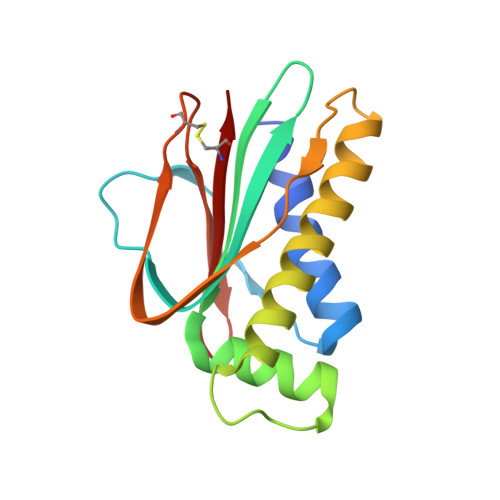
- Primary Citation Related Structures:
6VPW - PubMed Abstract:
Chemotaxis is an adaptive mechanism that shapes the behavior of motile bacteria in habitats characterized by fluctuating and often conflicting cues environmental (e.g. stay-or-go). Chemotactic responses are orchestrated by phosphorylation of CheY, which triggers rotational switching of the flagella. In Escherichia coli and similar taxa, CheZ is the principal CheY-P phosphatase, whereas in lineages lacking CheZ, members of the structurally distinct CheC-FliY-CheX family fulfill this role. Intriguingly, some bacteria code for CheX and CheZ, presenting a conundrum regarding their function, and the role of CheX in CheZ-containing organisms is unknown. We imposed a sustained motility constraint under conditions of looming nutrient depletion in Vibrio vulnificus, which possesses both CheX and CheZ, using the c-di-GMP effector PlzD that robustly curtails swimming motility. Our analyses revealed that the activity of CheX, but not CheZ, could be attenuated to mitigate the imposed constraint, assigning CheX a pivotal function in fine-tuning foraging behavior during a "stay-or-go" decision. V. vulnificus CheX maintained CheY-P phosphatase activity despite its conserved dimeric fold structure exhibiting divergence in active-site architecture, suggesting a preserved catalytic mechanism among distantly related homologs. Co-conservation of cheX and cheZ across disparate bacterial phyla suggests their adaptative retention confers robustness and versatility to chemotactic control.
- Department of Biology, Indiana University Bloomington, Bloomington, IN, USA.
Organizational Affiliation: