Download Mendeley
Machine learning-driven multiscale modeling reveals lipid-dependent dynamics of RAS signaling proteins.
Ingolfsson, H.I., Neale, C., Carpenter, T.S., Shrestha, R., Lopez, C.A., Tran, T.H., Oppelstrup, T., Bhatia, H., Stanton, L.G., Zhang, X., Sundram, S., Di Natale, F., Agarwal, A., Dharuman, G., Kokkila Schumacher, S.I.L., Turbyville, T., Gulten, G., Van, Q.N., Goswami, D., Jean-Francois, F., Agamasu, C., Hettige, J.J., Travers, T., Sarkar, S., Surh, M.P., Yang, Y., Moody, A., Liu, S., Van Essen, B.C., Voter, A.F., Ramanathan, A., Hengartner, N.W., Simanshu, D.K., Stephen, A.G., Bremer, P.T., Gnanakaran, S., Glosli, J.N., Lightstone, F.C., McCormick, F., Nissley, D.V., Streitz, F.H.(2022) Proc Natl Acad Sci U S A 119
- PubMed: 34983849 Search on PubMedSearch on PubMed Central
- DOI: https://doi.org/10.1073/pnas.2113297119
- Primary Citation Related Structures:
6VC8 - PubMed Abstract:
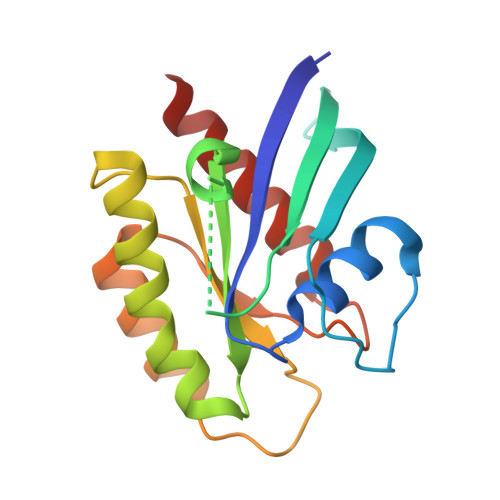
RAS is a signaling protein associated with the cell membrane that is mutated in up to 30% of human cancers. RAS signaling has been proposed to be regulated by dynamic heterogeneity of the cell membrane. Investigating such a mechanism requires near-atomistic detail at macroscopic temporal and spatial scales, which is not possible with conventional computational or experimental techniques. We demonstrate here a multiscale simulation infrastructure that uses machine learning to create a scale-bridging ensemble of over 100,000 simulations of active wild-type KRAS on a complex, asymmetric membrane. Initialized and validated with experimental data (including a new structure of active wild-type KRAS), these simulations represent a substantial advance in the ability to characterize RAS-membrane biology. We report distinctive patterns of local lipid composition that correlate with interfacially promiscuous RAS multimerization. These lipid fingerprints are coupled to RAS dynamics, predicted to influence effector binding, and therefore may be a mechanism for regulating cell signaling cascades.
- Physical and Life Sciences Directorate, Lawrence Livermore National Laboratory, Livermore, CA 94550.
Organizational Affiliation: