6V8X | pdb_00006v8x

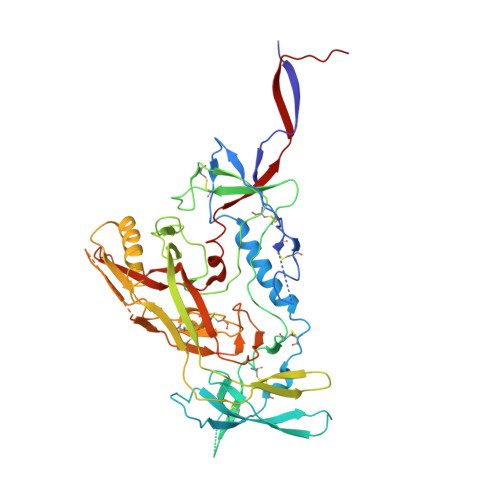
VRC01 Bound BG505 F14 HIV-1 SOSIP Envelope Trimer Structure


Experimental Data Snapshot

  • Method: ELECTRON MICROSCOPY
  • Resolution: 3.00 Å
  • Aggregation State: PARTICLE 
  • Reconstruction Method: SINGLE PARTICLE 

wwPDB Validation 3D Report Full Report

Validation slider image for 6V8X

This is version 2.1 of the entry. See complete history. 

Literature

Disruption of the HIV-1 Envelope allosteric network blocks CD4-induced rearrangements.

Henderson, R., Lu, M., Zhou, Y., Mu, Z., Parks, R., Han, Q., Hsu, A.L., Carter, E., Blanchard, S.C., Edwards, R.J., Wiehe, K., Saunders, K.O., Borgnia, M.J., Bartesaghi, A., Mothes, W., Haynes, B.F., Acharya, P., Munir Alam, S.

(2020) Nat Commun 11: 520-520

  • DOI: https://doi.org/10.1038/s41467-019-14196-w
  • Primary Citation Related Structures: 
    6V8X, 6V8Z

  • PubMed Abstract: 

    The trimeric HIV-1 Envelope protein (Env) mediates viral-host cell fusion via a network of conformational transitions, with allosteric elements in each protomer orchestrating host receptor-induced exposure of the co-receptor binding site and fusion elements. To understand the molecular details of this allostery, here, we introduce Env mutations aimed to prevent CD4-induced rearrangements in the HIV-1 BG505 Env trimer. Binding analysis and single-molecule Förster Resonance Energy Transfer confirm that these mutations prevent CD4-induced transitions of the HIV-1 Env. Structural analysis by single-particle cryo-electron microscopy performed on the BG505 SOSIP mutant Env proteins shows rearrangements in the gp120 topological layer contacts with gp41. Displacement of a conserved tryptophan (W571) from its typical pocket in these Env mutants renders the Env insensitive to CD4 binding. These results reveal the critical function of W571 as a conformational switch in Env allostery and receptor-mediated viral entry and provide insights on Env conformation that are relevant for vaccine design.


  • Organizational Affiliation: 
    • Department of Medicine, Duke University School of Medicine, Durham, NC, 27710, USA. rory.henderson@duke.edu.

Macromolecule Content 

  • Total Structure Weight: 371.13 kDa 
  • Atom Count: 24,825 
  • Modeled Residue Count: 2,997 
  • Deposited Residue Count: 3,144 
  • Unique protein chains: 4

Macromolecules

Find similar proteins by:|  3D Structure
Entity ID: 1
MoleculeChains  Sequence LengthOrganismDetailsImage
Envelope glycoprotein gp120
A, E, I
471Human immunodeficiency virus 1Mutation(s): 0 
Gene Names: env
UniProt
Find proteins for Q2N0S6 (Human immunodeficiency virus type 1)
Explore Q2N0S6 
Go to UniProtKB:  Q2N0S6
Entity Groups
Sequence Clusters30% Identity50% Identity70% Identity90% Identity95% Identity100% Identity
UniProt GroupQ2N0S6
Glycosylation
Glycosylation Sites: 16
Sequence Annotations
Expand
Reference Sequence
Find similar proteins by:|  3D Structure
Entity ID: 2
MoleculeChains  Sequence LengthOrganismDetailsImage
Envelope glycoprotein gp41
B, F, J
145Human immunodeficiency virus 1Mutation(s): 0 
Gene Names: env
UniProt
Find proteins for Q2N0S9 (Human immunodeficiency virus type 1)
Explore Q2N0S9 
Go to UniProtKB:  Q2N0S9
Entity Groups
Sequence Clusters30% Identity50% Identity70% Identity90% Identity95% Identity100% Identity
UniProt GroupQ2N0S9
Glycosylation
Glycosylation Sites: 1
Sequence Annotations
Expand
Reference Sequence
Find similar proteins by:|  3D Structure
Entity ID: 3
MoleculeChains  Sequence LengthOrganismDetailsImage
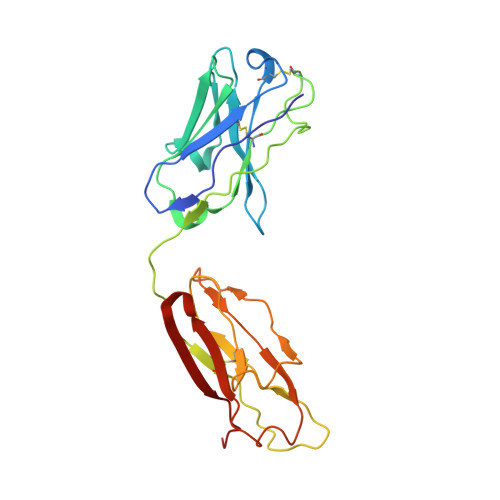
VRC01 Fab Heavy Chain
C, G, K
224Homo sapiensMutation(s): 0 
UniProt
Find proteins for Q6N095 (Homo sapiens)
Explore Q6N095 
Go to UniProtKB:  Q6N095
Entity Groups
Sequence Clusters30% Identity50% Identity70% Identity90% Identity95% Identity100% Identity
UniProt GroupQ6N095
Sequence Annotations
Expand
Reference Sequence
Find similar proteins by:|  3D Structure
Entity ID: 4
MoleculeChains  Sequence LengthOrganismDetailsImage
VRC01 Fab Light Chain
D, H, L
208Homo sapiensMutation(s): 0 
UniProt
Find proteins for Q6PIL8 (Homo sapiens)
Explore Q6PIL8 
Go to UniProtKB:  Q6PIL8
Entity Groups
Sequence Clusters30% Identity50% Identity70% Identity90% Identity95% Identity100% Identity
UniProt GroupQ6PIL8
Sequence Annotations
Expand
Reference Sequence

Oligosaccharides

Help  
Entity ID: 5
MoleculeChains Length2D Diagram GlycosylationD Interactions
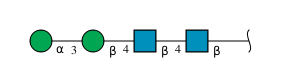
alpha-D-mannopyranose-(1-3)-beta-D-mannopyranose-(1-4)-2-acetamido-2-deoxy-beta-D-glucopyranose-(1-4)-2-acetamido-2-deoxy-beta-D-glucopyranoseKA [auth k],
M,
Y
4N-Glycosylation
Glycosylation Resources
GlyTouCan: G81315DD
GlyCosmos: G81315DD
GlyGen: G81315DD
Entity ID: 7
MoleculeChains Length2D Diagram GlycosylationD Interactions
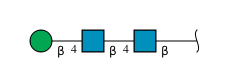
beta-D-mannopyranose-(1-4)-2-acetamido-2-deoxy-beta-D-glucopyranose-(1-4)-2-acetamido-2-deoxy-beta-D-glucopyranose
AA [auth a],
BA [auth b],
CA [auth c],
FA [auth f],
MA [auth m],
AA [auth a],
BA [auth b],
CA [auth c],
FA [auth f],
MA [auth m],
NA [auth n],
O,
OA [auth o],
P,
Q,
RA [auth r],
T
3N-Glycosylation
Glycosylation Resources
GlyTouCan: G15407YE
GlyCosmos: G15407YE
GlyGen: G15407YE

Small Molecules

Ligands 1 Unique
IDChains Name / Formula / InChI Key2D Diagram3D Interactions
NAG

Query on NAG


Download:Ideal Coordinates CCD File
AB [auth B]
BB [auth E]
CB [auth E]
DB [auth E]
EB [auth E]
AB [auth B],
BB [auth E],
CB [auth E],
DB [auth E],
EB [auth E],
FB [auth F],
GB [auth I],
HB [auth I],
IB [auth I],
JB [auth I],
KB [auth J],
WA [auth A],
XA [auth A],
YA [auth A],
ZA [auth A]
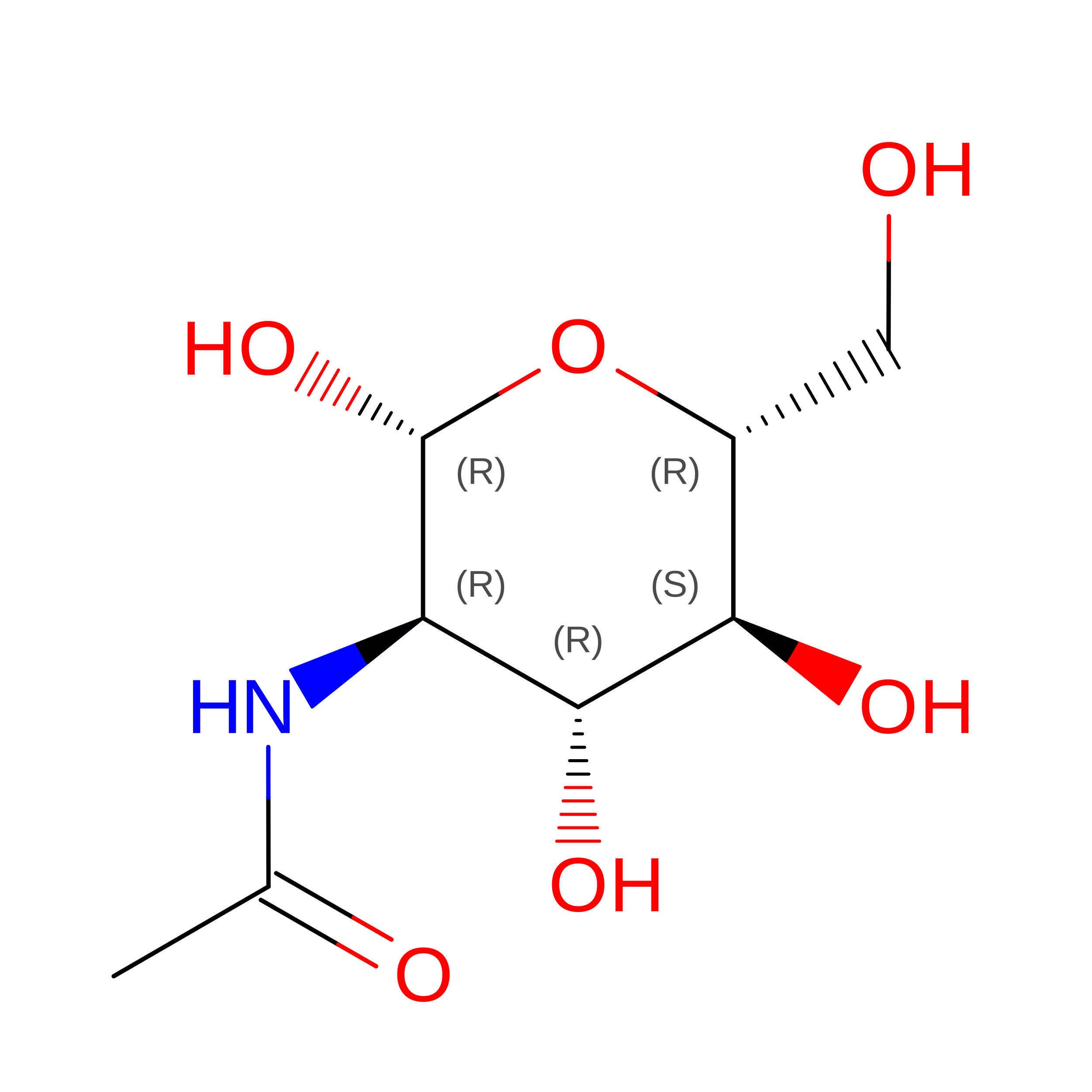
2-acetamido-2-deoxy-beta-D-glucopyranose
C8 H15 N O6
OVRNDRQMDRJTHS-FMDGEEDCSA-N

Experimental Data & Validation

Experimental Data

  • Method: ELECTRON MICROSCOPY
  • Resolution: 3.00 Å
  • Aggregation State: PARTICLE 
  • Reconstruction Method: SINGLE PARTICLE 

Structure Validation

View Full Validation Report


Entry History 

& Funding Information

Deposition Data


Funding OrganizationLocationGrant Number
National Institutes of Health/National Institute Of Allergy and Infectious Diseases (NIH/NIAID)United States1R01AI145687-01

Revision History  (Full details and data files)

  • Version 1.0: 2020-02-05
    Type: Initial release
  • Version 1.1: 2020-02-12
    Changes: Database references
  • Version 2.0: 2020-07-29
    Type: Remediation
    Reason: Carbohydrate remediation
    Changes: Advisory, Atomic model, Data collection, Derived calculations, Structure summary
  • Version 2.1: 2024-10-16
    Changes: Data collection, Database references, Structure summary