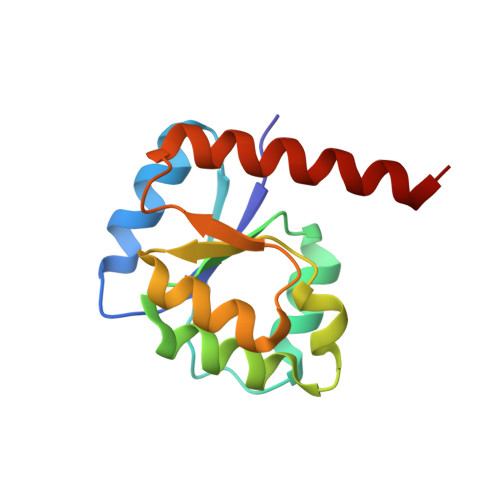
6TH8 | pdb_00006th8

Reconstructing the Origins of the HemD-like fold


Experimental Data Snapshot

  • Method: SOLUTION NMR
  • Conformers Calculated: 50 
  • Conformers Submitted: 21 
  • Selection Criteria: structures with the least restraint violations 

wwPDB Validation 3D Report Full Report

Validation slider image for 6TH8

This is version 1.3 of the entry. See complete history

Literature

Reconstructing the Remote Origins of a Fold Singleton from a Flavodoxin-Like Ancestor.

Toledo-Patino, S.Chaubey, M.Coles, M.Hocker, B.

(2019) Biochemistry 58: 4790-4793

  • DOI: https://doi.org/10.1021/acs.biochem.9b00900
  • Primary Citation Related Structures: 
    6TH8

  • PubMed Abstract: 

    Evolutionary processes that led to the emergence of structured protein domains left footprints in the sequences of modern proteins. We searched for such hints employing state-of-the-art sequence analysis and found evidence that the HemD-like fold emerged from the flavodoxin-like fold through segment swap and gene duplication. To verify this hypothesis, we reverted these evolutionary steps experimentally, constructing a HemD-half that resulted in a protein with the canonical flavodoxin-like architecture. These results of fold reconstruction from the sequence of a different fold strongly support our hypothesis of common ancestry. It further illustrates the plasticity of modern proteins to form new folded proteins.


  • Organizational Affiliation
    • Department of Biochemistry , University of Bayreuth , 95447 Bayreuth , Germany.

Macromolecule Content 

  • Total Structure Weight: 13.65 kDa 
  • Atom Count: 960 
  • Modeled Residue Count: 125 
  • Deposited Residue Count: 125 
  • Unique protein chains: 1

Macromolecules

Find similar proteins by:|  3D Structure
Entity ID: 1
MoleculeChains  Sequence LengthOrganismDetailsImage
cU3Sd125Thermus thermophilusMutation(s): 0 
EC: 4.2.1.75
UniProt
Find proteins for P48246 (Pseudomonas aeruginosa (strain ATCC 15692 / DSM 22644 / CIP 104116 / JCM 14847 / LMG 12228 / 1C / PRS 101 / PAO1))
Explore P48246 
Go to UniProtKB:  P48246
Entity Groups
Sequence Clusters30% Identity50% Identity70% Identity90% Identity95% Identity100% Identity
UniProt GroupP48246
Sequence Annotations
Expand
Reference Sequence

Experimental Data & Validation

Experimental Data

  • Method: SOLUTION NMR
  • Conformers Calculated: 50 
  • Conformers Submitted: 21 
  • Selection Criteria: structures with the least restraint violations 

Structure Validation

View Full Validation Report


Entry History 

& Funding Information

Deposition Data


Funding OrganizationLocationGrant Number
European Research CouncilGermany647548

Revision History  (Full details and data files)

  • Version 1.0: 2019-11-27
    Type: Initial release
  • Version 1.1: 2019-12-11
    Changes: Database references
  • Version 1.2: 2023-06-14
    Changes: Database references, Other
  • Version 1.3: 2024-06-19
    Changes: Data collection, Database references