Download Mendeley
Towards improved understanding of intersubunit interactions in modular polyketide biosynthesis: Docking in the enacyloxin IIa polyketide synthase.
Risser, F., Collin, S., Dos Santos-Morais, R., Gruez, A., Chagot, B., Weissman, K.J.(2020) J Struct Biol 212: 107581-107581
- PubMed: 32717326 Search on PubMed
- DOI: https://doi.org/10.1016/j.jsb.2020.107581
- Primary Citation Related Structures:
6TDD, 6TDM, 6TDN - PubMed Abstract:
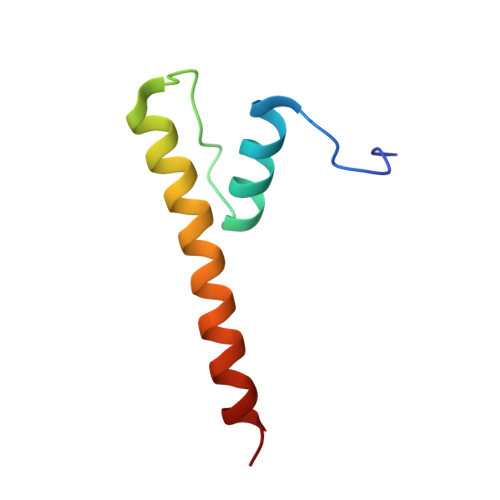
Modular polyketide synthases (PKSs) are molecular-scale assembly lines comprising multiple gigantic polypeptide subunits. Faithful ordering of the subunits is mediated by extreme C- and N-terminal regions called docking domains (DDs). Decrypting how specificity is achieved by these elements is important both for understanding PKS function and modifying it to generate useful polyketide analogues for biological evaluation. Here we report the biophysical and structural characterisation of all six PKS/PKS interfaces in the unusual, chimaeric cis-AT/trans-AT PKS pathway responsible for biosynthesis of the antibiotic enacyloxin IIa in Burkholderia ambifaria. Taken together with previous work, our data reveal that specificity is achieved in the enacyloxin PKS by deploying at least three functionally orthogonal classes of DDs. We also demonstrate for the first time that cis-AT PKS subunits incorporate DDs with intrinsically disordered character, reinforcing the utility of such regions for achieving both medium affinity and high specificity at PKS intersubunit junctions. Overall, this work substantially increases the number of orthogonal DDs available for creating novel, highly-specific interfaces within cis- and trans-AT PKSs and their hybrids. It also reveals unexpected sequence/structure relationships in PKS DDs, identifying major current limitations to both accurately predicting and categorising these useful protein-protein interaction motifs.
- Université de Lorraine, CNRS, IMoPA, F-54000 Nancy, France.
Organizational Affiliation: