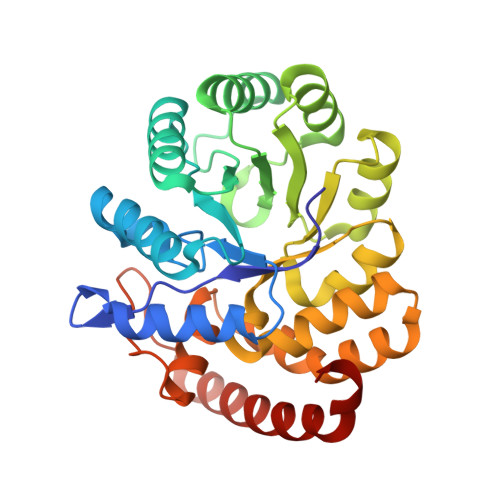
6T3T | pdb_00006t3t

Structure of the 4-hydroxy-tetrahydrodipicolinate synthase from the thermoacidophilic methanotroph Methylacidiphilum fumariolicum SolV


Experimental Data Snapshot

  • Method: X-RAY DIFFRACTION
  • Resolution: 2.10 Å
  • R-Value Free: 
    0.232 (Depositor), 0.232 (DCC) 
  • R-Value Work: 
    0.181 (Depositor), 0.182 (DCC) 
  • R-Value Observed: 
    0.184 (Depositor) 

Starting Model: experimental
View more details

wwPDB Validation 3D Report Full Report

Validation slider image for 6T3T

This is version 1.2 of the entry. See complete history

Literature

Structure of the 4-hydroxy-tetrahydrodipicolinate synthase from the thermoacidophilic methanotroph Methylacidiphilum fumariolicum SolV and the phylogeny of the aminotransferase pathway.

Schmitz, R.A.Dietl, A.Muller, M.Berben, T.Op den Camp, H.J.M.Barends, T.R.M.

(2020) Acta Crystallogr F Struct Biol Commun 76: 199-208

  • DOI: https://doi.org/10.1107/S2053230X20005294
  • Primary Citation Related Structures: 
    6T3T

  • PubMed Abstract: 

    The enzyme 4-hydroxy-tetrahydrodipicolinate synthase (DapA) is involved in the production of lysine and precursor molecules for peptidoglycan synthesis. In a multistep reaction, DapA converts pyruvate and L-aspartate-4-semialdehyde to 4-hydroxy-2,3,4,5-tetrahydrodipicolinic acid. In many organisms, lysine binds allosterically to DapA, causing negative feedback, thus making the enzyme an important regulatory component of the pathway. Here, the 2.1 Å resolution crystal structure of DapA from the thermoacidophilic methanotroph Methylacidiphilum fumariolicum SolV is reported. The enzyme crystallized as a contaminant of a protein preparation from native biomass. Genome analysis reveals that M. fumariolicum SolV utilizes the recently discovered aminotransferase pathway for lysine biosynthesis. Phylogenetic analyses of the genes involved in this pathway shed new light on the distribution of this pathway across the three domains of life.


  • Organizational Affiliation
    • Department of Microbiology, Institute for Water and Wetland Research, Radboud University Nijmegen, 6525 AJ Nijmegen, The Netherlands.

Macromolecule Content 

  • Total Structure Weight: 132.73 kDa 
  • Atom Count: 10,059 
  • Modeled Residue Count: 1,200 
  • Deposited Residue Count: 1,204 
  • Unique protein chains: 1

Macromolecules

Find similar proteins by:|  3D Structure
Entity ID: 1
MoleculeChains  Sequence LengthOrganismDetailsImage
4-hydroxy-tetrahydrodipicolinate synthaseA [auth B],
B [auth A],
C,
D
301Methylacidiphilum fumariolicum SolVMutation(s): 0 
EC: 4.3.3.7
UniProt
Find proteins for I0JZ23 (Methylacidiphilum fumariolicum (strain SolV))
Explore I0JZ23 
Go to UniProtKB:  I0JZ23
Entity Groups
Sequence Clusters30% Identity50% Identity70% Identity90% Identity95% Identity100% Identity
UniProt GroupI0JZ23
Sequence Annotations
Expand
Reference Sequence

Experimental Data & Validation

Experimental Data

  • Method: X-RAY DIFFRACTION
  • Resolution: 2.10 Å
  • R-Value Free:  0.232 (Depositor), 0.232 (DCC) 
  • R-Value Work:  0.181 (Depositor), 0.182 (DCC) 
  • R-Value Observed: 0.184 (Depositor) 
Space Group: P 42
Unit Cell:
Length ( Å )Angle ( ˚ )
a = 109.06α = 90
b = 109.06β = 90
c = 107.84γ = 90
Software Package:
Software NamePurpose
XDSdata reduction
XSCALEdata scaling
PHASERphasing
PHENIXrefinement
PDB_EXTRACTdata extraction

Structure Validation

View Full Validation Report


Entry History 

Deposition Data

Revision History  (Full details and data files)

  • Version 1.0: 2020-05-06
    Type: Initial release
  • Version 1.1: 2020-05-13
    Changes: Database references
  • Version 1.2: 2024-01-24
    Changes: Data collection, Database references, Refinement description