6SAW | pdb_00006saw

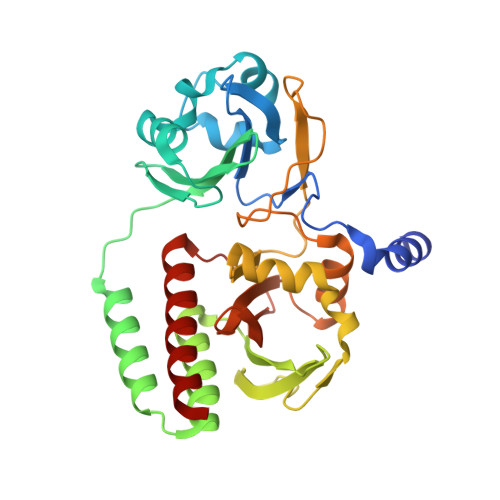
Chromophore binding domain of bacteriophytochrome linked diguanylyl cyclase from Idiomarina species A28L (dimeric Pfr-like state).


Experimental Data Snapshot

  • Method: X-RAY DIFFRACTION
  • Resolution: 3.00 Å
  • R-Value Free: 
    0.229 (Depositor), 0.228 (DCC) 
  • R-Value Work: 
    0.197 (Depositor), 0.197 (DCC) 
  • R-Value Observed: 
    0.198 (Depositor) 

Starting Model: experimental
View more details

wwPDB Validation 3D Report Full Report

Validation slider image for 6SAW

Ligand Structure Quality Assessment 


This is version 1.4 of the entry. See complete history

Literature

Distinct chromophore-protein environments enable asymmetric activation of a bacteriophytochrome-activated diguanylate cyclase.

Buhrke, D.Gourinchas, G.Muller, M.Michael, N.Hildebrandt, P.Winkler, A.

(2020) J Biological Chem 295: 539-551

  • DOI: https://doi.org/10.1074/jbc.RA119.011915
  • Primary Citation Related Structures: 
    6SAW, 6SAX

  • PubMed Abstract: 

    Sensing of red and far-red light by bacteriophytochromes involves intricate interactions between their bilin chromophore and the protein environment. The light-triggered rearrangements of the cofactor configuration and eventually the protein conformation enable bacteriophytochromes to interact with various protein effector domains for biological modulation of diverse physiological functions. Excitation of the holoproteins by red or far-red light promotes the photoconversion to their far-red light-absorbing Pfr state or the red light-absorbing Pr state, respectively. Because prototypical bacteriophytochromes have a parallel dimer architecture, it is generally assumed that symmetric activation with two Pfr state protomers constitutes the signaling-active species. However, the bacteriophytochrome from Idiomarina species A28L ( Is PadC) has recently been reported to enable long-range signal transduction also in asymmetric dimers containing only one Pfr protomer. By combining crystallography, hydrogen-deuterium exchange coupled to MS, and vibrational spectroscopy, we show here that Pfr of Is PadC is in equilibrium with an intermediate "Pfr-like" state that combines features of Pfr and Meta-R states observed in other bacteriophytochromes. We also show that structural rearrangements in the N-terminal segment (NTS) can stabilize this Pfr-like state and that the PHY-tongue conformation of Is PadC is partially uncoupled from the initial changes in the NTS. This uncoupling enables structural asymmetry of the overall homodimeric assembly and allows signal transduction to the covalently linked physiological diguanylate cyclase output module in which asymmetry might play a role in the enzyme-catalyzed reaction. The functional differences to other phytochrome systems identified here highlight opportunities for using additional red-light sensors in artificial sensor-effector systems.


  • Organizational Affiliation
    • Technische Universität Berlin, Institut für Chemie, Sekr. PC14, Straβe des 17. Juni 135, D-10623 Berlin, Germany. Electronic address: david.buhrke@campus.tu-berlin.de.

Macromolecule Content 

  • Total Structure Weight: 292.17 kDa 
  • Atom Count: 20,312 
  • Modeled Residue Count: 2,456 
  • Deposited Residue Count: 2,512 
  • Unique protein chains: 1

Macromolecules

Find similar proteins by:|  3D Structure
Entity ID: 1
MoleculeChains  Sequence LengthOrganismDetailsImage
Diguanylate cyclase (GGDEF) domain-containing protein
A, B, C, D, E
A, B, C, D, E, F, G, H
314Idiomarina sp. A28LMutation(s): 0 
Gene Names: A28LD_0430
UniProt
Find proteins for A0ACD6B9P8 (Idiomarina sp. A28L)
Explore A0ACD6B9P8 
Go to UniProtKB:  A0ACD6B9P8
Entity Groups
Sequence Clusters30% Identity50% Identity70% Identity90% Identity95% Identity100% Identity
UniProt GroupA0ACD6B9P8
Sequence Annotations
Expand
Reference Sequence

Small Molecules

Ligands 2 Unique
IDChains Name / Formula / InChI Key2D Diagram3D Interactions
LBV
(Subject of Investigation/LOI)

Query on LBV


Download:Ideal Coordinates CCD File
I [auth A]
K [auth B]
M [auth C]
O [auth D]
Q [auth E]
I [auth A],
K [auth B],
M [auth C],
O [auth D],
Q [auth E],
S [auth F],
U [auth G],
W [auth H]
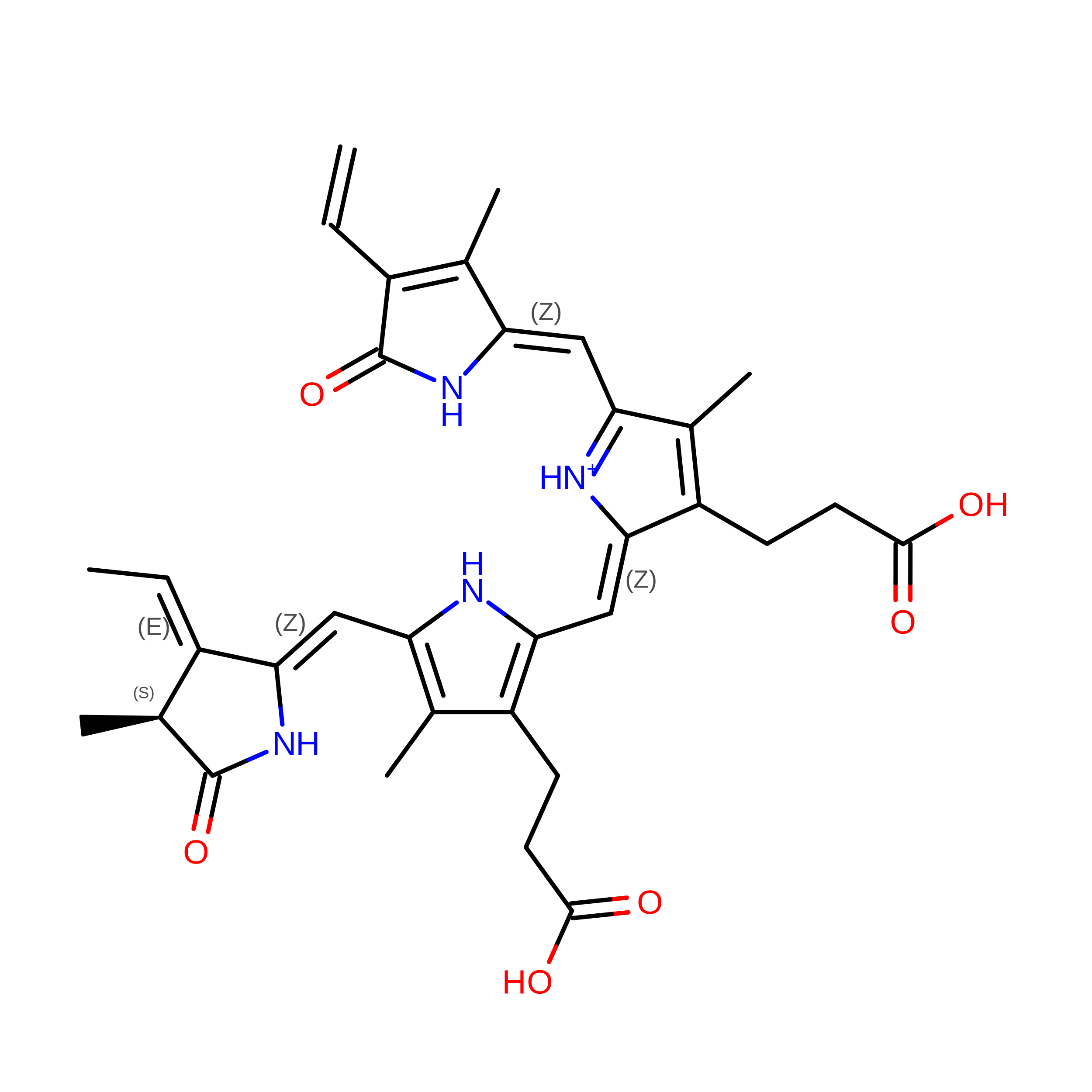
3-[2-[(Z)-[3-(2-carboxyethyl)-5-[(Z)-(4-ethenyl-3-methyl-5-oxidanylidene-pyrrol-2-ylidene)methyl]-4-methyl-pyrrol-1-ium -2-ylidene]methyl]-5-[(Z)-[(3E)-3-ethylidene-4-methyl-5-oxidanylidene-pyrrolidin-2-ylidene]methyl]-4-methyl-1H-pyrrol-3- yl]propanoic acid
C33 H37 N4 O6
DKMLMZVDTGOEGU-ISEYCTJISA-O
CL

Query on CL


Download:Ideal Coordinates CCD File
J [auth A]
L [auth B]
N [auth C]
P [auth D]
R [auth E]
J [auth A],
L [auth B],
N [auth C],
P [auth D],
R [auth E],
T [auth F],
V [auth G],
X [auth H]
CHLORIDE ION
Cl
VEXZGXHMUGYJMC-UHFFFAOYSA-M

Experimental Data & Validation

Experimental Data

  • Method: X-RAY DIFFRACTION
  • Resolution: 3.00 Å
  • R-Value Free:  0.229 (Depositor), 0.228 (DCC) 
  • R-Value Work:  0.197 (Depositor), 0.197 (DCC) 
  • R-Value Observed: 0.198 (Depositor) 
Space Group: H 3
Unit Cell:
Length ( Å )Angle ( ˚ )
a = 344.65α = 90
b = 344.65β = 90
c = 92.44γ = 120
Software Package:
Software NamePurpose
PHENIXrefinement
XDSdata reduction
XSCALEdata scaling
PHASERphasing
PDB_EXTRACTdata extraction

Structure Validation

View Full Validation Report


Ligand Structure Quality Assessment 


Entry History 

& Funding Information

Deposition Data


Funding OrganizationLocationGrant Number
Austrian Science FundAustriaP32022

Revision History  (Full details and data files)

  • Version 1.0: 2019-12-11
    Type: Initial release
  • Version 1.1: 2019-12-25
    Changes: Database references
  • Version 1.2: 2020-01-22
    Changes: Database references
  • Version 1.3: 2024-01-24
    Changes: Data collection, Database references, Derived calculations, Refinement description, Structure summary
  • Version 1.4: 2024-10-16
    Changes: Structure summary