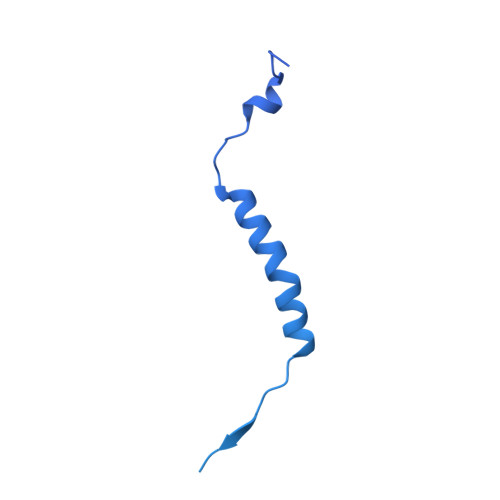
6RD6 | pdb_00006rd6

CryoEM structure of Polytomella F-ATP synthase, focussed refinement of upper peripheral stalk


Experimental Data Snapshot

  • Method: ELECTRON MICROSCOPY
  • Resolution: 2.75 Å
  • Aggregation State: PARTICLE 
  • Reconstruction Method: SINGLE PARTICLE 

wwPDB Validation 3D Report Full Report

Validation slider image for 6RD6

This is version 1.5 of the entry. See complete history

Literature

Rotary substates of mitochondrial ATP synthase reveal the basis of flexible F 1 -F o coupling.

Murphy, B.J.Klusch, N.Langer, J.Mills, D.J.Yildiz, O.Kuhlbrandt, W.

(2019) Science 364

  • DOI: https://doi.org/10.1126/science.aaw9128
  • Primary Citation Related Structures: 
    6RD4, 6RD5, 6RD6, 6RD7, 6RD8, 6RD9, 6RDA, 6RDB, 6RDC, 6RDD, 6RDE, 6RDF, 6RDG, 6RDH, 6RDI, 6RDJ, 6RDK, 6RDL, 6RDM, 6RDN, 6RDO, 6RDP, 6RDQ, 6RDR, 6RDS, 6RDT, 6RDU, 6RDV, 6RDW, 6RDX, 6RDY, 6RDZ, 6RE0, 6RE1, 6RE2, 6RE3, 6RE4, 6RE5, 6RE6, 6RE7, 6RE8, 6RE9, 6REA, 6REB, 6REC, 6RED, 6REE, 6REF, 6REP, 6RER, ... Search all related entries

  • PubMed Abstract: 

    F 1 F o -adenosine triphosphate (ATP) synthases make the energy of the proton-motive force available for energy-consuming processes in the cell. We determined the single-particle cryo-electron microscopy structure of active dimeric ATP synthase from mitochondria of Polytomella sp. at a resolution of 2.7 to 2.8 angstroms. Separation of 13 well-defined rotary substates by three-dimensional classification provides a detailed picture of the molecular motions that accompany c -ring rotation and result in ATP synthesis. Crucially, the F 1 head rotates along with the central stalk and c -ring rotor for the first ~30° of each 120° primary rotary step to facilitate flexible coupling of the stoichiometrically mismatched F 1 and F o subcomplexes. Flexibility is mediated primarily by the interdomain hinge of the conserved OSCP subunit. A conserved metal ion in the proton access channel may synchronize c -ring protonation with rotation.


  • Organizational Affiliation
    • Department of Structural Biology, Max Planck Institute of Biophysics, Frankfurt 60438, Germany.

Macromolecule Content 

  • Total Structure Weight: 182.97 kDa 
  • Atom Count: 7,758 
  • Modeled Residue Count: 1,035 
  • Deposited Residue Count: 1,716 
  • Unique protein chains: 5

Macromolecules

Find similar proteins by:|  3D Structure
Entity ID: 1
MoleculeChains  Sequence LengthOrganismDetailsImage
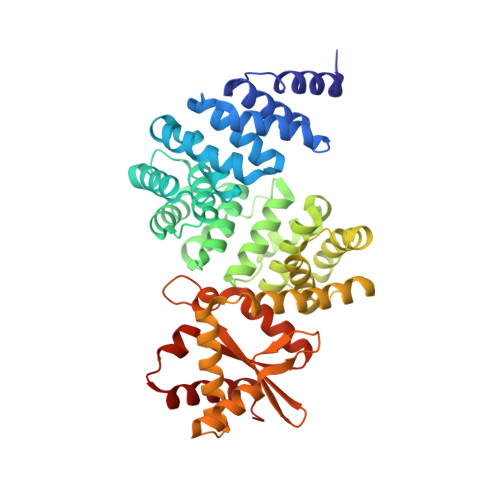
ASA-2: Polytomella F-ATP synthase associated subunit 2A [auth 2]441Polytomella sp. Pringsheim 198.80Mutation(s): 0 
UniProt
Find proteins for D7P6B9 (Polytomella sp. Pringsheim 198.80)
Explore D7P6B9 
Go to UniProtKB:  D7P6B9
Entity Groups
Sequence Clusters30% Identity50% Identity70% Identity90% Identity95% Identity100% Identity
UniProt GroupD7P6B9
Sequence Annotations
Expand
Reference Sequence
Find similar proteins by:|  3D Structure
Entity ID: 2
MoleculeChains  Sequence LengthOrganismDetailsImage
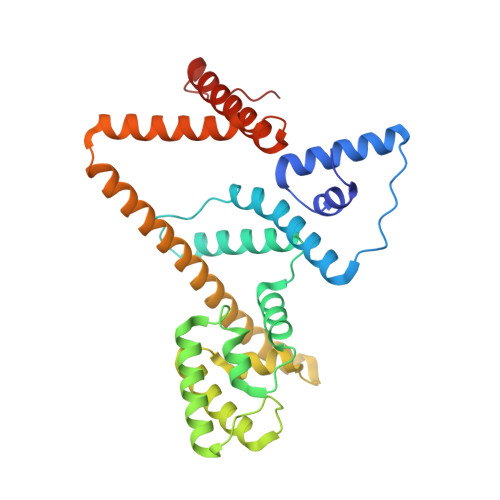
Mitochondrial ATP synthase associated protein ASA4B [auth 4]294Polytomella sp. Pringsheim 198.80Mutation(s): 0 
UniProt
Find proteins for D7NIZ2 (Polytomella sp. Pringsheim 198.80)
Explore D7NIZ2 
Go to UniProtKB:  D7NIZ2
Entity Groups
Sequence Clusters30% Identity50% Identity70% Identity90% Identity95% Identity100% Identity
UniProt GroupD7NIZ2
Sequence Annotations
Expand
Reference Sequence
Find similar proteins by:|  3D Structure
Entity ID: 3
MoleculeChains  Sequence LengthOrganismDetailsImage
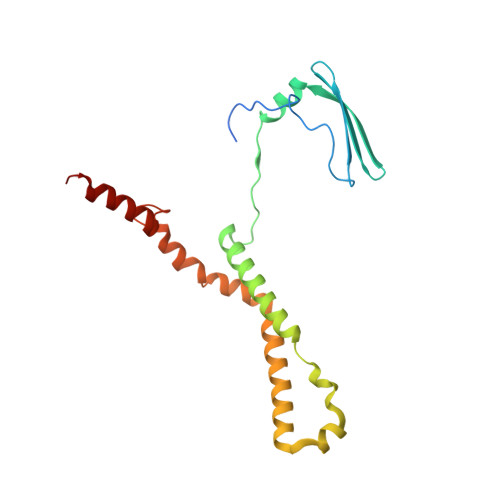
Mitochondrial ATP synthase associated protein ASA7C [auth 7]190Polytomella sp. Pringsheim 198.80Mutation(s): 0 
UniProt
Find proteins for D8V7I2 (Polytomella sp. Pringsheim 198.80)
Explore D8V7I2 
Go to UniProtKB:  D8V7I2
Entity Groups
Sequence Clusters30% Identity50% Identity70% Identity90% Identity95% Identity100% Identity
UniProt GroupD8V7I2
Sequence Annotations
Expand
Reference Sequence
Find similar proteins by:|  3D Structure
Entity ID: 4
MoleculeChains  Sequence LengthOrganismDetailsImage
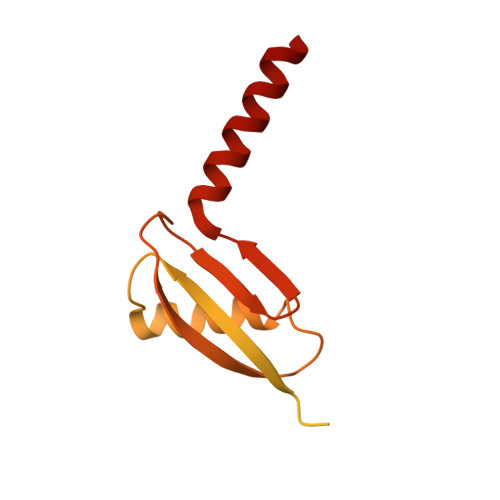
Mitochondrial ATP synthase subunit OSCPD [auth P]229Polytomella sp. Pringsheim 198.80Mutation(s): 0 
UniProt
Find proteins for D8V7I1 (Polytomella sp. Pringsheim 198.80)
Explore D8V7I1 
Go to UniProtKB:  D8V7I1
Entity Groups
Sequence Clusters30% Identity50% Identity70% Identity90% Identity95% Identity100% Identity
UniProt GroupD8V7I1
Sequence Annotations
Expand
Reference Sequence
Find similar proteins by:|  3D Structure
Entity ID: 5
MoleculeChains  Sequence LengthOrganismDetailsImage
ATP synthase subunit alphaE [auth T]562Polytomella sp. Pringsheim 198.80Mutation(s): 0 
UniProt
Find proteins for A0ZW40 (Polytomella sp. Pringsheim 198.80)
Explore A0ZW40 
Go to UniProtKB:  A0ZW40
Entity Groups
Sequence Clusters30% Identity50% Identity70% Identity90% Identity95% Identity100% Identity
UniProt GroupA0ZW40
Sequence Annotations
Expand
Reference Sequence

Experimental Data & Validation

Experimental Data

  • Method: ELECTRON MICROSCOPY
  • Resolution: 2.75 Å
  • Aggregation State: PARTICLE 
  • Reconstruction Method: SINGLE PARTICLE 
EM Software:
TaskSoftware PackageVersion
MODEL REFINEMENTPHENIX1.14
RECONSTRUCTIONRELION3

Structure Validation

View Full Validation Report


Entry History 

& Funding Information

Deposition Data


Funding OrganizationLocationGrant Number
Max Planck SocietyGermany--
European Molecular Biology Organization (EMBO)European Union--

Revision History  (Full details and data files)

  • Version 1.0: 2019-07-03
    Type: Initial release
  • Version 1.1: 2019-12-18
    Changes: Author supporting evidence, Data collection, Data processing, Experimental preparation, Other
  • Version 1.2: 2020-09-30
    Changes: Database references
  • Version 1.3: 2024-05-22
    Changes: Data collection, Database references
  • Version 1.4: 2025-09-24
    Changes: Author supporting evidence, Data collection, Structure summary
  • Version 1.5: 2025-10-01
    Changes: Author supporting evidence, Data collection