6R31 | pdb_00006r31

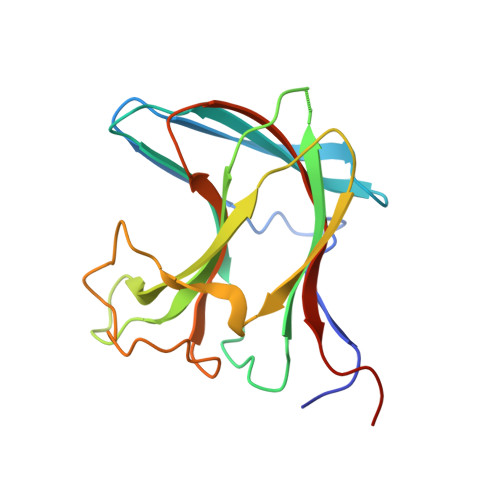
Family 11 Carbohydrate-Binding Module from Clostridium thermocellum in complex with beta-1,3-1,4-mixed-linked tetrasaccharide


Experimental Data Snapshot

  • Method: X-RAY DIFFRACTION
  • Resolution: 2.60 Å
  • R-Value Free: 
    0.254 (Depositor), 0.258 (DCC) 
  • R-Value Work: 
    0.190 (Depositor), 0.195 (DCC) 
  • R-Value Observed: 
    0.197 (Depositor) 

wwPDB Validation 3D Report Full Report

Validation slider image for 6R31

This is version 2.1 of the entry. See complete history

Literature

Molecular basis for the preferential recognition of beta 1,3-1,4-glucans by the family 11 carbohydrate-binding module from Clostridium thermocellum.

Ribeiro, D.O.Viegas, A.Pires, V.M.R.Medeiros-Silva, J.Bule, P.Chai, W.Marcelo, F.Fontes, C.M.G.A.Cabrita, E.J.Palma, A.S.Carvalho, A.L.

(2020) FEBS J 287: 2723-2743

  • DOI: https://doi.org/10.1111/febs.15162
  • Primary Citation Related Structures: 
    6R31, 6R3M

  • PubMed Abstract: 

    Understanding the specific molecular interactions between proteins and β1,3-1,4-mixed-linked d-glucans is fundamental to harvest the full biological and biotechnological potential of these carbohydrates and of proteins that specifically recognize them. The family 11 carbohydrate-binding module from Clostridium thermocellum (CtCBM11) is known for its binding preference for β1,3-1,4-mixed-linked over β1,4-linked glucans. Despite the growing industrial interest of this protein for the biotransformation of lignocellulosic biomass, the molecular determinants of its ligand specificity are not well defined. In this report, a combined approach of methodologies was used to unravel, at a molecular level, the ligand recognition of CtCBM11. The analysis of the interaction by carbohydrate microarrays and NMR and the crystal structures of CtCBM11 bound to β1,3-1,4-linked glucose oligosaccharides showed that both the chain length and the position of the β1,3-linkage are important for recognition, and identified the tetrasaccharide Glcβ1,4Glcβ1,4Glcβ1,3Glc sequence as a minimum epitope required for binding. The structural data, along with site-directed mutagenesis and ITC studies, demonstrated the specificity of CtCBM11 for the twisted conformation of β1,3-1,4-mixed-linked glucans. This is mediated by a conformation-selection mechanism of the ligand in the binding cleft through CH-π stacking and a hydrogen bonding network, which is dependent not only on ligand chain length, but also on the presence of a β1,3-linkage at the reducing end and at specific positions along the β1,4-linked glucan chain. The understanding of the detailed mechanism by which CtCBM11 can distinguish between linear and mixed-linked β-glucans strengthens its exploitation for the design of new biomolecules with improved capabilities and applications in health and agriculture. DATABASE: Structural data are available in the Protein Data Bank under the accession codes 6R3M and 6R31.


  • Organizational Affiliation
    • UCIBIO, Departamento de Química, Faculdade de Ciências e Tecnologia, Universidade NOVA de Lisboa, Caparica, Portugal.

Macromolecule Content 

  • Total Structure Weight: 21.05 kDa 
  • Atom Count: 1,454 
  • Modeled Residue Count: 170 
  • Deposited Residue Count: 178 
  • Unique protein chains: 1

Macromolecules

Find similar proteins by:|  3D Structure
Entity ID: 1
MoleculeChains  Sequence LengthOrganismDetailsImage
Endoglucanase H178Acetivibrio thermocellus ATCC 27405Mutation(s): 0 
Gene Names: celHCthe_1472
EC: 3.2.1.4
UniProt
Find proteins for P16218 (Acetivibrio thermocellus (strain ATCC 27405 / DSM 1237 / JCM 9322 / NBRC 103400 / NCIMB 10682 / NRRL B-4536 / VPI 7372))
Explore P16218 
Go to UniProtKB:  P16218
Entity Groups
Sequence Clusters30% Identity50% Identity70% Identity90% Identity95% Identity100% Identity
UniProt GroupP16218
Sequence Annotations
Expand
Reference Sequence

Oligosaccharides

Help  
Entity ID: 2
MoleculeChains Length2D Diagram GlycosylationD Interactions
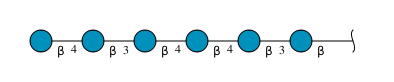
beta-D-glucopyranose-(1-4)-beta-D-glucopyranose-(1-3)-beta-D-glucopyranose-(1-4)-beta-D-glucopyranose-(1-4)-beta-D-glucopyranose-(1-3)-beta-D-glucopyranose
B
6N/A
Glycosylation Resources
GlyTouCan: G50882AV
GlyCosmos: G50882AV
GlyGen: G50882AV

Experimental Data & Validation

Experimental Data

  • Method: X-RAY DIFFRACTION
  • Resolution: 2.60 Å
  • R-Value Free:  0.254 (Depositor), 0.258 (DCC) 
  • R-Value Work:  0.190 (Depositor), 0.195 (DCC) 
  • R-Value Observed: 0.197 (Depositor) 
Space Group: H 3
Unit Cell:
Length ( Å )Angle ( ˚ )
a = 104.91α = 90
b = 104.91β = 90
c = 39.511γ = 120
Software Package:
Software NamePurpose
REFMACrefinement
MOSFLMdata reduction
SCALAdata scaling
PHASERphasing

Structure Validation

View Full Validation Report


Entry History 

& Funding Information

Deposition Data


Funding OrganizationLocationGrant Number
Foundation for Science and TechnologyPortugalSFRH/BD/100569/2014
Foundation for Science and TechnologyPortugalPTDC/BBB-BEP/0869/2014
Foundation for Science and TechnologyPortugalEXPL/IF/01621/2013

Revision History  (Full details and data files)

  • Version 1.0: 2020-02-05
    Type: Initial release
  • Version 1.1: 2020-07-15
    Changes: Database references
  • Version 2.0: 2020-07-29
    Type: Remediation
    Reason: Carbohydrate remediation
    Changes: Advisory, Atomic model, Data collection, Derived calculations, Structure summary
  • Version 2.1: 2024-05-15
    Changes: Data collection, Database references, Structure summary