Download Mendeley
The lytic transglycosylase, LtgG, controls cell morphology and virulence in Burkholderia pseudomallei.
Jenkins, C.H., Wallis, R., Allcock, N., Barnes, K.B., Richards, M.I., Auty, J.M., Galyov, E.E., Harding, S.V., Mukamolova, G.V.(2019) Sci Rep 9: 11060-11060
- PubMed: 31363151 Search on PubMedSearch on PubMed Central
- DOI: https://doi.org/10.1038/s41598-019-47483-z
- Primary Citation Related Structures:
6QK4 - PubMed Abstract:
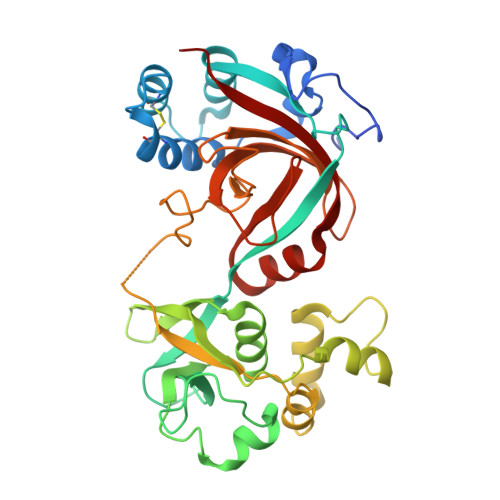
Burkholderia pseudomallei is the causative agent of the tropical disease melioidosis. Its genome encodes an arsenal of virulence factors that allow it, when required, to switch from a soil dwelling bacterium to a deadly intracellular pathogen. With a high intrinsic resistance to antibiotics and the ability to overcome challenges from the host immune system, there is an increasing requirement for new antibiotics and a greater understanding into the molecular mechanisms of B. pseudomallei virulence and dormancy. The peptidoglycan remodeling enzymes, lytic transglycosylases (Ltgs) are potential targets for such new antibiotics. Ltgs cleave the glycosidic bonds within bacterial peptidoglycan allowing for the insertion of peptidoglycan precursors during cell growth and division, and cell membrane spanning structures such as flagella and secretion systems. Using bioinformatic analysis we have identified 8 putative Ltgs in B. pseudomallei K96243. We aimed to investigate one of these Ltgs, LtgG (BPSL3046) through the generation of deletion mutants and biochemical analysis. We have shown that LtgG is a key contributor to cellular morphology, division, motility and virulence in BALB/c mice. We have determined the crystal structure of LtgG and have identified various amino acids likely to be important in peptidoglycan binding and catalytic activity. Recombinant protein assays and complementation studies using LtgG containing a site directed mutation in aspartate 343, confirmed the essentiality of this amino acid in the function of LtgG.
- Department of Infection, Immunity and Inflammation, University of Leicester, Leicester, UK. cjenkins@dstl.gov.uk.
Organizational Affiliation: