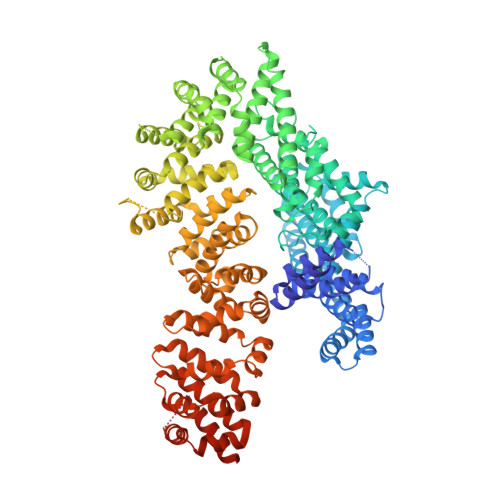
6QDL | pdb_00006qdl

Molecular features of the UNC-45 chaperone critical for binding and folding muscle myosin


Experimental Data Snapshot

  • Method: X-RAY DIFFRACTION
  • Resolution: 2.93 Å
  • R-Value Free: 
    0.268 (Depositor), 0.268 (DCC) 
  • R-Value Work: 
    0.221 (Depositor), 0.224 (DCC) 
  • R-Value Observed: 
    0.224 (Depositor) 

Starting Model: experimental
View more details

wwPDB Validation 3D Report Full Report

Validation slider image for 6QDL

This is version 1.1 of the entry. See complete history

Literature

Molecular features of the UNC-45 chaperone critical for binding and folding muscle myosin.

Hellerschmied, D.Lehner, A.Franicevic, N.Arnese, R.Johnson, C.Vogel, A.Meinhart, A.Kurzbauer, R.Deszcz, L.Gazda, L.Geeves, M.Clausen, T.

(2019) Nat Commun 10: 4781-4781

  • DOI: https://doi.org/10.1038/s41467-019-12667-8
  • Primary Citation Related Structures: 
    6QDJ, 6QDK, 6QDL, 6QDM

  • PubMed Abstract: 

    Myosin is a motor protein that is essential for a variety of processes ranging from intracellular transport to muscle contraction. Folding and assembly of myosin relies on a specific chaperone, UNC-45. To address its substrate-targeting mechanism, we reconstitute the interplay between Caenorhabditis elegans UNC-45 and muscle myosin MHC-B in insect cells. In addition to providing a cellular chaperone assay, the established system enabled us to produce large amounts of functional muscle myosin, as evidenced by a biochemical and structural characterization, and to directly monitor substrate binding to UNC-45. Data from in vitro and cellular chaperone assays, together with crystal structures of binding-deficient UNC-45 mutants, highlight the importance of utilizing a flexible myosin-binding domain. This so-called UCS domain can adopt discrete conformations to efficiently bind and fold substrate. Moreover, our data uncover the molecular basis of temperature-sensitive UNC-45 mutations underlying one of the most prominent motility defects in C. elegans.


  • Organizational Affiliation
    • Research Institute of Molecular Pathology, Vienna BioCenter, Vienna, Austria. doris.hellerschmied@uni-due.de.

Macromolecule Content 

  • Total Structure Weight: 107.6 kDa 
  • Atom Count: 6,931 
  • Modeled Residue Count: 885 
  • Deposited Residue Count: 961 
  • Unique protein chains: 1

Macromolecules

Find similar proteins by:|  3D Structure
Entity ID: 1
MoleculeChains  Sequence LengthOrganismDetailsImage
UNC-45961Caenorhabditis elegansMutation(s): 1 
Gene Names: unc-45CELE_F30H5.1F30H5.1
UniProt
Find proteins for G5EG62 (Caenorhabditis elegans)
Explore G5EG62 
Go to UniProtKB:  G5EG62
Entity Groups
Sequence Clusters30% Identity50% Identity70% Identity90% Identity95% Identity100% Identity
UniProt GroupG5EG62
Sequence Annotations
Expand
Reference Sequence

Experimental Data & Validation

Experimental Data

  • Method: X-RAY DIFFRACTION
  • Resolution: 2.93 Å
  • R-Value Free:  0.268 (Depositor), 0.268 (DCC) 
  • R-Value Work:  0.221 (Depositor), 0.224 (DCC) 
  • R-Value Observed: 0.224 (Depositor) 
Space Group: P 1 21 1
Unit Cell:
Length ( Å )Angle ( ˚ )
a = 54.124α = 90
b = 114.323β = 107.99
c = 85.006γ = 90
Software Package:
Software NamePurpose
PHENIXrefinement
Cootmodel building
Omodel building
XDSdata reduction
SCALAdata scaling
PHASERphasing

Structure Validation

View Full Validation Report


Entry History 

& Funding Information

Deposition Data


Funding OrganizationLocationGrant Number
Austrian Science FundAustriaP 22570

Revision History  (Full details and data files)

  • Version 1.0: 2019-10-30
    Type: Initial release
  • Version 1.1: 2024-01-24
    Changes: Data collection, Database references, Refinement description