6Q4Z | pdb_00006q4z

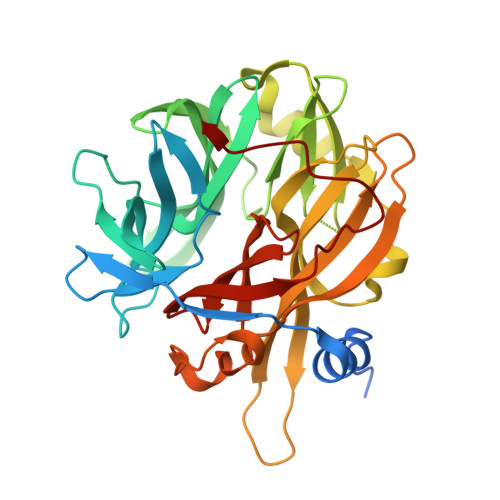
Structure of an inactive variant (D94N) of MPT-2, a GDP-Man-dependent mannosyltransferase from Leishmania mexicana, in complex with beta-1,2-mannobiose


Experimental Data Snapshot

  • Method: X-RAY DIFFRACTION
  • Resolution: 1.55 Å
  • R-Value Free: 
    0.189 (Depositor), 0.198 (DCC) 
  • R-Value Work: 
    0.127 (Depositor), 0.141 (DCC) 
  • R-Value Observed: 
    0.130 (Depositor) 

Starting Model: experimental
View more details

wwPDB Validation 3D Report Full Report

Validation slider image for 6Q4Z

This is version 2.2 of the entry. See complete history

Literature

A Family of Dual-Activity Glycosyltransferase-Phosphorylases Mediates Mannogen Turnover and Virulence in Leishmania Parasites.

Sernee, M.F.Ralton, J.E.Nero, T.L.Sobala, L.F.Kloehn, J.Vieira-Lara, M.A.Cobbold, S.A.Stanton, L.Pires, D.E.V.Hanssen, E.Males, A.Ward, T.Bastidas, L.M.van der Peet, P.L.Parker, M.W.Ascher, D.B.Williams, S.J.Davies, G.J.McConville, M.J.

(2019) Cell Host Microbe 26: 385-399.e9

  • DOI: https://doi.org/10.1016/j.chom.2019.08.009
  • Primary Citation Related Structures: 
    6Q4W, 6Q4X, 6Q4Y, 6Q4Z, 6Q50

  • PubMed Abstract: 

    Parasitic protists belonging to the genus Leishmania synthesize the non-canonical carbohydrate reserve, mannogen, which is composed of β-1,2-mannan oligosaccharides. Here, we identify a class of dual-activity mannosyltransferase/phosphorylases (MTPs) that catalyze both the sugar nucleotide-dependent biosynthesis and phosphorolytic turnover of mannogen. Structural and phylogenic analysis shows that while the MTPs are structurally related to bacterial mannan phosphorylases, they constitute a distinct family of glycosyltransferases (GT108) that have likely been acquired by horizontal gene transfer from gram-positive bacteria. The seven MTPs catalyze the constitutive synthesis and turnover of mannogen. This metabolic rheostat protects obligate intracellular parasite stages from nutrient excess, and is essential for thermotolerance and parasite infectivity in the mammalian host. Our results suggest that the acquisition and expansion of the MTP family in Leishmania increased the metabolic flexibility of these protists and contributed to their capacity to colonize new host niches.


  • Organizational Affiliation
    • Department of Biochemistry and Molecular Biology, Bio21 Molecular Science and Biotechnology Institute, University of Melbourne, Parkville, VIC 3010, Australia.

Macromolecule Content 

  • Total Structure Weight: 76.87 kDa 
  • Atom Count: 5,400 
  • Modeled Residue Count: 611 
  • Deposited Residue Count: 682 
  • Unique protein chains: 1

Macromolecules

Find similar proteins by:|  3D Structure
Entity ID: 1
MoleculeChains  Sequence LengthOrganismDetailsImage
LmxM MPT-2 D94N
A, B
341Leishmania mexicana MHOM/GT/2001/U1103Mutation(s): 1 
UniProt
Find proteins for E9AND8 (Leishmania mexicana (strain MHOM/GT/2001/U1103))
Explore E9AND8 
Go to UniProtKB:  E9AND8
Entity Groups
Sequence Clusters30% Identity50% Identity70% Identity90% Identity95% Identity100% Identity
UniProt GroupE9AND8
Sequence Annotations
Expand
Reference Sequence

Oligosaccharides

Help  
Entity ID: 2
MoleculeChains Length2D Diagram GlycosylationD Interactions
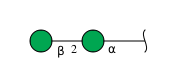
beta-D-mannopyranose-(1-2)-alpha-D-mannopyranose
C, D
2N/A
Glycosylation Resources
GlyTouCan: G08254PX
GlyCosmos: G08254PX
GlyGen: G08254PX

Experimental Data & Validation

Experimental Data

  • Method: X-RAY DIFFRACTION
  • Resolution: 1.55 Å
  • R-Value Free:  0.189 (Depositor), 0.198 (DCC) 
  • R-Value Work:  0.127 (Depositor), 0.141 (DCC) 
  • R-Value Observed: 0.130 (Depositor) 
Space Group: P 21 21 21
Unit Cell:
Length ( Å )Angle ( ˚ )
a = 55.389α = 90
b = 98.115β = 90
c = 105.621γ = 90
Software Package:
Software NamePurpose
REFMACrefinement
DIALSdata reduction
Aimlessdata scaling
REFMACphasing

Structure Validation

View Full Validation Report


Entry History 

& Funding Information

Deposition Data


Funding OrganizationLocationGrant Number
Australian Research CouncilAustraliaDP160100597
Australian Research CouncilAustraliaDP180101957
Biotechnology and Biological Sciences Research CouncilUnited KingdomBB/M011151
European Research CouncilUnited KingdomERC-2012-AdG-322942
National Health and Medical Research Council (Australia)AustraliaAPP1072476

Revision History  (Full details and data files)

  • Version 1.0: 2019-09-25
    Type: Initial release
  • Version 2.0: 2020-07-29
    Type: Remediation
    Reason: Carbohydrate remediation
    Changes: Atomic model, Data collection, Derived calculations, Structure summary
  • Version 2.1: 2021-02-17
    Changes: Database references, Derived calculations, Structure summary
  • Version 2.2: 2024-01-24
    Changes: Data collection, Database references, Refinement description