6NTY | pdb_00006nty

2.1 A resolution structure of the Musashi-2 (Msi2) RNA recognition motif 1 (RRM1) domain


Experimental Data Snapshot

  • Method: X-RAY DIFFRACTION
  • Resolution: 2.10 Å
  • R-Value Free: 
    0.280 (Depositor), 0.280 (DCC) 
  • R-Value Work: 
    0.205 (Depositor), 0.209 (DCC) 
  • R-Value Observed: 
    0.210 (Depositor) 

Starting Model: experimental
View more details

wwPDB Validation 3D Report Full Report

Validation slider image for 6NTY

This is version 1.4 of the entry. See complete history

Literature

Crystal and solution structures of human oncoprotein Musashi-2 N-terminal RNA recognition motif 1.

Lan, L.Xing, M.Kashipathy, M.Douglas, J.Gao, P.Battaile, K.Hanzlik, R.Lovell, S.Xu, L.

(2020) Proteins 88: 573-583

  • DOI: https://doi.org/10.1002/prot.25836
  • Primary Citation Related Structures: 
    6C8U, 6NTY

  • PubMed Abstract: 

    Musashi-2 (MSI2) belongs to Musashi family of RNA binding proteins (RBP). Like Musashi-1 (MSI1), it is overexpressed in a variety of cancers and is a promising therapeutic target. Both MSI proteins contain two N-terminal RNA recognition motifs and play roles in posttranscriptional regulation of target mRNAs. Previously, we have identified several inhibitors of MSI1, all of which bind to MSI2 as well. In order to design MSI2-specific inhibitors and compare the differences of binding mode of the inhibitors, we set out to solve the structure of MSI2-RRM1, the key motif that is responsible for the binding. Here, we report the crystal structure and the first NMR solution structure of MSI2-RRM1, and compare these to the structures of MSI1-RBD1 and other RBPs. A high degree of structural similarity was observed between the crystal and solution NMR structures. MSI2-RRM1 shows a highly similar overall folding topology to MSI1-RBD1 and other RBPs. The structural information of MSI2-RRM1 will be helpful for understanding MSI2-RNA interaction and for guiding rational drug design of MSI2-specific inhibitors.


  • Organizational Affiliation
    • Department of Molecular Biosciences, The University of Kansas, Lawrence, Kansas.

Macromolecule Content 

  • Total Structure Weight: 21.37 kDa 
  • Atom Count: 1,243 
  • Modeled Residue Count: 162 
  • Deposited Residue Count: 188 
  • Unique protein chains: 1

Macromolecules

Find similar proteins by:|  3D Structure
Entity ID: 1
MoleculeChains  Sequence LengthOrganismDetailsImage
RNA-binding protein Musashi homolog 2
A, B
94Homo sapiensMutation(s): 0 
Gene Names: MSI2
UniProt & NIH Common Fund Data Resources
Find proteins for Q96DH6 (Homo sapiens)
Explore Q96DH6 
Go to UniProtKB:  Q96DH6
PHAROS:  Q96DH6
GTEx:  ENSG00000153944 
Entity Groups
Sequence Clusters30% Identity50% Identity70% Identity90% Identity95% Identity100% Identity
UniProt GroupQ96DH6
Sequence Annotations
Expand
Reference Sequence

Small Molecules

Ligands 1 Unique
IDChains Name / Formula / InChI Key2D Diagram3D Interactions
PO4

Query on PO4


Download:Ideal Coordinates CCD File
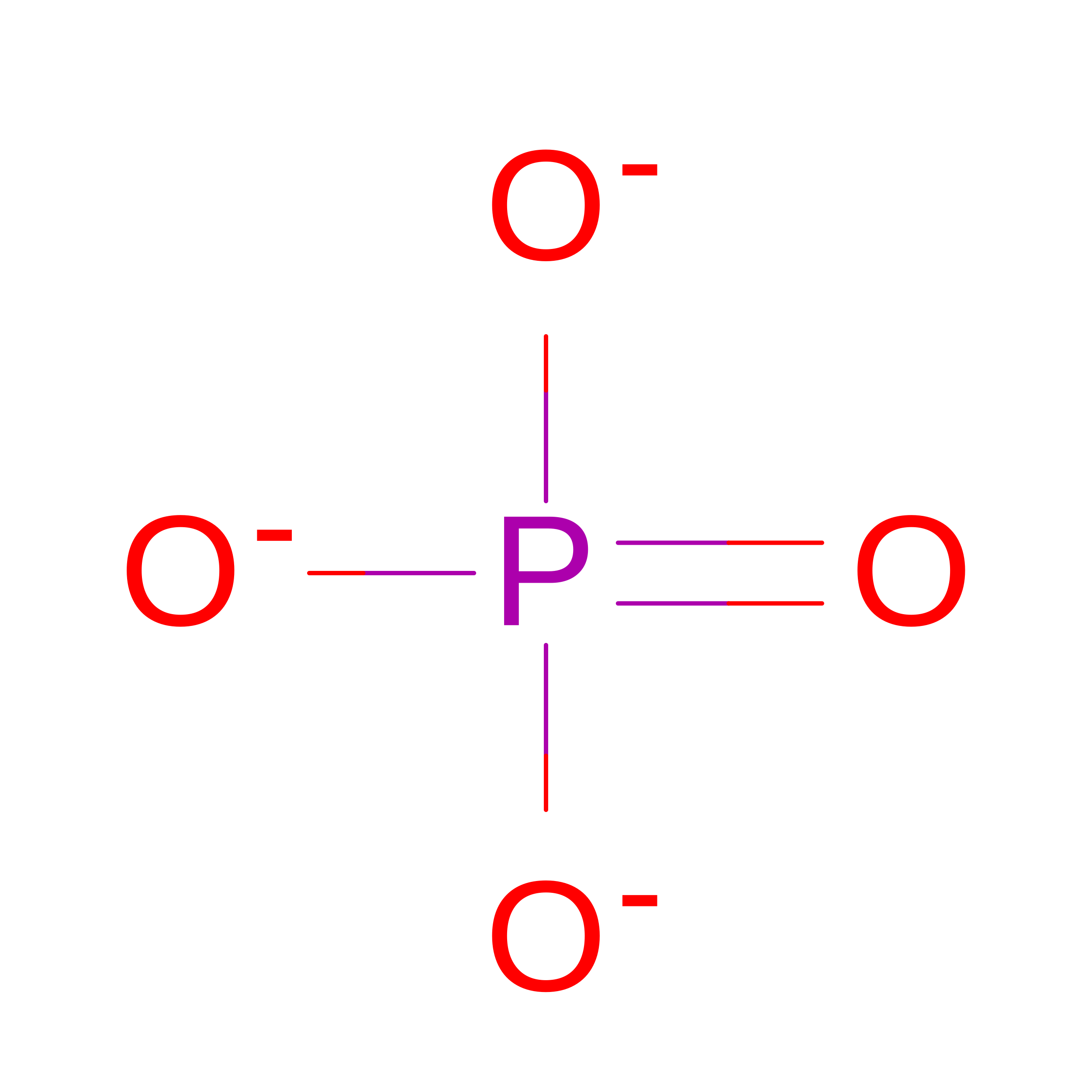
C [auth A]PHOSPHATE ION
O4 P
NBIIXXVUZAFLBC-UHFFFAOYSA-K

Experimental Data & Validation

Experimental Data

  • Method: X-RAY DIFFRACTION
  • Resolution: 2.10 Å
  • R-Value Free:  0.280 (Depositor), 0.280 (DCC) 
  • R-Value Work:  0.205 (Depositor), 0.209 (DCC) 
  • R-Value Observed: 0.210 (Depositor) 
Space Group: P 1 21 1
Unit Cell:
Length ( Å )Angle ( ˚ )
a = 30.795α = 90
b = 57.37β = 101.32
c = 41.315γ = 90
Software Package:
Software NamePurpose
XDSdata reduction
Aimlessdata scaling
PHASERphasing
PHENIXrefinement
PDB_EXTRACTdata extraction

Structure Validation

View Full Validation Report


Entry History 

& Funding Information

Deposition Data


Funding OrganizationLocationGrant Number
National Institutes of Health/National Cancer Institute (NIH/NCI)United StatesR01CA191785
National Institutes of Health/National Institute of General Medical Sciences (NIH/NIGMS)United StatesP30GM110761

Revision History  (Full details and data files)

  • Version 1.0: 2019-10-23
    Type: Initial release
  • Version 1.1: 2019-12-04
    Changes: Author supporting evidence
  • Version 1.2: 2020-03-18
    Changes: Database references
  • Version 1.3: 2020-05-06
    Changes: Structure summary
  • Version 1.4: 2023-10-11
    Changes: Data collection, Database references, Refinement description