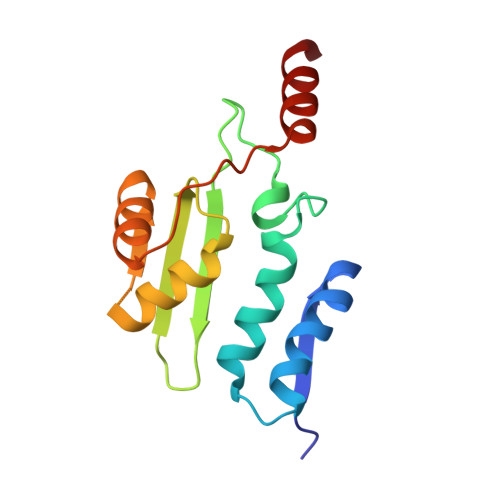
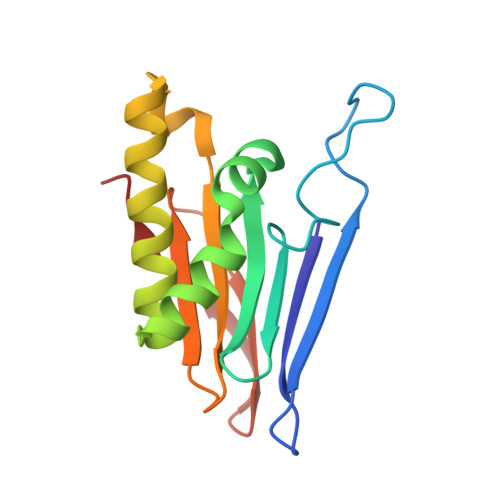
6NQ6 | pdb_00006nq6

Structure & function of a new Aspartylglucosaminuria variant


Experimental Data Snapshot

  • Method: X-RAY DIFFRACTION
  • Resolution: 1.50 Å
  • R-Value Free: 
    0.224 (Depositor), 0.234 (DCC) 
  • R-Value Work: 
    0.194 (Depositor) 
  • R-Value Observed: 
    0.196 (Depositor) 

Starting Model: experimental
View more details

wwPDB Validation 3D Report Full Report

Validation slider image for 6NQ6

This is version 1.3 of the entry. See complete history

Literature

The T99K variant of glycosylasparaginase shows a new structural mechanism of the genetic disease aspartylglucosaminuria.

Pande, S.Guo, H.C.

(2019) Protein Sci 28: 1013-1023

  • DOI: https://doi.org/10.1002/pro.3607
  • Primary Citation Related Structures: 
    6NQ6

  • PubMed Abstract: 

    Aspartylglucosaminuria (AGU) is an inherited disease caused by mutations in a lysosomal amidase called aspartylglucosaminidase (AGA) or glycosylasparaginase (GA). This disorder results in an accumulation of glycoasparagines in the lysosomes of virtually all cell types, with severe clinical symptoms affecting the central nervous system, skeletal abnormalities, and connective tissue lesions. GA is synthesized as a single-chain precursor that requires an intramolecular autoprocessing to form a mature amidase. Previously, we showed that a Canadian AGU mutation disrupts this obligatory intramolecular autoprocessing with the enzyme trapped as an inactive precursor. Here, we report biochemical and structural characterization of a model enzyme corresponding to a new American AGU allele, the T99K variant. Unlike other variants with known 3D structures, this T99K model enzyme still has autoprocessing capacity to generate a mature form. However, its amidase activity to digest glycoasparagines remains low, consistent with its association with AGU. We have determined a 1.5-Å-resolution structure of this new AGU model enzyme and built an enzyme-substrate complex to provide a structural basis to analyze the negative effects of the T99K point mutation on K M and k cat of the amidase. It appears that a "molecular clamp" capable of fixing local disorders at the dimer interface might be able to rescue the deficiency of this new AGU variant.


  • Organizational Affiliation
    • Department of Biological Sciences, University of Massachusetts Lowell, Lowell, Massachusetts, 01854.

Macromolecule Content 

  • Total Structure Weight: 61.37 kDa 
  • Atom Count: 4,421 
  • Modeled Residue Count: 556 
  • Deposited Residue Count: 564 
  • Unique protein chains: 2

Macromolecules

Find similar proteins by:|  3D Structure
Entity ID: 1
MoleculeChains  Sequence LengthOrganismDetailsImage
N(4)-(Beta-N-acetylglucosaminyl)-L-asparaginase
A, C
138Elizabethkingia meningosepticaMutation(s): 1 
Gene Names: NCTC10588_03193
EC: 3.5.1.26
Find similar proteins by:|  3D Structure
Entity ID: 2
MoleculeChains  Sequence LengthOrganismDetailsImage
N(4)-(Beta-N-acetylglucosaminyl)-L-asparaginase
B, D
144Elizabethkingia meningosepticaMutation(s): 0 
Gene Names: NCTC10588_03193
EC: 3.5.1.26

Experimental Data & Validation

Experimental Data

  • Method: X-RAY DIFFRACTION
  • Resolution: 1.50 Å
  • R-Value Free:  0.224 (Depositor), 0.234 (DCC) 
  • R-Value Work:  0.194 (Depositor) 
  • R-Value Observed: 0.196 (Depositor) 
Space Group: P 1 21 1
Unit Cell:
Length ( Å )Angle ( ˚ )
a = 46.15α = 90
b = 96.02β = 90.05
c = 61.49γ = 90
Software Package:
Software NamePurpose
REFMACrefinement
MOSFLMdata reduction
Aimlessdata scaling
MOLREPphasing

Structure Validation

View Full Validation Report


Entry History 

& Funding Information

Deposition Data


Funding OrganizationLocationGrant Number
National Institutes of Health/National Human Genome Research Institute (NIH/NHGRI)United StatesDK075294

Revision History  (Full details and data files)

  • Version 1.0: 2019-04-17
    Type: Initial release
  • Version 1.1: 2019-05-29
    Changes: Data collection, Database references
  • Version 1.2: 2019-12-18
    Changes: Author supporting evidence
  • Version 1.3: 2023-10-11
    Changes: Data collection, Database references, Refinement description