6NHV | pdb_00006nhv

Single particle reconstruction of DARPin and its bound GFP on a symmetric scaffold


Experimental Data Snapshot

  • Method: ELECTRON MICROSCOPY
  • Resolution: 3.50 Å
  • Aggregation State: PARTICLE 
  • Reconstruction Method: SINGLE PARTICLE 

Starting Models: experimental
View more details

wwPDB Validation 3D Report Full Report

Validation slider image for 6NHV

This is version 2.0 of the entry. See complete history

Literature

A 3.8 angstrom resolution cryo-EM structure of a small protein bound to an imaging scaffold.

Liu, Y.Huynh, D.T.Yeates, T.O.

(2019) Nat Commun 10: 1864-1864

  • DOI: https://doi.org/10.1038/s41467-019-09836-0
  • Primary Citation Related Structures: 
    6NHT, 6NHV

  • PubMed Abstract: 

    Proteins smaller than about 50 kDa are currently too small to be imaged at high resolution by cryo-electron microscopy (cryo-EM), leaving most protein molecules in the cell beyond the reach of this powerful structural technique. Here we use a designed protein scaffold to bind and symmetrically display 12 copies of a small 26 kDa protein, green fluorescent protein (GFP). We show that the bound cargo protein is held rigidly enough to visualize it at a resolution of 3.8 Å by cryo-EM, where specific structural features of the protein are visible. The designed scaffold is modular and can be modified through modest changes in its amino acid sequence to bind and display diverse proteins for imaging, thus providing a general method to break through the lower size limitation in cryo-EM.


  • Organizational Affiliation
    • UCLA Department of Chemistry and Biochemistry, Los Angeles, CA, 90095, USA.

Macromolecule Content 

  • Total Structure Weight: 173.82 kDa 
  • Atom Count: 8,948 
  • Modeled Residue Count: 1,166 
  • Deposited Residue Count: 1,584 
  • Unique protein chains: 3

Macromolecules

Find similar proteins by:|  3D Structure
Entity ID: 1
MoleculeChains  Sequence LengthOrganismDetailsImage
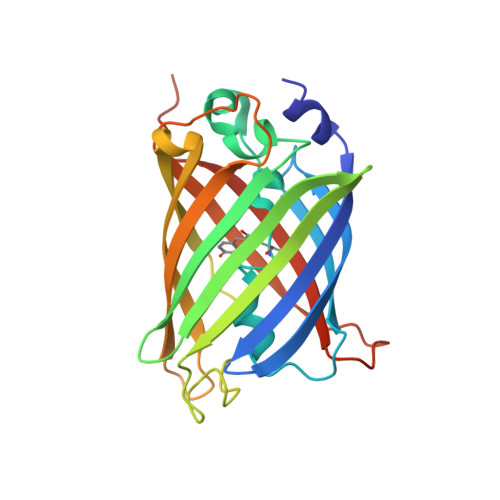
superfolder GFP234Aequorea victoriaMutation(s): 0 
Find similar proteins by:|  3D Structure
Entity ID: 2
MoleculeChains  Sequence LengthOrganismDetailsImage
DARP14 - Subunit BB [auth N],
C [auth O],
G [auth X]
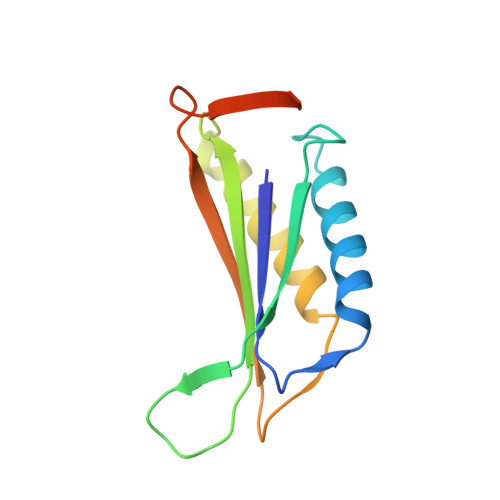
131Pseudomonas aeruginosa PAO1Mutation(s): 8 
Gene Names: PA1966
UniProt
Find proteins for Q9I2D8 (Pseudomonas aeruginosa (strain ATCC 15692 / DSM 22644 / CIP 104116 / JCM 14847 / LMG 12228 / 1C / PRS 101 / PAO1))
Explore Q9I2D8 
Go to UniProtKB:  Q9I2D8
Entity Groups
Sequence Clusters30% Identity50% Identity70% Identity90% Identity95% Identity100% Identity
UniProt GroupQ9I2D8
Sequence Annotations
Expand
Reference Sequence
Find similar proteins by:|  3D Structure
Entity ID: 3
MoleculeChains  Sequence LengthOrganismDetailsImage
Subunit A-DARPinD [auth R],
E [auth S],
F [auth T]
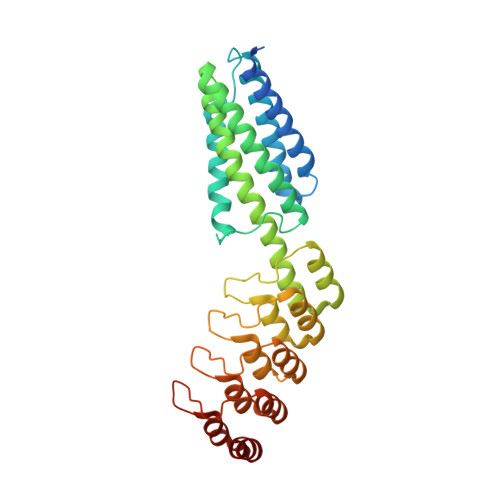
319Pyrococcus horikoshii OT3Mutation(s): 0 

Small Molecules

Modified Residues  1 Unique
IDChains TypeFormula2D DiagramParent
CRO
Query on CRO
A
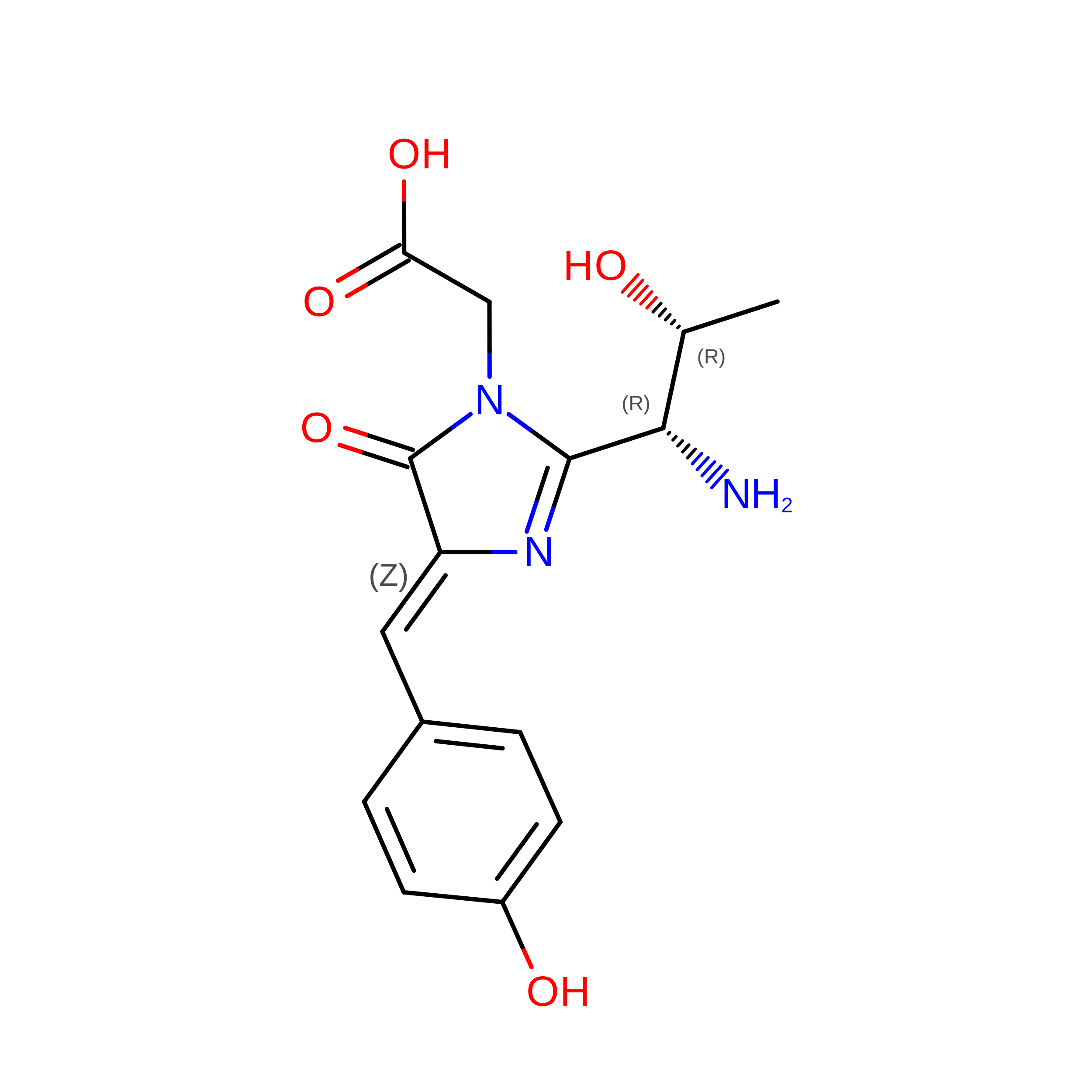
L-PEPTIDE LINKINGC15 H17 N3 O5THR, TYR, GLY

Experimental Data & Validation

Experimental Data

  • Method: ELECTRON MICROSCOPY
  • Resolution: 3.50 Å
  • Aggregation State: PARTICLE 
  • Reconstruction Method: SINGLE PARTICLE 
EM Software:
TaskSoftware PackageVersion
MODEL REFINEMENTPHENIX
RECONSTRUCTIONRELION3.0

Structure Validation

View Full Validation Report


Entry History 

& Funding Information

Deposition Data


Funding OrganizationLocationGrant Number
Department of Energy (DOE, United States)United StatesDE-FC02-02ER63421
National Institutes of Health/National Human Genome Research Institute (NIH/NHGRI)United StatesS10RR23057
National Institutes of Health/National Human Genome Research Institute (NIH/NHGRI)United StatesS10OD018111
National Institutes of Health/National Human Genome Research Institute (NIH/NHGRI)United StatesU24GM11679
National Science Foundation (NSF, United States)United StatesDBI-1338135
National Science Foundation (NSF, United States)United StatesDMR-1548924

Revision History  (Full details and data files)

  • Version 1.0: 2019-05-08
    Type: Initial release
  • Version 1.1: 2019-11-27
    Changes: Author supporting evidence
  • Version 1.2: 2024-11-13
    Changes: Data collection, Database references, Refinement description, Structure summary
  • Version 2.0: 2026-03-18
    Changes: Data collection, Polymer sequence