6NE1 | pdb_00006ne1

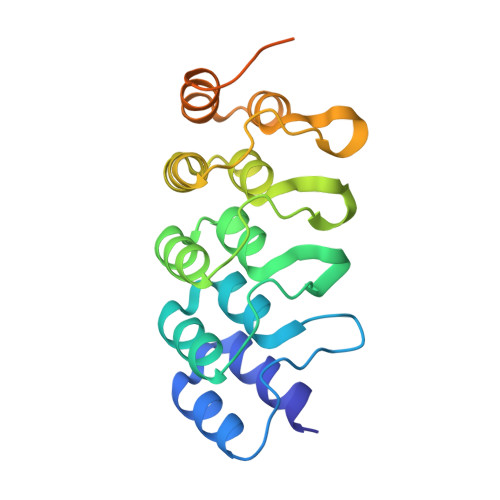
Designed repeat protein in complex with Fz4


Experimental Data Snapshot

  • Method: X-RAY DIFFRACTION
  • Resolution: 3.01 Å
  • R-Value Free: 
    0.293 (Depositor), 0.294 (DCC) 
  • R-Value Work: 
    0.234 (Depositor), 0.238 (DCC) 
  • R-Value Observed: 
    0.240 (Depositor) 

Starting Model: experimental
View more details

wwPDB Validation 3D Report Full Report

Validation slider image for 6NE1

Ligand Structure Quality Assessment 


This is version 1.6 of the entry. See complete history

Literature

Receptor subtype discrimination using extensive shape complementary designed interfaces.

Dang, L.T.Miao, Y.Ha, A.Yuki, K.Park, K.Janda, C.Y.Jude, K.M.Mohan, K.Ha, N.Vallon, M.Yuan, J.Vilches-Moure, J.G.Kuo, C.J.Garcia, K.C.Baker, D.

(2019) Nat Struct Mol Biol 26: 407-414

  • DOI: https://doi.org/10.1038/s41594-019-0224-z
  • Primary Citation Related Structures: 
    6NDZ, 6NE1, 6NE2, 6NE4

  • PubMed Abstract: 

    To discriminate between closely related members of a protein family that differ at a limited number of spatially distant positions is a challenge for drug discovery. We describe a combined computational design and experimental selection approach for generating binders targeting functional sites with large, shape complementary interfaces to read out subtle sequence differences for subtype-specific antagonism. Repeat proteins are computationally docked against a functionally relevant region of the target protein surface that varies in the different subtypes, and the interface sequences are optimized for affinity and specificity first computationally and then experimentally. We used this approach to generate a series of human Frizzled (Fz) subtype-selective antagonists with extensive shape complementary interaction surfaces considerably larger than those of repeat proteins selected from random libraries. In vivo administration revealed that Wnt-dependent pericentral liver gene expression involves multiple Fz subtypes, while maintenance of the intestinal crypt stem cell compartment involves only a limited subset.


  • Organizational Affiliation
    • Department of Biochemistry, University of Washington, Seattle, WA, USA.

Macromolecule Content 

  • Total Structure Weight: 34.01 kDa 
  • Atom Count: 2,062 
  • Modeled Residue Count: 278 
  • Deposited Residue Count: 312 
  • Unique protein chains: 2

Macromolecules

Find similar proteins by:|  3D Structure
Entity ID: 1
MoleculeChains  Sequence LengthOrganismDetailsImage
Frizzled-4120Homo sapiensMutation(s): 0 
Gene Names: FZD4
UniProt & NIH Common Fund Data Resources
Find proteins for Q9ULV1 (Homo sapiens)
Explore Q9ULV1 
Go to UniProtKB:  Q9ULV1
PHAROS:  Q9ULV1
GTEx:  ENSG00000174804 
Entity Groups
Sequence Clusters30% Identity50% Identity70% Identity90% Identity95% Identity100% Identity
UniProt GroupQ9ULV1
Glycosylation
Glycosylation Sites: 2Go to GlyGen: Q9ULV1-1
Sequence Annotations
Expand
Reference Sequence
Find similar proteins by:|  3D Structure
Entity ID: 2
MoleculeChains  Sequence LengthOrganismDetailsImage
Pfs, NACHT and Ankyrin domain protein192Aspergillus fumigatus Af293Mutation(s): 0 
Gene Names: AFUA_1G01020

Experimental Data & Validation

Experimental Data

  • Method: X-RAY DIFFRACTION
  • Resolution: 3.01 Å
  • R-Value Free:  0.293 (Depositor), 0.294 (DCC) 
  • R-Value Work:  0.234 (Depositor), 0.238 (DCC) 
  • R-Value Observed: 0.240 (Depositor) 
Space Group: P 2 21 21
Unit Cell:
Length ( Å )Angle ( ˚ )
a = 51.846α = 90
b = 62.611β = 90
c = 86.217γ = 90
Software Package:
Software NamePurpose
PHENIXrefinement
HKL-2000data reduction
HKL-2000data scaling
PHASERphasing

Structure Validation

View Full Validation Report


Ligand Structure Quality Assessment 


Entry History 

& Funding Information

Deposition Data


Funding OrganizationLocationGrant Number
National Institutes of Health/National Institute of Diabetes and Digestive and Kidney Disease (NIH/NIDDK)United States1R01DK115728
Howard Hughes Medical Institute (HHMI)United States--

Revision History  (Full details and data files)

  • Version 1.0: 2019-05-15
    Type: Initial release
  • Version 1.1: 2019-05-29
    Changes: Data collection, Database references
  • Version 1.2: 2019-06-19
    Changes: Data collection, Database references
  • Version 1.3: 2019-11-20
    Changes: Author supporting evidence
  • Version 1.4: 2020-07-29
    Type: Remediation
    Reason: Carbohydrate remediation
    Changes: Data collection, Derived calculations, Structure summary
  • Version 1.5: 2023-10-11
    Changes: Data collection, Database references, Refinement description, Structure summary
  • Version 1.6: 2024-11-06
    Changes: Structure summary