6ND2 | pdb_00006nd2

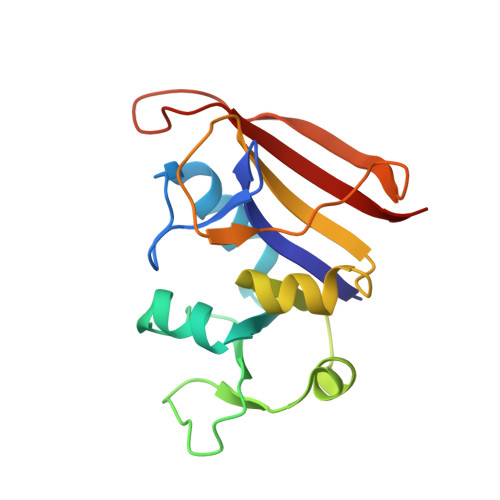
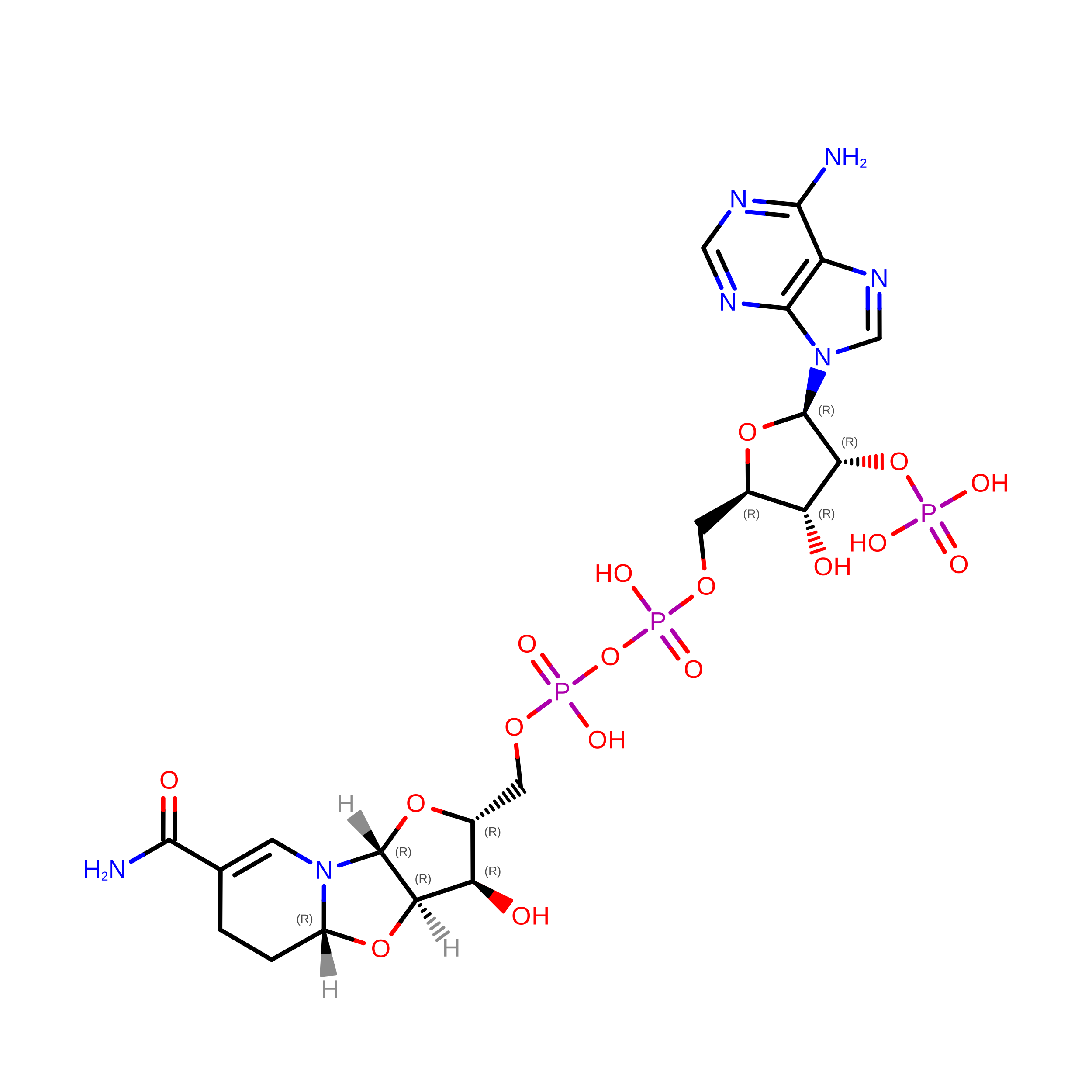
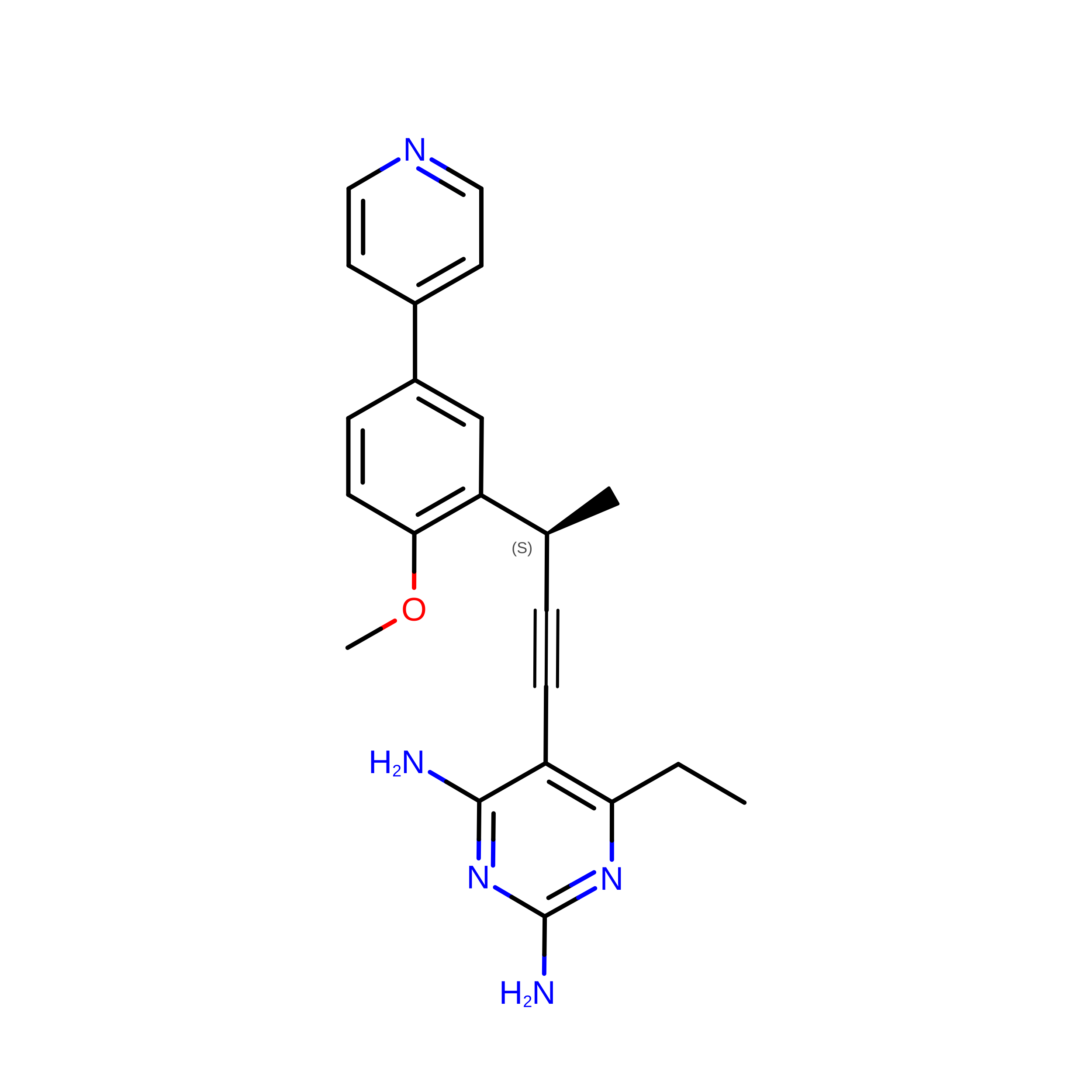
Staphylococcus aureus Dihydrofolate Reductase complexed with NADPH and 6-ETHYL-5-[(3R)-3-[2-METHOXY-5-(PYRIDIN-4-YL)PHENYL]BUT-1-YN-1-YL]PYRIMIDINE-2,4-DIAMINE (UCP1063)


Experimental Data Snapshot

  • Method: X-RAY DIFFRACTION
  • Resolution: 2.24 Å
  • R-Value Free: 
    0.235 (Depositor) 
  • R-Value Work: 
    0.185 (Depositor) 
  • R-Value Observed: 
    0.190 (Depositor) 

Starting Model: experimental
View more details

wwPDB Validation 3D Report Full Report

Validation slider image for 6ND2

Ligand Structure Quality Assessment 


This is version 1.2 of the entry. See complete history

Literature

Structure-Guided In Vitro to In Vivo Pharmacokinetic Optimization of Propargyl-Linked Antifolates.

Lombardo, M.N.G-Dayanandan, N.Keshipeddy, S.Zhou, W.Si, D.Reeve, S.M.Alverson, J.Barney, P.Walker, L.Hoody, J.Priestley, N.D.Obach, R.S.Wright, D.L.

(2019) Drug Metab Dispos 47: 995-1003

  • DOI: https://doi.org/10.1124/dmd.119.086504
  • Primary Citation Related Structures: 
    6ND2

  • PubMed Abstract: 

    Pharmacokinetic/pharmacodynamic properties are strongly correlated with the in vivo efficacy of antibiotics. Propargyl-linked antifolates, a novel class of antibiotics, demonstrate potent antibacterial activity against both Gram-positive and Gram-negative pathogenic bacteria, including multidrug-resistant Staphylococcus aureus Here, we report our efforts to optimize the pharmacokinetic profile of this class to best match the established pharmacodynamic properties. High-resolution crystal structures were used in combination with in vitro pharmacokinetic models to design compounds that not only are metabolically stable in vivo but also retain potent antibacterial activity. The initial lead compound was prone to both N -oxidation and demethylation, which resulted in an abbreviated in vivo half-life (∼20 minutes) in mice. Stability of leads toward mouse liver microsomes was primarily used to guide medicinal chemistry efforts so robust efficacy could be demonstrated in a mouse disease model. Structure-based drug design guided mitigation of N -oxide formation through substitutions of sterically demanding groups adjacent to the pyridyl nitrogen. Additionally, deuterium and fluorine substitutions were evaluated for their effect on the rate of oxidative demethylation. The resulting compound was characterized and demonstrated to have a low projected clearance in humans with limited potential for drug-drug interactions as predicted by cytochrome P450 inhibition as well as an in vivo exposure profile that optimizes the potential for bactericidal activity, highlighting how structural data, merged with substitutions to introduce metabolic stability, are a powerful approach to drug design.


  • Organizational Affiliation
    • Department of Pharmaceutical Sciences, University of Connecticut, Storrs, Connecticut (M.N.L., N.G.-D., S.K., W.Z., D.S., S.M.R., D.L.W.); Pfizer Worldwide Research & Development, Pharmacokinetics, Dynamics, and Metabolism, Groton, Connecticut (R.S.O.); and Department of Chemistry and Biochemistry, University of Montana, Missoula, Montana (J.A., P.B., L.W., J.H., N.D.P.).

Macromolecule Content 

  • Total Structure Weight: 19.23 kDa 
  • Atom Count: 1,402 
  • Modeled Residue Count: 157 
  • Deposited Residue Count: 157 
  • Unique protein chains: 1

Macromolecules

Find similar proteins by:|  3D Structure
Entity ID: 1
MoleculeChains  Sequence LengthOrganismDetailsImage
Dihydrofolate reductaseA [auth X]157Staphylococcus aureusMutation(s): 0 
Gene Names: folA
EC: 1.5.1.3
UniProt
Find proteins for P0A017 (Staphylococcus aureus)
Explore P0A017 
Go to UniProtKB:  P0A017
Entity Groups
Sequence Clusters30% Identity50% Identity70% Identity90% Identity95% Identity100% Identity
UniProt GroupP0A017
Sequence Annotations
Expand
Reference Sequence

Small Molecules

Ligands 3 Unique
IDChains Name / Formula / InChI Key2D Diagram3D Interactions
XNP

Query on XNP


Download:Ideal Coordinates CCD File
D [auth X]Tricyclic NADPH
C21 H30 N7 O17 P3
AJKICLDTLPZSPE-MTKBYBFRSA-N
G8J

Query on G8J


Download:Ideal Coordinates CCD File
C [auth X]6-ethyl-5-{(3S)-3-[2-methoxy-5-(pyridin-4-yl)phenyl]but-1-yn-1-yl}pyrimidine-2,4-diamine
C22 H23 N5 O
PPKWGSTVAQFAGZ-AWEZNQCLSA-N
GOL

Query on GOL


Download:Ideal Coordinates CCD File
B [auth X]GLYCEROL
C3 H8 O3
PEDCQBHIVMGVHV-UHFFFAOYSA-N

Experimental Data & Validation

Experimental Data

  • Method: X-RAY DIFFRACTION
  • Resolution: 2.24 Å
  • R-Value Free:  0.235 (Depositor) 
  • R-Value Work:  0.185 (Depositor) 
  • R-Value Observed: 0.190 (Depositor) 
Space Group: P 61 2 2
Unit Cell:
Length ( Å )Angle ( ˚ )
a = 78.878α = 90
b = 78.878β = 90
c = 107.908γ = 120
Software Package:
Software NamePurpose
PHENIXrefinement
HKL-2000data reduction
HKL-2000data scaling
PHENIXphasing

Structure Validation

View Full Validation Report


Ligand Structure Quality Assessment 


Entry History 

& Funding Information

Deposition Data


Funding OrganizationLocationGrant Number
National Institutes of Health/National Institute Of Allergy and Infectious Diseases (NIH/NIAID)United StatesAI104841
National Institutes of Health/National Institute Of Allergy and Infectious Diseases (NIH/NIAID)United StatesAI111957

Revision History  (Full details and data files)

  • Version 1.0: 2019-09-25
    Type: Initial release
  • Version 1.1: 2019-12-18
    Changes: Author supporting evidence
  • Version 1.2: 2023-10-11
    Changes: Data collection, Database references, Refinement description